
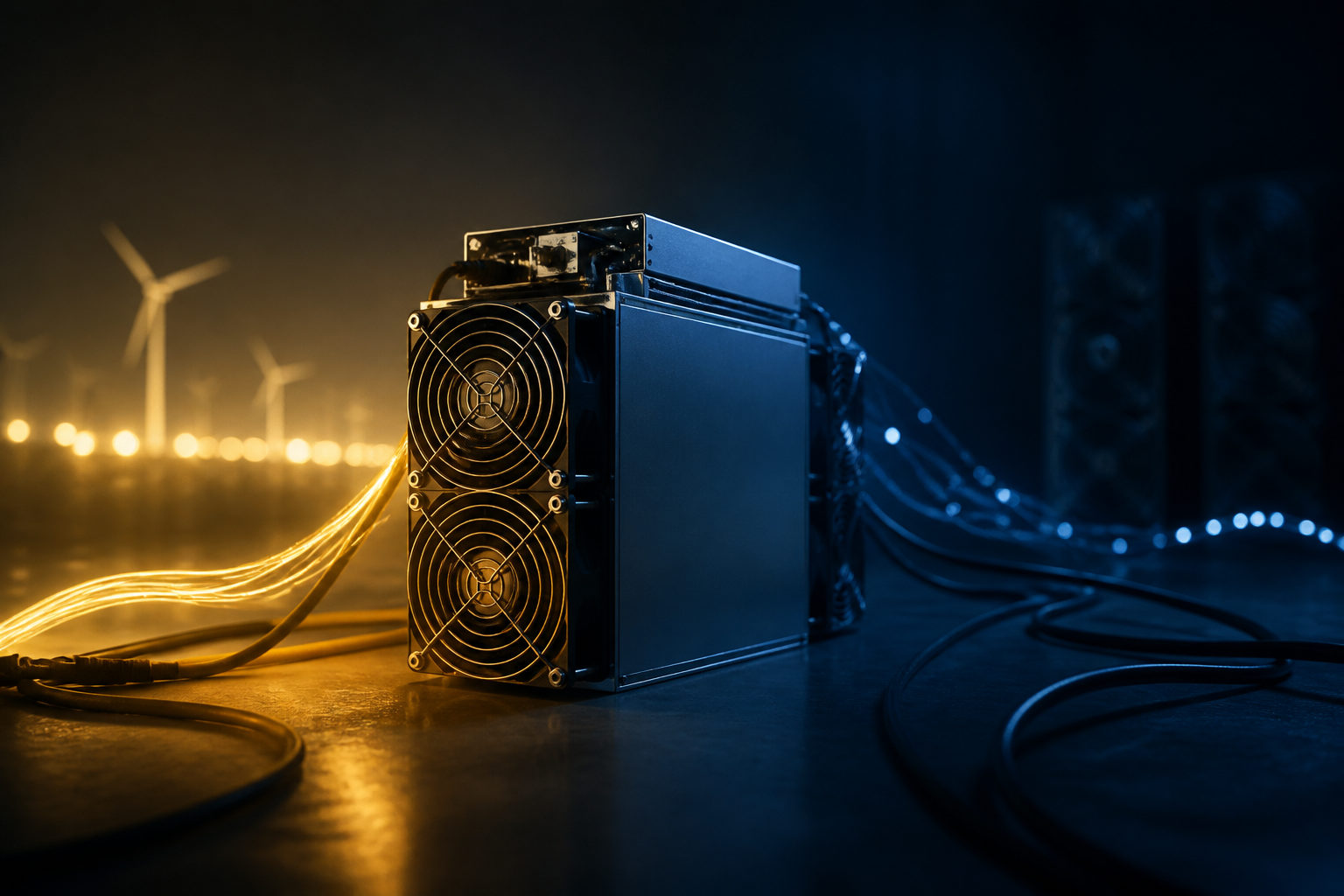
A way to make bitcoin cleaner starts with the energy mix behind mining, the ability to cut power use when grids are stressed, and using the base layer more efficiently. Looking at raw electricity use alone misses the factors that shape environmental impact.
Why cleaner Bitcoin is mainly an energy question
Bitcoin uses proof of work, so energy use is built into the system. The environmental question is not solved by pointing out that mining consumes electricity; the harder question is what kind of electricity is being used, where it is produced, and whether that power had a better use at the same moment.
That distinction matters because one unit of electricity does not carry the same emissions profile in every setting. A mining site tied to lower-emission generation can have a very different footprint from one running on power with a heavier carbon profile. Any serious discussion about making Bitcoin cleaner has to begin there.
Time also matters. Some power systems produce excess electricity at certain hours and struggle to move or store it efficiently. In those cases, mining can act as a buyer that turns otherwise stranded or underused energy into revenue. That does not excuse every mining operation, but it does show why the source and timing of power use are more informative than a single headline about consumption.
Location changes the picture as well. A project that appears efficient on paper may still create pressure if it sits in a market where households or essential industries are competing for supply. Cleaner Bitcoin depends on context, not slogans.
The clearest path: better power sourcing and flexible demand
If the goal is to make Bitcoin cleaner, the most direct lever is the electricity feeding the machines. Mining operations that connect to lower-emission power, or that operate near energy that would otherwise be curtailed, can reduce the carbon intensity attached to their activity. This is usually more meaningful than cosmetic changes around branding or public relations.
Flexible demand is the next major lever. Mining hardware can often be powered down faster than many other industrial loads. That gives operators a chance to step back during grid stress and consume more power when supply is abundant. When that flexibility is real and enforced, mining begins to look less like a constant drain and more like a controllable load.
This point is easy to overstate, so it needs a careful reading. A miner is not automatically helpful just because it can shut down. The benefit appears only when the operation actually responds to grid conditions and does not simply run at full capacity whenever prices allow. The cleaner outcome depends on behavior, not theoretical capability.
There is also a project-finance angle. Some energy sites struggle in early stages because demand is too weak, too distant, or too irregular. Mining can provide an initial customer for electricity that lacks enough local buyers. In some cases, that can support the economics of low-emission generation. In others, it can become little more than a sales pitch. The difference lies in whether the mining load fits the local system without crowding out higher-priority use.
Hardware efficiency and cooling design are part of the answer
Energy source is only one side of the cleaner-Bitcoin discussion. Hardware efficiency matters because better-performing machines can deliver the same amount of computational work with less electricity. Old equipment left online for too long raises energy intensity and weakens the environmental case for the operation using it.
Cooling deserves more attention than it usually gets. Mining does not only consume power through the chips doing the calculations; it also uses electricity to remove heat and keep equipment stable. Poor airflow, weak site design, and unsuitable climates can push a large share of extra power into non-computing overhead. Better thermal planning can improve the total energy profile without changing the core protocol at all.
Maintenance practices shape outcomes too. Machines that are repaired, refurbished, or redeployed sensibly can reduce waste compared with a model built around fast turnover and unclear disposal. A cleaner approach to Bitcoin mining should include a plan for equipment life cycle, not just a claim about electricity procurement.
Transparency helps readers judge whether a project is serious. If an operator explains where power comes from, how curtailment works, how hardware is refreshed, and how retired units are handled, outsiders can make a more grounded assessment. Green claims without operational detail are hard to trust.
Bitcoin can also become cleaner through better use of the chain
Environmental debates often stay focused on miners, yet transaction design matters too. The Bitcoin base chain has limited block space, and that space is valuable because it carries the strongest settlement assurances. If every small, frequent, low-importance transfer is pushed directly onto the base layer, the network is being used in a blunt way.
Layered usage can improve efficiency. High-value or final settlement activity can stay on the base chain, while repeated small transfers can be handled through other arrangements and settled back later. That does not change the fact that Bitcoin mining uses energy, but it can increase how much economic activity is supported by the same security budget.
Service providers play a large role here. Exchanges, custodians, payment companies, and wallet services can reduce unnecessary on-chain congestion by batching transactions, improving settlement design, and avoiding wasteful patterns. Individual users matter as well. Sending many tiny transfers back and forth without a real need consumes scarce block space less efficiently than planned settlement behavior.
For that reason, a way to make bitcoin cleaner is partly a user-side issue. Better energy sourcing helps, better machines help, and smarter transaction structure helps. Treating only one of those layers as relevant leads to shallow analysis.
Common claims that deserve closer inspection
One weak claim is that any mining operation using renewable power is automatically clean. That skips the key question of substitution. If that electricity would have been used elsewhere, or if the project changes local grid conditions in a harmful way, the environmental story is more complicated.
Another weak claim is that the entire debate can be settled by saying Bitcoin uses a lot of energy. That statement says little about emissions, grid effects, hardware turnover, or transaction efficiency. It is a starting point for analysis, not the end of it.
A third weak claim is that better machines alone solve the issue. Hardware upgrades can improve the margin, but they do not fix a poor power mix or wasteful transaction habits. Cleaner Bitcoin usually comes from several improvements working together over time.
Readers can evaluate almost any proposal by asking four practical questions: What is the power source? Can the mining load be interrupted when needed? Is the hardware reasonably efficient and managed well? Is the chain being used in a way that respects the scarcity of block space? If those questions are unanswered, the proposal is incomplete.
FAQ
Can Bitcoin ever be completely clean?
Any system that depends on real-world energy and hardware has some environmental cost. A more realistic target is to lower the share of high-emission electricity, improve operating efficiency, and reduce wasteful use of block space.
Does renewable-powered mining always make Bitcoin cleaner?
No. The answer depends on local grid conditions, timing, and whether that electricity displaces more important demand. A renewable label on its own does not settle the question.
Would moving more activity off the base chain weaken Bitcoin?
Not necessarily. The base chain is well suited for final settlement, while other layers can handle more frequent activity. That is closer to division of labor than a loss of function.
What can regular users do to support a cleaner form of Bitcoin use?
They can choose services that batch transactions and use settlement efficiently, and they can avoid unnecessary small transfers. Paying attention to network congestion before sending also helps reduce wasteful on-chain activity.
How can I tell whether a “green mining” claim is credible?
Look for clear disclosure on power sourcing, curtailment behavior, hardware refresh policies, and equipment disposal. If the claim stays broad and avoids operating detail, it deserves extra skepticism.
If you want to judge whether any proposal is truly a way to make bitcoin cleaner, check the power source, curtailment behavior, hardware efficiency, and transaction design before anything else. Those four areas reveal much more than a polished label ever will.