
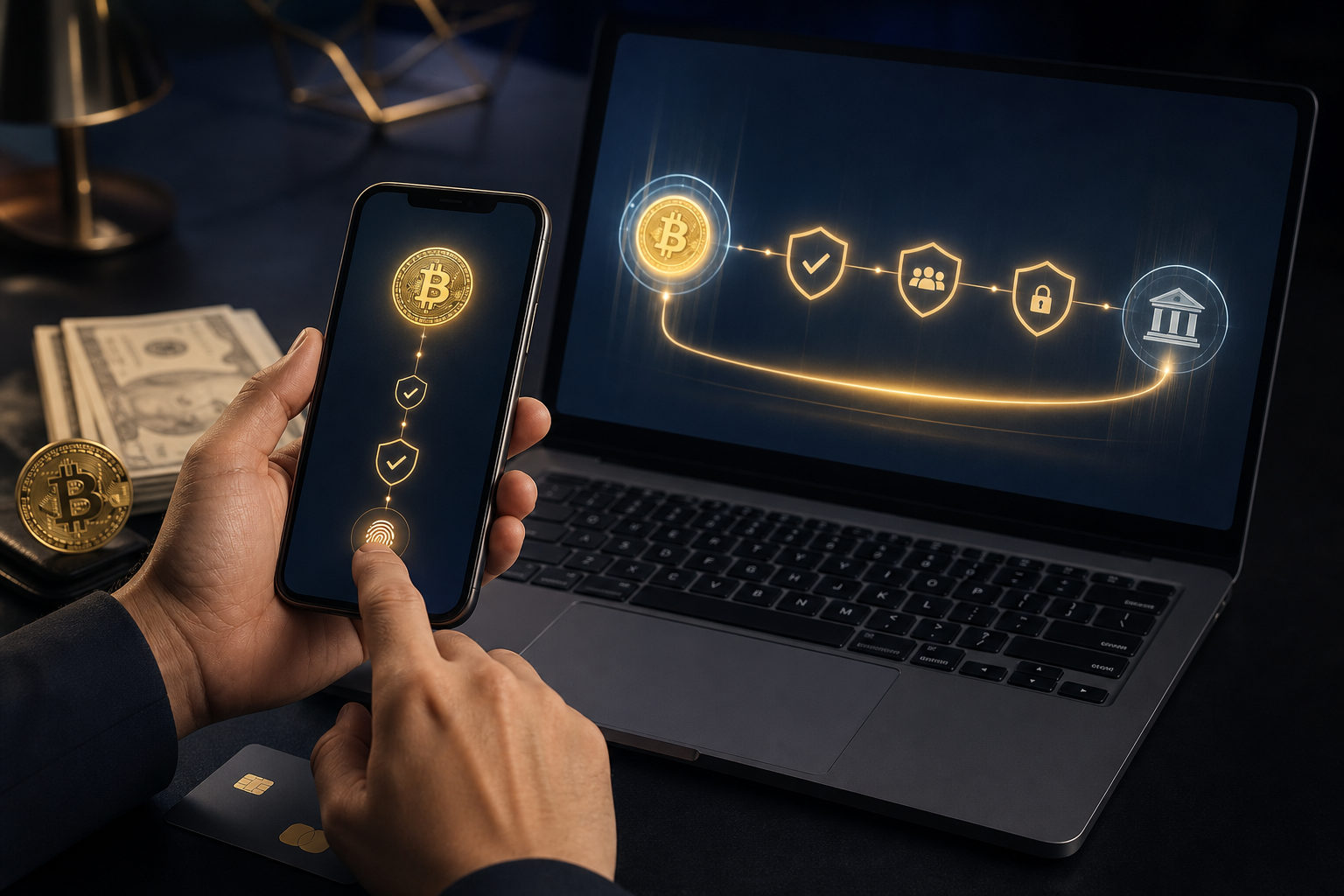
To liquidate bitcoin, you need to do more than press a sell button. The safe process is to confirm where your BTC is held, choose a selling route you can verify, complete the sale, and make sure the proceeds reach an account you control.
What “liquidating bitcoin” really means
Many people use the phrase as if it only means selling BTC on a trading screen. In practice, liquidating bitcoin usually includes several separate actions: checking where the coins are stored, moving them if needed, selling them through a channel you understand, and withdrawing the proceeds to an account you personally control.
That distinction matters. Problems often appear outside the sale itself. A user may discover that an old account can no longer be accessed, a withdrawal method is not ready, a wallet transfer was sent incorrectly, or a buyer claims to have paid when the funds are not actually there. A good liquidation plan treats each stage as a checkpoint, not as one rushed click.
There are a few common paths. One is selling directly from an account that already supports BTC trading. Another is transferring bitcoin from a self-custody wallet into a selling venue and then placing the order. A third is arranging a peer-to-peer sale with another person. The last route can be flexible, but it also puts more pressure on you to verify who you are dealing with and whether the payment is real.
If your real question is how to turn bitcoin into spendable funds, start with the route, not with the promise of speed. “Fast payout” and “premium rate” are exactly the phrases that can push people into weak decisions.
Step 1: Confirm where your bitcoin is and whether you truly control it
The first step is inventory, not selling. Your BTC may be in a trading account, a hardware wallet, a software wallet, or an older account you have not used in a long time. The liquidation process changes depending on where the coins are and whether you still have full access.
In practical terms, log in to the wallet or account you control and check the available balance, the security settings, and whether trading or withdrawals are restricted. If the bitcoin is in self-custody, make sure your recovery phrase remains private and that your device is functioning as expected. If the bitcoin sits in a custodial account, make sure you can still log in, receive security codes, and complete identity or security checks if the service requires them.
This step has a clear purpose. A sale cannot finish smoothly if access fails midway. People often think the hard part is the market side, when the real obstacle is account recovery, expired authentication methods, or confusion about what asset they actually hold.
There are a few points to watch. First, do not rely on the asset name alone. Confirm that it is actually BTC, not another token with a similar label or wrapped format that follows different rules. Second, never share your recovery phrase, private keys, or one-time security codes with anyone who claims to be helping you liquidate bitcoin. No legitimate sale requires that. Third, if the account has been inactive for a long time, complete your security checks before moving funds. Trying to fix access issues while sending coins at the same time is how avoidable mistakes happen.
Step 2: Choose a selling method based on verifiability, not marketing claims
If you want to know how to liquidate bitcoin safely, ask a simple question: can you verify every step on your own? If the process depends on a stranger guiding you in real time, asking you to install software, or directing you to an unfamiliar page, the risk is already high.
Selling directly from an account that already supports BTC trading is often easier to follow because the order, trade history, and withdrawal records tend to sit in one place. That does not remove risk, but it gives you a clearer audit trail. You can review what happened without relying on someone else’s explanation.
If your bitcoin is in a self-custody wallet, you may need to transfer it to a place where you can sell it. In that case, the key issue is accuracy. Bitcoin transfers are generally irreversible once sent, so this stage is about careful verification rather than speed. Confirm that the destination supports BTC deposits, check the address closely, and make sure you understand what account will receive the funds after the sale.
Peer-to-peer selling deserves extra caution. You are not only selling bitcoin; you are taking on counterparty risk. The other side may delay payment, send a fake proof of payment, try to move the conversation to a private channel, or pressure you into releasing BTC before the funds are actually received.
Questions to ask before you choose a route
- Can I verify every stage by myself? If not, the process may be too dependent on another person.
- Will I have a clear record of the transaction? Order history, transfer history, and payout records matter if something goes wrong.
- Does the payout go to an account I control? Avoid sending proceeds to someone else’s account or to a method arranged by a third party.
- Can I pause after each step and review the result? A safe process lets you stop and confirm before moving on.
A common mistake is using speed as the only filter. Scammers know that urgency lowers standards. If someone pushes “instant” above all else, treat that as a warning sign rather than a benefit.
Step 3: Execute in stages — test, confirm, then scale up
Once you are ready to act, break the process into small pieces. Do not transfer all your BTC at once the first time you use a route, and do not rush through an order format you do not fully understand. A staged approach reduces the cost of mistakes.
If your bitcoin is in self-custody, a small test transfer can make sense before moving a larger amount. The reason is simple: blockchain transfers cannot usually be reversed by support staff after the fact. Address errors, copy-and-paste problems, device switching mistakes, and clipboard tampering are all real risks. A test helps confirm that the destination is correct and that you are following the process you intended.
If your BTC is already in an account where selling is possible, take a moment to understand how the sale will be executed. Are you selling at the prevailing market level for immediate execution, or setting a condition and waiting for a match? Those choices affect speed and control in different ways, even without discussing any specific price.
During this stage, avoid combining sensitive actions with distractions. Do not manage a wallet while screen-sharing with a stranger. Do not enter login details on a page sent through an unsolicited message. Do not let a countdown or threat of cancellation push you into skipping basic checks. Pressure is often part of the trap.
Checklist for the execution stage
- Login environment: Use a device and network you trust. Avoid random downloads and unknown browser prompts.
- Two-factor protection: Enable extra protection for login, withdrawals, and transfers whenever possible.
- Address review: Check the full destination carefully. Do not glance at only the first and last characters.
- Order details: Review the amount, payout method, and receiving account information before confirming.
- Pacing: Complete one step, verify the record, then move to the next.
Liquidating bitcoin is not a speed test. It is a process where one irreversible error can matter more than ten careful checks.
Step 4: At payout time, trust actual account records, not screenshots
Many losses happen near the end because people relax once they think the sale is basically done. This is especially common in peer-to-peer situations, where fake payment screenshots, forged notifications, and made-up support messages can create the illusion that the funds have arrived.
The safer standard is straightforward: rely on the actual incoming record inside the account you control. Do not rely on chat messages, screenshots, verbal promises, or a page controlled by the other party. Log in to your own payout account and verify that the funds have truly arrived and are in the state you expect.
This matters because images can be edited, notifications can be delayed, and interfaces can be imitated. Your own account record is the stronger source of truth. If the buyer says, “Release the bitcoin now and the payment will show up shortly,” stop there and verify before doing anything else.
It also helps to keep the payout destination simple. Use an account that belongs to you and that you control directly. Avoid having a friend receive the proceeds on your behalf. Avoid mysterious payout channels suggested by a stranger. The more layers you add, the harder it becomes to verify what happened if something goes wrong.
What to watch at the payout stage
- Status wording: “Processing” is not the same as completed receipt.
- Account ownership: The proceeds should go to your own account, not to an intermediary.
- Record keeping: Save order identifiers, chat logs, transfer records, and a clean timeline of events.
- Unexpected demands: Stop immediately if anyone asks for an extra transfer, a release fee, a verification deposit, or a private workaround.
A useful rule is this: if the process starts asking you to send more money or more crypto to “unlock” your own proceeds, something is wrong. A normal liquidation flow should not depend on that.
Step 5: After the sale, review the result and close any security gaps
The job is not finished when the sale completes. You should still verify that the amount of BTC reduced as expected, that the payout reached the correct account, and that no temporary shortcut created a new security problem.
In practice, review the transaction record, payout record, and remaining account state. Save the relevant documentation in a place you control. If you changed any security settings for convenience, switch them back. If you logged in from a public or unfamiliar environment, update your password and review recent account access activity.
This is not just extra caution for its own sake. Some issues show up later, not during the transaction itself. You may notice repeated login attempts, missing records, or a detail that does not line up with your notes. Good records make later checks much easier.
If you expect to liquidate bitcoin in stages over time, write down what worked and where friction appeared. A personal checklist is more useful than any “secret trick” video or message thread.
Common scams and avoidable mistakes
Knowing the steps is only part of the job. You also need to recognize the patterns used to make people fail those steps. The methods change, but the logic is consistent: create urgency, reduce independent verification, and push the user to hand over control.
- Fake support agents: Someone contacts you first, claims there is a withdrawal issue, and asks for codes, wallet access, or an extra transfer.
- Fake login or trading pages: The page looks familiar but exists to capture your credentials or replace an address.
- Fake proof of payment: The buyer sends a screenshot or forged notification and asks you to release BTC before the funds are truly in your account.
- Premium-buyout bait: A very attractive offer is used to move you into a private process with fewer protections.
- Remote access “help”: Someone asks you to install screen-sharing or remote control software and then takes over the session.
A simple boundary helps: if a person asks for your recovery phrase, private key, one-time code, or an extra transfer to finish the sale, do not continue.
FAQ
What counts as fully liquidated bitcoin?
It is not just the moment you click sell. A practical standard is that the order is completed, your BTC balance reflects the sale, and the proceeds are actually received in an account you control.
Do I need to move bitcoin to another wallet before selling?
Not always. If your BTC is already in an account that supports selling, you may not need another transfer. If it is in self-custody, you may need to move it first, and a small test transfer can help reduce address risk.
What is the most common mistake when selling bitcoin for the first time?
Rushing. New sellers often focus on finishing quickly and pay less attention to address checks, payout verification, and whether the counterparty’s payment is actually real.
Can I trust someone who messages me and says they can help me cash out bitcoin faster?
No private message should be treated as trustworthy by default. If the person wants you to click an unfamiliar page, install software, share your screen, or move the conversation off the main service flow, that is a serious warning sign.
Why should I keep records after I liquidate bitcoin?
Records help with reconciliation, later review, and any dispute about what happened. A saved timeline with order details, transfer history, and payout confirmation is much better than trying to reconstruct events from memory.
If you are planning to liquidate bitcoin soon, the most useful move is to prepare your own checklist before touching the coins: where the BTC is stored, which selling path you will use, whether the payout account is fully under your control, whether security protection is enabled, and whether you will test first. That routine is safer than any promise of a shortcut.