
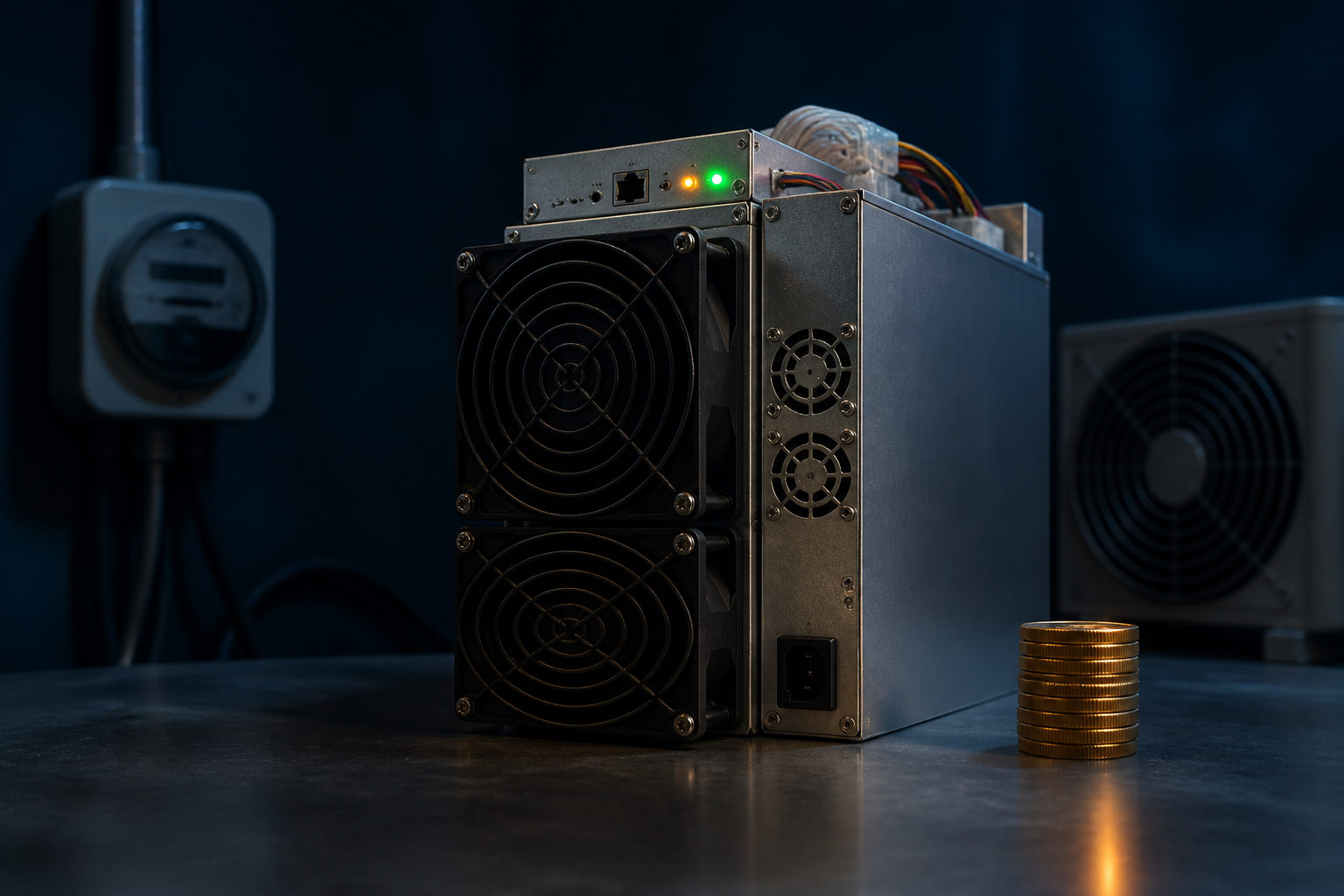
Bitcoin mining can be a good investment only for people with clear advantages in power, hardware, operations, or hosting; for most individuals, it is closer to running a capital-heavy business than earning easy passive income.
Start with the right comparison
People often compare bitcoin mining with simply buying bitcoin and stop there. That misses the main point. Buying bitcoin gives you price exposure. Mining gives you price exposure plus operating risk, equipment risk, uptime risk, and a long list of execution issues that can change the outcome even if your market view is correct.
If your goal is just to accumulate bitcoin, direct purchase is usually the simpler path. Mining makes more sense when you want to evaluate it as an operating model with recurring inputs and moving parts, not as a shortcut to getting coins.
| Area | Buying bitcoin directly | Bitcoin mining |
|---|---|---|
| Main exposure | Price movement | Price, mining difficulty, hardware efficiency, uptime, and operating quality |
| Upfront needs | Capital and custody plan | Capital, machines, power, space, setup, and maintenance process |
| Ongoing work | Usually limited | Continuous monitoring and problem solving |
| Liquidity | Often more direct | Equipment resale and site exit can be slow |
| What drives results | Entry, exit, and holding discipline | Execution quality as much as market direction |
The four variables that decide whether mining works
Power cost and power stability
Mining turns electricity into hashpower, then uses that hashpower to compete for block rewards. Cheap power matters, but stable power matters almost as much. A setup that looks profitable on paper can fail in practice if outages, curtailment, poor wiring, or unstable hosting conditions keep machines offline.
This is why the first serious question is not how much bitcoin a machine may produce. The better question is whether your power source is reliable, contract terms are clear, and the pricing structure can hold over time. If those points are weak, the rest of the model rests on shaky ground.
Hardware efficiency, depreciation, and resale
Mining hardware is not a static asset. Machine efficiency shapes your margin for error, especially when network competition rises. Older units can still run in some cases, but weaker efficiency leaves less room for mistakes, and resale value can drop fast when better models become available or market conditions soften.
You also need to look beyond the sticker price. Shipping delays, warranty limits, repair turnaround, spare parts access, and installation quality all affect the real investment case. A machine is only part of the story; keeping it productive is the harder part.
Difficulty changes and reward pressure
The Bitcoin network produces a block roughly every 10 minutes. Miner revenue comes from a share of block rewards, but that share changes with network competition, fee conditions, and your own uptime. A spreadsheet built on today's assumptions should never be treated as a stable long-term result.
Bitcoin has a total supply cap of 21 million coins, and the block subsidy halves every 210,000 blocks, roughly every 4 years. The halving years so far are 2012, 2016, 2020, and 2024. That matters because any long-range mining plan must account for changing issuance rather than assuming current conditions will continue.
Operations and hidden costs
Many poor mining decisions come from focusing on public specs while ignoring daily operations. Cooling, dust control, noise management, networking, machine tuning, and maintenance discipline all affect output. Even a strong setup can disappoint if these basics are weak.
Hidden costs deserve their own line of thinking. Your time, troubleshooting ability, relationship with the hosting provider, access to replacement units, and the ability to verify machine status all carry weight. If you outsource most of that work, the apparent convenience may come with lower control and thinner margins.
| Variable | What people often look at | What actually needs review |
|---|---|---|
| Power | Headline electricity rate | Reliability, contract terms, extra charges, and long-term clarity |
| Hardware | Published performance | Efficiency, warranty, failure handling, spare parts, and resale path |
| Revenue | Static calculator output | Difficulty shifts, uptime, pool rules, and fee environment |
| Hosting | Convenient outsourcing | Service quality, reporting, withdrawal process, and exit terms |
Key risks that people often underprice
Price risk gets most of the attention, but bitcoin mining carries a wider set of risks. You can be right about bitcoin over the long term and still get a poor result if your machines arrive late, your site runs hot, your hosting partner is sloppy, or repairs take too long. The business has many ways to go wrong before price ever enters the picture.
There is also rule and location risk. Requirements around industrial power use, noise, fire safety, site use, and local compliance can change the economics of a setup. Anyone using third-party hosting must add counterparty risk as well, because convenience does not remove the need for verification.
| Risk type | How it shows up | Why it matters |
|---|---|---|
| Operating risk | Downtime, overheating, unstable networking, repair delays | Reduces actual output over time |
| Asset risk | Fast depreciation or weak resale demand | Losses may become visible when you try to exit |
| Counterparty risk | Poor hosting practices or weak transparency | You may not have full real-time control |
| Rule risk | Changes in site, power, or compliance conditions | Can rewrite the cost structure quickly |
A practical decision framework
If you want to judge whether bitcoin mining is a good investment, start by asking what real edge you have. Do you have access to stable low-cost power, skilled operators, trusted repair channels, or a reliable hosting relationship? If the answer is no across the board, then mining is likely to be a harder path than it first appears.
Next, test the idea under different operating conditions rather than one clean forecast. Build a case for smooth deployment, a normal case with friction, and a weak case with delays or lower efficiency. The purpose is not to produce a perfect return number. The purpose is to learn whether the setup still makes sense when things do not go according to plan.
Then review your exit path before you commit. Can the machines be resold? Is the hosting contract easy to leave? Who controls access to the equipment and payout process? A mining plan without an exit plan is incomplete because hardware is not as liquid as bitcoin itself.
| Step | Question to ask | Warning sign |
|---|---|---|
| Check your edge | What advantage do I have that others cannot easily copy? | You are paying retail for everything with no operational edge |
| Map all costs | What fixed and variable costs exist beyond electricity? | You only model power cost and ignore maintenance or downtime |
| Stress test | What happens if setup is delayed or output is weaker? | One problem would disrupt your broader finances |
| Plan the exit | How do I unwind the position if needed? | No clear buyer, no contract clarity, no resale plan |
FAQ
Is bitcoin mining better than just buying bitcoin?
That depends on your goal and your edge. If you only want bitcoin exposure, buying directly is usually simpler because it avoids machine management, site issues, and resale problems.
Mining becomes more relevant when you can operate efficiently enough to justify the added complexity.
Can a beginner make bitcoin mining work at home?
Home setups are often harder than they look because heat, noise, ventilation, wiring, and power limits all matter. A machine that can run is not the same as a setup that makes economic sense.
Once meaningful changes to space or electrical capacity are required, the project starts to resemble a small operating business.
Does joining a mining pool solve the investment problem?
A mining pool can smooth payout variability, but it does not fix weak power economics or poor machine efficiency. It changes how rewards are distributed, not whether your overall setup is competitive.
You still need to understand pool terms, reporting, and how payouts are handled.
Does halving automatically make mining unattractive?
No, but it does make weak setups easier to expose. Since the subsidy changes every 210,000 blocks, any miner with thin margins has less room for error after a halving unless other parts of the setup are strong.
The right takeaway is to re-evaluate assumptions, not to rely on a single rule of thumb.
What is the biggest mistake people make when judging bitcoin mining?
The biggest mistake is trusting a clean spreadsheet without adding messy real-world friction. Delays, downtime, repairs, reporting gaps, and resale pressure can each chip away at returns.
A realistic model is usually less exciting than a marketing pitch, but it is far more useful.
Before spending money, list your power terms, machine support options, hosting obligations, maintenance process, and exit path in one place; if any of those remain vague, bitcoin mining is not ready to be treated as a sound investment case.
Disclaimer: This article is for informational and educational purposes only and is not investment, financial, or legal advice. Crypto assets are highly volatile and you could lose your entire investment. Do your own research and decide carefully.