
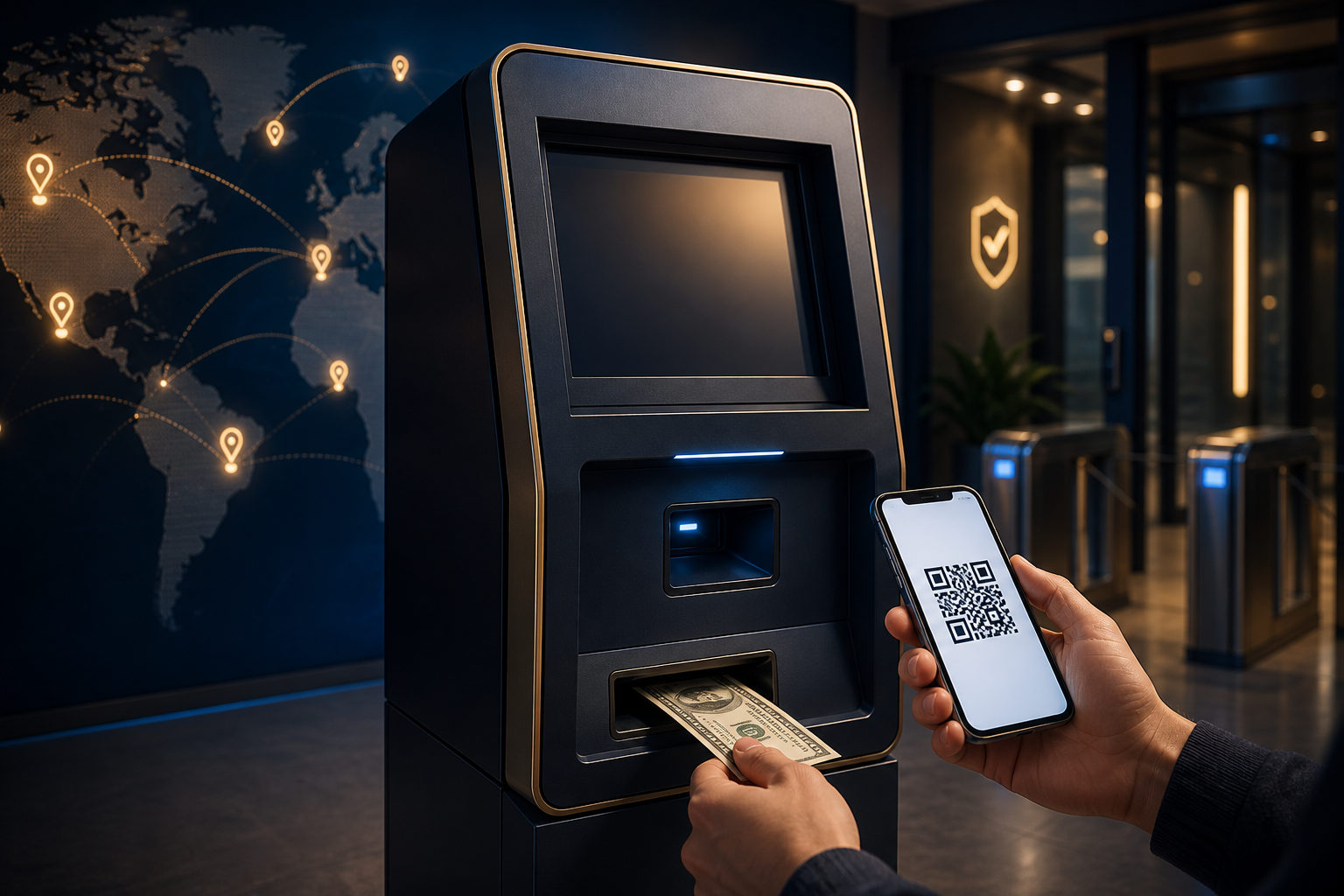
To find a Bitcoin ATM that accepts cash, start by verifying that such machines are actually available in your area, then confirm the machine supports cash purchases of Bitcoin, sends coins to your own wallet, and clearly shows fees and verification rules before you put in any money.
Know what you are actually looking for
Many people search for a Bitcoin ATM as if every crypto kiosk works the same way. That is where trouble starts. The machine you want is one that lets you insert cash, buy Bitcoin, and send the Bitcoin to a wallet address you control. That is different from a bank ATM, a crypto terminal that only handles sales, a card-only kiosk, or a machine tied mainly to an internal account system.
This distinction matters because “accepts cash” can mean different things. Some machines accept cash when a user is selling Bitcoin. Some are branded around crypto but route the user into an account top-up flow. Others may show Bitcoin on the screen without offering a direct cash-to-Bitcoin purchase sent to an external wallet. If you do not define the target first, you can waste time, expose personal data unnecessarily, or push money into a system you do not fully understand.
Before you leave home, look for three signals:
- Clear wording that the machine supports buying Bitcoin with cash
- A stated ability to send the purchased Bitcoin to an external wallet
- Fee, limit, and identity-check information shown before the transaction is finalized
If any of those points remain unclear, treat the listing as unverified.
Step 1: Check whether your area actually has active machines
Your first move should not be driving to the nearest map pin. First confirm that Bitcoin ATMs with cash purchase capability are active where you live. Availability varies a lot by region. In some places, machines are rare. In others, access may depend on store hours, local compliance rules, or the policies of the business hosting the device.
The practical reason is simple: location data goes stale. A listing may point to a real store, but the machine could have been removed, moved, disabled, or switched to another service model. That means a search result is only a lead, not proof.
When checking a location, focus on these questions:
- Is the host business still open and accessible to the public?
- Does the operator still list that machine or service area?
- Does the machine still support cash purchases rather than another transaction type?
- Will you need to complete identity steps before using it?
This approach saves more than time. It also reduces the chance of making rushed decisions in a store aisle, parking lot, or convenience shop where distractions are everywhere.
Step 2: Confirm it accepts cash for buying Bitcoin, not some other flow
Once you find a possible location, verify the transaction type. The key question is not whether a place has a Bitcoin ATM. The real question is whether the machine lets you deposit cash and receive Bitcoin in your own wallet.
That sounds obvious, but many terminals are easy to misread. Some are designed for selling Bitcoin for cash. Some ask you to create or use a hosted account first. Some support several coins with different paths for each. Some allow purchases but only through non-cash payment methods.
Look for details such as:
- Whether the machine is buy-only, sell-only, or two-way
- Whether cash is listed as a supported payment method for buying
- Whether the output goes to your external wallet or stays inside a platform account
- Whether the screen explains the process before you begin
The reason to be strict here is fraud prevention. The less clear the flow, the easier it is to misunderstand what you are paying for, where the Bitcoin is going, or what you must do later to gain access. A simple process is usually safer for a first-time user: scan your wallet, insert cash, review the details, confirm the purchase, and keep your receipt.
Do not assume that “cash deposit” works like putting money into a bank account. In this context, the machine may be converting cash directly into a Bitcoin purchase, or it may be starting a more complicated process. If the screen does not make that plain, stop there.
Step 3: Prepare your own Bitcoin wallet before going out
If the machine sends Bitcoin to a wallet address, then your wallet setup is part of the trip, not a separate issue. Prepare it in advance. Doing this at home is safer than trying to install an app, create backups, and learn the interface while standing beside a machine.
A good pre-trip checklist looks like this:
- Choose a Bitcoin wallet you understand and can operate confidently
- Complete the initial setup in a quiet setting
- Back up the recovery information offline and store it privately
- Open the receive screen and confirm you have a Bitcoin receiving address or QR code ready
- Double-check that you are using a Bitcoin receive option, not another asset or network
Each of these steps lowers the risk of user error. On-site pressure changes how people behave. They hurry. They click through warnings. They let strangers “help.” They forget where they saved recovery details. Preparing your wallet in advance cuts out those weak points.
There is also a hard security rule here: never let anyone create the wallet for you, handle your phone during setup, or view your recovery phrase, private key, one-time code, or exchange login. A legitimate Bitcoin ATM transaction needs your receiving address. It does not need control over your wallet.
Step 4: At the machine, inspect first and transact second
When you finally reach the machine, do not rush to feed in cash. Pause and inspect the environment and the interface. This is one of the most useful habits for avoiding scams and avoidable mistakes.
Start with the setting. Is the host business open and normal? Is the machine fixed in place rather than appearing temporary or improvised? Does the screen clearly identify the service and guide the user through the transaction? Are there visible instructions, customer support details, and fee disclosures?
Then review the on-screen flow before committing:
- Does the machine show fees or the rate logic before money goes in?
- Does it ask you to scan your wallet first?
- Does it clearly show what asset you are buying?
- Does it explain identity checks, transaction limits, or refund restrictions?
- Can you get a receipt or transaction reference?
If the machine urges you to insert cash before telling you where the Bitcoin will go, how fees are applied, or how to track the transaction, that is a warning sign. Even if the machine is real, poor transparency is enough reason to walk away.
Another issue is social pressure. If someone nearby starts offering unsolicited help, be cautious. A scammer does not always need fake software or a fake website. Sometimes all they need is a quick glance at your screen, a chance to replace your QR code, or a moment to talk you into following their instructions.
Step 5: During the transaction, verify every key detail twice
Once you decide to proceed, slow the process down. The safest rhythm is simple: act, verify, then continue. Do not tap through screens in a hurry just because there is a line behind you or a stranger is watching.
A careful purchase flow usually looks like this:
- Select the option to buy Bitcoin
- Read the machine’s identity and fee disclosures
- Scan your own Bitcoin wallet QR code
- Check the address shown on-screen against your wallet address
- Insert cash only after the address is confirmed
- Review the final confirmation screen, including the asset and expected Bitcoin amount
- Save the receipt or transaction reference before leaving
The reason for the double-check is that address mistakes are hard to undo. Looking only once is not enough when there may be glare on the screen, a rushed interface, or someone trying to distract you.
You should also pay attention to how the machine presents the outcome. Some devices show an estimated Bitcoin amount before final confirmation. Others may apply fees through the exchange rate, a stated service charge, or both. You do not need a complex formula. What matters is understanding how much Bitcoin the machine says you will receive before you approve the transaction.
If you cannot tell what the machine is doing, do not continue just because you already started. Stopping before confirmation is far safer than fixing a completed mistake.
Step 6: After the purchase, stay long enough to check three things
The transaction is not really done the second the machine accepts your cash. Before leaving, complete three checks: keep proof, inspect your wallet, and save the official support path.
First, keep the receipt, printed record, or any transaction reference on the screen. If there is a delay, a verification issue, or a dispute about what happened, that information may be the only reliable starting point.
Second, open your wallet and confirm that you used the correct receiving address. If your wallet shows an incoming or pending transaction indicator, that can help confirm you completed the intended purchase path. If it does not show up right away, do not panic. What matters first is matching the address and preserving the transaction details.
Third, note the official customer support contact shown on the machine or receipt. If you later need help, use only that route. Do not trust random phone numbers or social accounts that appear in search results after the fact.
One more caution: if the Bitcoin does not appear immediately, do not buy a second time just because you feel uncertain. Repeating the transaction can turn one manageable issue into a much messier record problem.
Step 7: Know the scam signals that mean you should stop immediately
This topic is not only about finding a machine. It is also about knowing when not to use one. The most dangerous situations usually involve urgency, secrecy, outside instructions, or someone else directing the purchase.
Stop at once if any of these happen:
- Someone on the phone, in a chat app, or on social media tells you to go to a Bitcoin ATM
- You are told to buy Bitcoin and send it to a “support,” “security,” “investment,” or “recovery” address
- A stranger at the location offers to operate the machine for you
- The machine does not clearly display fees, wallet delivery details, or confirmation information
- Anyone asks for your wallet recovery phrase, private key, verification code, or account login
- You are told the payment is needed to unlock funds, release an account, pass a review, or secure a profit
These scams work by shifting your focus. Instead of asking whether you are buying Bitcoin safely, they push you into completing a task for someone else. The moment the purchase is being directed by another person, the risk jumps.
A legitimate cash Bitcoin purchase does not require remote coaching from a stranger. It does not require you to hand over wallet control. It does not require sending the coins onward to fix a problem.
FAQ
How can I tell whether a nearby Bitcoin ATM really takes cash?
Look for clear wording that the machine supports buying Bitcoin with cash, not just general crypto services. You should also confirm that the purchased Bitcoin can be sent to an external wallet you control.
Can I use a Bitcoin ATM without setting up my own wallet first?
It is better to prepare your wallet in advance. That gives you time to secure your recovery details properly and reduces the chance of making address mistakes under pressure.
Is it normal for a Bitcoin ATM to ask for identity verification?
Yes, that can happen depending on the operator and the local rules. The key point is to read the requirements before inserting cash and stop if the machine is vague about what it needs or why.
Why did my wallet not show the Bitcoin right away after I put in cash?
There can be a processing delay or a pending stage in the transaction flow. First compare the receipt and the wallet address you used, then contact official support if the status does not update.
What if someone tells me to buy Bitcoin at an ATM and send it to them?
Treat that as a major warning sign. If another person is directing the purchase and giving you a destination address, especially under pressure, you should stop immediately.
Final on-site checklist
Before leaving home, have your own Bitcoin wallet and receiving QR code ready. At the machine, confirm it supports cash purchases of Bitcoin, review the fees, verify the destination address twice, and keep the receipt. Do not let anyone touch your phone, and never share your recovery phrase, private key, one-time code, or account login with anyone.
Disclaimer: This article is for informational and educational purposes only and is not investment, financial, or legal advice. Crypto assets are highly volatile and you could lose your entire investment. Do your own research and decide carefully.