


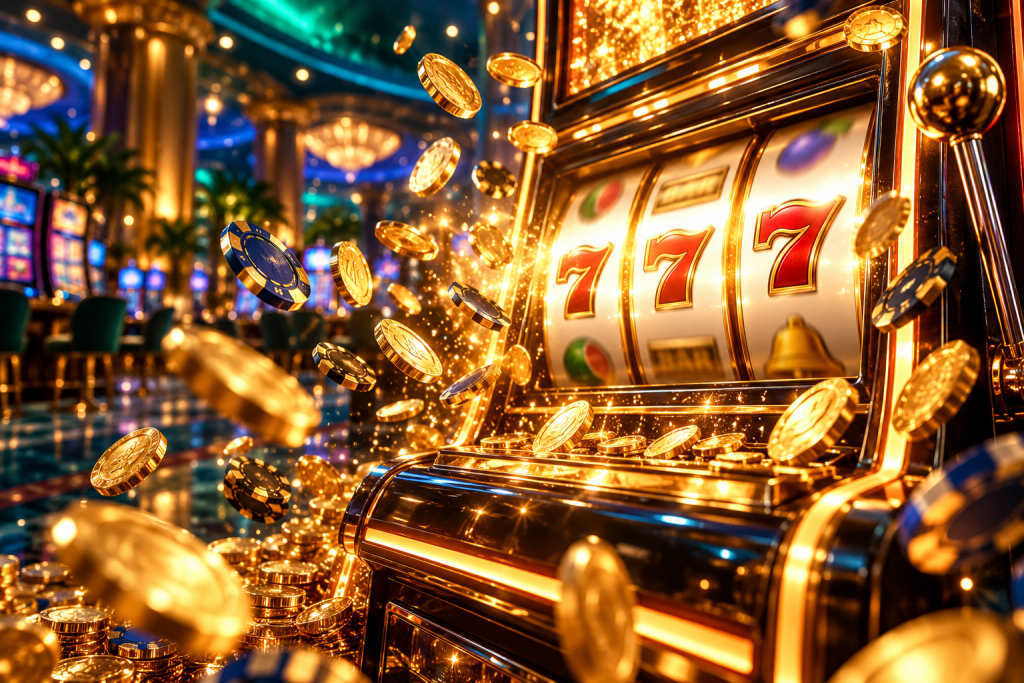
The payout exists, but it is not built for you to hit
A slot machine can display a seven-figure jackpot. The game is not lying about that number. What matters is how that number gets built, and how little it tells you about your own next spin. A machine that advertises a million-dollar top prize is collecting the money for that prize from the losing spins that happen before it, and it is doing so on a schedule that can stretch across years and across thousands of players.
Progressive jackpots grow from a share of qualifying wagers. Every time someone plays, a small portion of the coin-in is diverted into the jackpot pool instead of being returned through the normal paytable. The jackpot resets after a win and starts climbing again. Fixed jackpots work differently: they pay a set amount, and the operator funds that payout from the game's overall return. In both cases, the top prize is a line item inside a larger mathematical structure, not a gift that sits on top of it.
RTP and house edge are two names for the same subtraction
Return to Player is a theoretical percentage of total wagered money a game returns to players over a very large number of spins or hands. It is a long-run statistical average, not a per-session guarantee. House edge is the mathematical advantage the operator holds on a given game, expressed as a percentage of each wager. The two are complements: they sum to 100% for the same game under the same rule set.
This relationship is the entire answer to the money question underneath the query. If a game returns a certain percentage to players over its full statistical life, the operator keeps the remainder on every unit wagered. That remainder is not collected at the end of the month. It is built into the paytable itself, spin by spin, as the gap between what a spin costs and what the paytable is mathematically expected to return for that spin.
The key word is expected. Expected value is the average outcome per unit wagered if the same bet were repeated an enormous number of times. It is not what happens on any one spin. A single spin is dominated by variance: the game pays nothing, or a small amount, or a large amount, or the jackpot. The long-run average is real, but it lives behind a wall of short-term noise.
Where the million comes from
A million-dollar slot payout is almost always a progressive jackpot, and the mechanics of that prize change the game's return profile. The contributions that grow the jackpot are typically taken out of the game's base return. That means the machine is paying less through its ordinary symbol combinations in order to fund the headline number. Some progressives also require a maximum-stake bet to qualify for the top prize. If you are not betting at that level, you may be funding a jackpot you cannot win.
This is a decision point, not a secret. The game information panel states the qualifying conditions. The terms screen for the specific title states whether the progressive is local to one venue or pooled across many, and what the reset value is after a win. Read those screens before you assume the million is in play for your stake.
| Feature | Fixed jackpot | Progressive jackpot |
|---|---|---|
| Prize amount | Set and printed in the paytable | Grows from a share of qualifying wagers |
| Funding source | Built into the game's overall return | Diverted from the base game return |
| After a win | Pays the same set amount again | Resets to a seed value and rebuilds |
| Qualifying conditions | Usually any valid spin | Often requires maximum stake |
| Where the prize pools | Per machine or per venue | Per venue or across many venues |
Short sessions and long-run averages look like different games
Suppose a slot game is designed to return a certain percentage of all wagers over its full statistical life. That percentage is not a promise that a player who wagers a hundred units will leave with that percentage of them. The player might leave with nothing, or with more than they started. Both outcomes are ordinary. The long-run average only emerges after enough spins that the rare large payouts have had time to appear in something close to their expected frequency.
This is why short sessions feel nothing like the published return. A session of a few hundred spins is a tiny sample. The jackpot, which may occur once in millions of spins on average, will almost certainly not appear in that sample. The session's result will be shaped by the small and medium payouts, and by pure chance. The player has not experienced the game's RTP; they have experienced a slice of its variance.
Volatility is how payouts are distributed over time. High volatility means rarer but larger payouts; low volatility means more frequent but smaller ones. Volatility does not change a game's RTP. Two games can have the same long-run return and feel completely different, because one pays small amounts often and the other pays almost nothing for long stretches and then pays big. A million-dollar jackpot slot is, by definition, an extreme high-volatility game.
Decisions per hour multiply your exposure, not your edge
Slots are fast. A player can complete hundreds of spins in an hour, far more hands than at a table game. Each spin carries the same built-in edge. The total expected loss for a session is not the edge on one spin; it is the edge per spin multiplied by the amount wagered per spin multiplied by the number of spins. Speed multiplies exposure.
As an example, suppose a game has a house edge of a few percent, and a player wagers one unit per spin. After one spin, the expected loss is a tiny fraction of a unit. After a thousand spins, the expected loss is that same fraction multiplied by a thousand. The edge did not get worse; the player simply bought more of it. This is the arithmetic that sits behind every session, and it is the reason the size of the jackpot does not improve the player's position. The jackpot is part of the same return structure that produces the edge.
What genuinely varies under the player's control is bet selection and its edge, rule variants where they exist, game speed and decisions per hour, session length, bankroll sizing as a method, and stopping rules. None of these change the built-in edge of a negative-expectation game, but they change how much total wager passes through the machine, and therefore how much expected loss accumulates.
Why doubling systems cannot reach the million
Progression systems are betting patterns that change the stake after wins or losses. The most famous is doubling after a loss, on the theory that a win will eventually recover all previous losses plus a small profit. The theory is arithmetically true in a vacuum: if you have unlimited funds, no table limit, and infinite time, a doubling sequence will eventually produce a winning spin that covers the losing streak.
None of those conditions holds on a real slot machine. The player has a finite bankroll, the machine has a maximum stake, and the sequence can end before the recovery spin arrives. More fundamentally, the pattern does not change the edge on any individual spin. Each spin still carries the same expected loss. What a progression system does is redistribute outcomes: it turns many small losses into a high probability of a small win and a low probability of a catastrophic loss. The expected value is unchanged, or slightly worse because the player is wagering more total money while the losing streak lasts.
No betting pattern changes the built-in edge of a negative-expectation game. The million-dollar jackpot is not a target that a system can reach; it is a rare event that happens to someone, on a schedule the game's mathematics determines, funded by everyone who played and did not hit it.
What the machine's own screens tell you
The information panel on the game states the paytable, the qualifying conditions for any progressive, and the stake levels. The operator's terms page states the game's published return where the jurisdiction requires disclosure, and the rules for any promotional play. None of these documents will tell you when the jackpot will hit, because the game does not know. A random number generator determines game outcomes, and independent testing laboratories are commonly used to certify RNG behaviour. That certification covers game mechanics, not a prediction of your session.
The honest answer to the query is therefore yes in the narrowest sense: a slot machine can pay a million dollars, and people do win such prizes. But the question underneath the query is whether the player has a realistic route to that outcome, and the answer is that the route runs through a negative-expectation game whose top prize is funded by the edge itself. The jackpot is real. The edge is also real. They are the same machine.
FAQ
Does a bigger jackpot mean better odds of winning?
No. A larger progressive jackpot means more money has been diverted into the prize pool from qualifying wagers. The odds of hitting the jackpot are set by the game's mathematics, not by the size of the pool. A jackpot that has grown large is not closer to paying out; the game has no memory of past spins.
Can you win a million on a penny slot?
Only if the game's top prize is a million and you meet the qualifying conditions. Many large progressives require a maximum-stake bet, so a minimum wager may not qualify for the headline prize. The paytable and the game information panel state which stake levels are eligible for which prizes.
What happens to the jackpot money if you win?
The operator pays the prize according to the game's terms, which typically offer a lump sum or a structured payout. The payment process is separate from the game mechanics: the win is recorded, the player's identity is verified, and the operator releases the funds through its standard withdrawal channels. The terms page for the specific game and operator states the payout options and any conditions that apply.
If you or someone you know is struggling with gambling, help is available. Contact the National Problem Gambling Helpline at the helpline printed in the footer below for confidential support, or visit the National Council on Problem Gambling website for resources and treatment options.
Play responsibly
Gambling should be treated as paid entertainment, never as a way to earn income or recover losses. 1-800-MY-RESET (1-800-697-3738)
18+ or 21+ depending on where you are; follow the minimum age that applies to you.
This article is general information about how these mechanics work. It is not legal advice and not a recommendation to gamble or to use any particular operator. Availability and legality differ by jurisdiction — check the rules that apply where you are.