


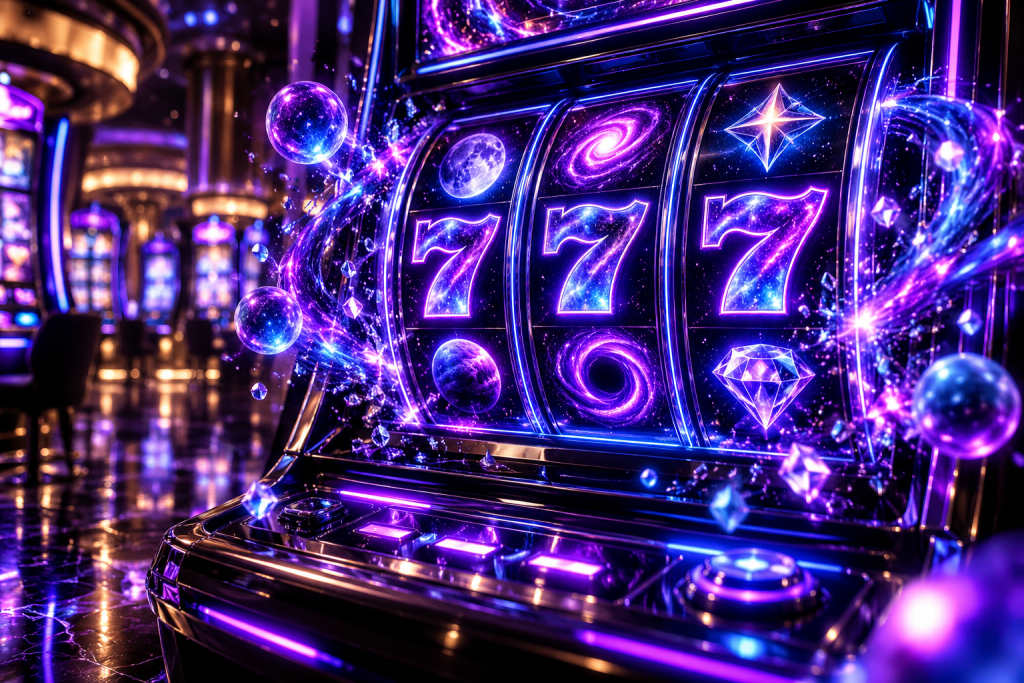
The spin you see is a replay of a decision already made
When you press the spin button on a dark matter slot, the reels you watch are not deciding anything. The outcome was fixed the instant the button registered. The animation that follows is a presentation layer. Understanding this one point changes how you read any slot review, because it means the symbols, the near-misses, and the speed of the spin are cosmetic. What happened is that the game's random number generator produced a number, and that number was mapped to a reel position.
An RNG does not know what you bet, what you won last spin, or how long you have been playing. It is an algorithm producing values at a rate far faster than any human can press a button. When you press spin, the game takes the next available value and converts it into a stopping position for each reel. The mapping from number to symbol is fixed in the game's configuration. A review that describes a slot as "tight" or "loose" based on a short session is describing variance, not the machine's programming.
What the game information panel tells you
Every real-money slot carries an information panel, usually behind a small "i" or question-mark icon. This panel is the most useful part of any slot review you will ever read, because it contains the figures that govern the game. The paytable shows every symbol, every combination, and what each pays as a multiple of your stake. The rules page shows how the bonus triggers, what the wild does, and whether the game uses fixed paylines or a ways-to-win format.
The panel also states the game's theoretical return to player. RTP is a long-run statistical average over a very large number of spins, not a per-session guarantee. A game with a high RTP does not return most of every 100 wagered in an evening. It means that across millions of spins, the game is configured to return that share of all wagers to players collectively. House edge and RTP are complements: they sum to 100% for the same game.
Paylines versus ways-to-win
Two slots can look almost identical on screen and resolve wins completely differently. A fixed-payline game requires you to bet on all lines, and a win only counts when matching symbols land on one of those specific patterns. A ways-to-win game pays on adjacent-symbol combinations instead of fixed lines, which means the number of possible winning paths is calculated from the reel heights rather than drawn on the glass.
| Feature | Fixed paylines | Ways-to-win |
|---|---|---|
| Winning condition | Symbols on a specific printed line | Adjacent symbols, typically left to right |
| Bet structure | Bet covers all lines | Single stake covers all ways |
| Number of paths | Printed on the panel, e.g. 20 or 25 | Calculated from reel height |
| Win display | Line highlights on screen | Often a total win without line tracing |
Neither format is inherently better. The difference matters because it changes how you read the paytable. On a ways-to-win game, a symbol combination that looks like it should pay may not if the symbols are not adjacent. On a fixed-line game, a win on line seven may be invisible to you if you are only watching the centre row.
Volatility changes the shape of a session, not its return
Volatility describes how payouts are distributed over time. High volatility means rarer but larger payouts; low volatility means more frequent but smaller ones. A dark matter slot with a space-horror theme is often built as a high-volatility game, because the theme invites long build-ups toward a bonus round. But volatility does not change a game's RTP. Two games can share the same theoretical return and play completely differently: one will drip small wins for an hour, the other will go silent for fifty spins and then pay a multiple of your stake.
Stake size interacts with volatility in one practical way: it changes the cash value of the swings, not their frequency. If a game pays a 100x win rarely, a higher stake turns that rare win into a larger cash amount, and it also turns the losing stretches into larger cash losses. The programmed return stays the same. No play pattern alters it.
Fixed and progressive jackpots
Some dark matter slots carry a fixed jackpot: a set amount printed in the paytable that does not change. Others link to a progressive jackpot that grows from a share of qualifying wagers and resets after a win. Progressive contributions are typically taken out of the game's return, which means the base game on a progressive slot often pays slightly less than an equivalent non-progressive game. Some progressives require a maximum-stake bet to qualify for the top prize; the rules page states this plainly, and a review should too.
| Feature | Fixed jackpot | Progressive jackpot |
|---|---|---|
| Prize amount | Set, printed in paytable | Grows until won, then resets |
| Funding | Part of the game's return | Share of qualifying wagers |
| Qualification | Any spin | Sometimes maximum stake only |
| Base game return | Unchanged | Often slightly reduced |
When you read a review that mentions a jackpot, check whether the reviewer states the qualification rule. A progressive jackpot you cannot win without a maximum bet is a different game from one where every spin qualifies.
What a review cannot tell you
A slot review describes one person's session, the game's theme, and the figures published in the information panel. It cannot tell you whether you will win, because no one can. It cannot tell you the game is "due" for a bonus, because the RNG has no memory. It cannot tell you the game is fair in a financial sense; RNG certification covers game mechanics, not an operator's financial conduct.
What a review can do is point you to the right screens. The paytable shows the symbol values. The rules page shows the bonus trigger conditions. The information panel shows the RTP and the volatility setting if the studio published one. Read those before you stake, and treat the reviewer's session as one data point from a very large distribution.
FAQ
Does a dark matter slot pay out more after a long losing streak?
No. Each spin is an independent event generated by the RNG. The game has no memory of previous spins, and a long losing streak does not make a win more likely on the next spin. A machine being "due" is a misreading of how independent random events work.
What is the difference between RTP and volatility in a slot review?
RTP is the theoretical share of all wagers the game returns over a very large number of spins. Volatility describes how those returns are distributed: frequent small wins or rare large ones. Two games can have the same RTP and very different volatility, so a review that only quotes RTP is telling you half the story.
Can I tell from the paytable whether a dark matter slot is worth playing?
The paytable tells you the symbol values, the bonus trigger conditions, and the jackpot qualification rules. It does not tell you whether you will win. What you can read from it is how the game is structured: whether the top prize requires a maximum stake, whether the bonus is frequent or rare, and how the base game pays relative to the bonus round.
Gambling involves risk. Please only gamble with funds you can comfortably afford to lose. While we do our best to provide accurate information, we cannot guarantee the accuracy of all content. If you or someone you know has a gambling problem, call the National Gambling Helpline at the helpline printed in the footer below.
Play responsibly
Gambling should be treated as paid entertainment, never as a way to earn income or recover losses. 1-800-MY-RESET (1-800-697-3738)
18+ or 21+ depending on where you are; follow the minimum age that applies to you.
This article is general information about how these mechanics work. It is not legal advice and not a recommendation to gamble or to use any particular operator. Availability and legality differ by jurisdiction — check the rules that apply where you are.