


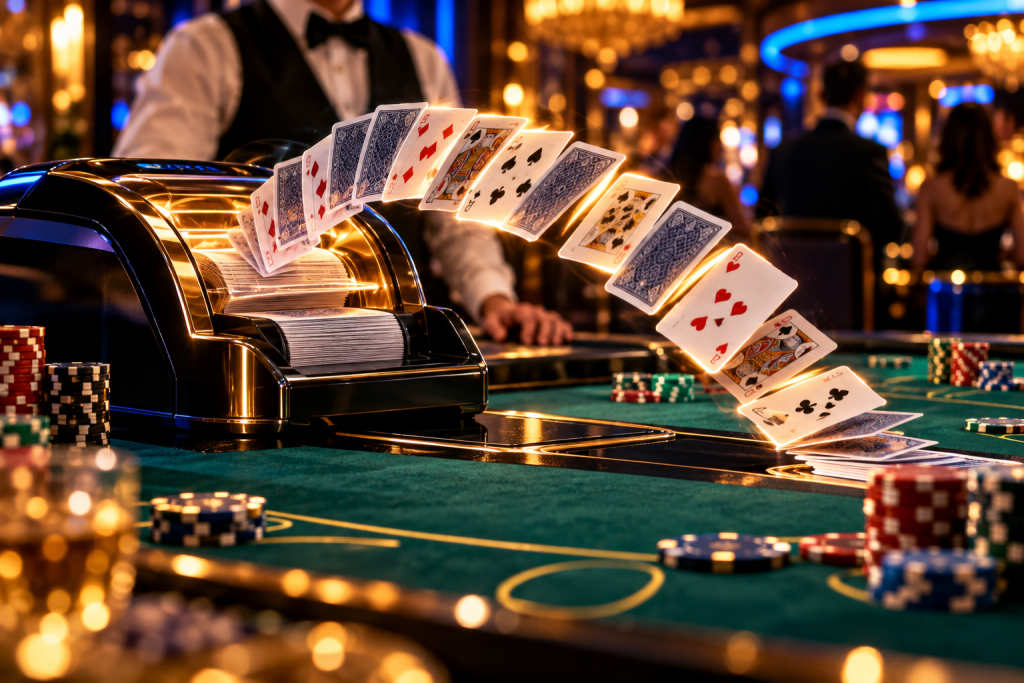
The machine is not sorting anything
When a reader asks whether blackjack shufflers organize cards, the image behind the question is usually a machine quietly building a favourable order for the house, or perhaps for a player who knows how to read it. Neither is what the device does. A shuffler takes one or more decks and randomizes them, and the difference between the two main types matters more to your play than any imagined sorting.
A batch shuffler, sometimes called an automatic shuffler, works on a fixed set of cards. A dealer feeds in the discards from the previous shoe, the machine mixes them, and the dealer then loads the shuffled stack into a dealing shoe. The order that comes out is the order the machine produced, and play proceeds through that order until the cut card appears. A continuous shuffling machine, or CSM, is different in a way that changes the rhythm of the game. The dealer places used cards back into the machine after every round, and the machine continuously mixes them into the cards still waiting to be dealt. There is no finished shoe to run through, because the supply is being replenished and remixed constantly.
In both cases the machine's job is randomization, not organization. The word organize implies a structure with a purpose: high cards grouped together, aces spaced at intervals, a known sequence. A shuffler is built to destroy structure, not create it. The casino's advantage in blackjack does not come from a secret ordering of the deck. It comes from the rules of the game itself: the player acts first and can bust before the dealer ever plays a hand.
What the machine does
The mechanical detail helps here because it explains why the question keeps coming up. A shuffler grips cards with rollers or belts and interleaves them from multiple input positions. The exact mechanism varies by manufacturer, but the operating principle is consistent: cards enter in one order and leave in an order that no observer can predict from the input. A batch machine shuffles the entire stack several times internally before presenting it. A continuous machine holds a buffer of cards and inserts returned cards into that buffer at positions determined by its internal algorithm, so that at any moment the next card to be dealt is not knowable from the cards already seen.
None of this requires the machine to "know" what any card is worth. A shuffler does not need to read card faces to do its job, and the question of whether it organizes cards is really a question about intent. Randomization is the intent. The machine is designed so that the sequence of cards approximates what a thorough hand shuffle would produce, but faster and with less opportunity for human error or manipulation.
Casinos like shufflers for operational reasons. They reduce the time spent hand-shuffling, they increase the number of hands dealt per hour, and they make certain forms of card marking or shuffle tracking less practical. A continuous shuffler in particular removes the end-of-shoe point where a card counter would normally have the most information about the remaining deck. That is a real effect on the game, but it is an effect of removing information, not of planting a sequence.
| Feature | Batch shuffler | Continuous shuffling machine |
|---|---|---|
| When cards are mixed | After a shoe is finished, all at once | Continuously, after every round |
| What the dealer deals from | A shoe loaded with the shuffled stack | The machine itself, which holds the mixed cards |
| Penetration and cut card | Dealt down to a cut card placed in the shoe | No meaningful cut card; supply is always being replenished |
| Effect on card counting | Counting remains possible but is less effective with shallow penetration | Makes counting impractical because the remaining composition stays near constant |
| Hands per hour | Higher than hand-shuffled games | Highest, since no shuffle pause exists between shoes |
Why the order still feels patterned
Players notice streaks. A table will sometimes produce a run of small cards, or a dealer will draw to twenty-one several times in a short session. The human mind reads these runs as evidence of design, because random sequences contain clusters that do not feel random. A genuinely shuffled deck will occasionally deal a long stretch of low cards or a burst of blackjacks. Those clusters are exactly what randomness produces over many hands, and they are the reason a player can feel certain that something has been arranged.
The feeling is reinforced by how blackjack is dealt. Cards come out in a fixed order from the shoe, and every player at the table sees the same sequence unfold. A bad run for the table looks collective, as if the shoe were built to beat everyone at once. But the shoe was not built at all. It was randomized, and the run is variance.
The same logic applies to the dealer's upcard. A dealer who shows a ten repeatedly is not being fed tens by the machine. The proportion of ten-value cards in a deck is high relative to any other single rank, so seeing them often is expected. In a standard deck, sixteen of the fifty-two cards are worth ten, which is why the dealer's upcard is a ten or face card more often than any other value. The shuffler does not need to organize anything for that pattern to appear.
What the shuffler does and does not change
The rules of blackjack are identical whether the cards come from a hand shuffle, a batch shuffler, or a continuous machine. The objective remains to finish with a hand total closer to twenty-one than the dealer's without exceeding it. The dealer's standing rules, the payout on a blackjack, the options to split or double, and the treatment of soft hands all come from the table's posted rules, not from the shuffling method.
What changes is the information available to a player who tracks cards. A batch shuffler shortens the effective shoe because the cut card is often placed deeper than in a hand-shuffled game, but the shoe still has a beginning and an end. A continuous machine removes the end entirely. The practical consequence is that published basic-strategy charts, which tell a player the correct action for each hand against each dealer upcard, remain valid under either shuffling method. Those charts derive from the specific rule set in use: the number of decks, whether the dealer stands or hits on soft seventeen, and which doubling and splitting options are allowed. A strategy chart for one rule set is not automatically correct for another, and the shuffler type does not change that.
One procedural point matters more than the shuffler itself. The cut card placement, the number of decks in play, and the dealer's procedure for returning cards to a continuous machine are all visible at the table. A player who wants to understand the game they are sitting at should read the placard that states the rules, watch how the dealer handles the cards, and ask the dealer or floor supervisor about anything unclear. The shuffler is part of the equipment, but the game is defined by the rules printed at the table.
FAQ
Can a casino program a shuffler to deal bad cards?
A shuffler is built to randomize, and the regulatory environment around casino equipment generally requires that shuffling devices be tested and approved before use. The machine's function is to remove predictable order, not to impose one. The house edge in blackjack exists because of the game's rules, and no special ordering of the deck is needed to maintain it.
Does a continuous shuffling machine make basic strategy useless?
No. Basic strategy tells you the correct play for the hand in front of you and the dealer's upcard, and that decision does not depend on which cards have already been dealt. What a continuous machine removes is the ability to gain an advantage by tracking the changing composition of the remaining cards. The correct play for any given hand is the same.
Why do some players refuse to play at continuous shufflers?
Some players prefer the rhythm of a shoe game, where the cards run through a fixed sequence and the cut card brings a natural pause. Others believe, correctly, that a continuous machine removes the small informational edge that card counting can provide late in a shoe. The preference is about game feel and counting opportunity, not about the machine dealing a worse hand to any individual player.
If you or someone you know is struggling with gambling, help is available. Contact the National Problem Gambling Helpline at the helpline printed in the footer below for free, confidential support, 24/7. Please play responsibly and within your limits.
Play responsibly
Gambling should be treated as paid entertainment, never as a way to earn income or recover losses. 1-800-MY-RESET (1-800-697-3738)
18+ or 21+ depending on where you are; follow the minimum age that applies to you.
This article is general information about how these mechanics work. It is not legal advice and not a recommendation to gamble or to use any particular operator. Availability and legality differ by jurisdiction — check the rules that apply where you are.