


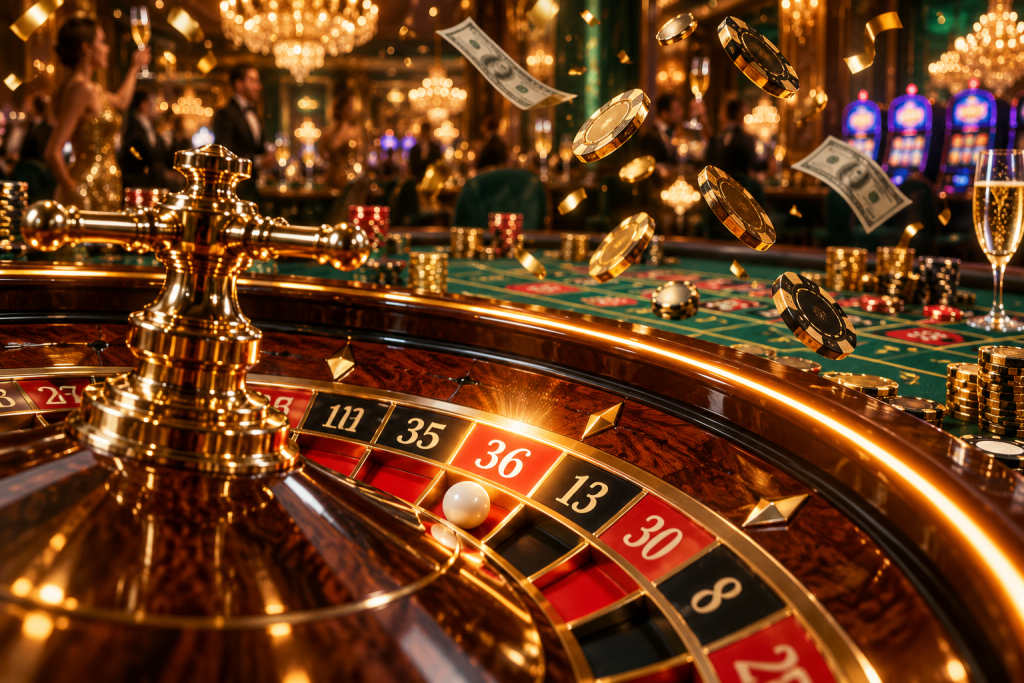
The number 36 is the top of the board, but the zero is the number that changes your odds
Every standard roulette wheel runs from 0 to 36, so 36 is the highest number you will see on the layout. The wheel itself does not place the numbers in order; they are arranged in a fixed sequence designed to alternate red and black, high and low, odd and even as evenly as the physics of a spinning wheel allows. The sequence differs between the European and American layouts, but the range of numbers does not.
What matters for your money is not the highest number but the presence of a zero. A European wheel has 37 pockets: the numbers 1 through 36 plus a single zero. An American wheel has 38 pockets: the same 1 through 36 plus a zero and a double zero. That one extra pocket is the single largest structural difference between the two wheels, because it changes the probability of every bet on the table.
When you place a straight-up bet on any single number, including 36, you are betting that the ball lands in that exact pocket. On a European wheel, a straight-up bet has one winning pocket out of 37. On an American wheel, it has one winning pocket out of 38. The payout is the same on both wheels, but the chance of hitting is lower on the American layout. That is why the wheel type matters more than which number you pick.
What the wheel and table show you
A roulette table has two main parts: the wheel and the betting layout. The wheel is the spinning dish with numbered pockets around its rim. The layout is the printed felt where you place chips. Both show the same numbers, but the layout arranges them in three columns of twelve, while the wheel arranges them in a circular sequence that has nothing to do with numerical order.
The layout groups numbers into the bets you can make. A straight-up bet covers one number. A split covers two adjacent numbers on the felt. A street covers three numbers in a row. A corner covers four. A six-line covers six. Outside the numbered grid sit the even-money bets: red or black, odd or even, high or low. High means 19 through 36, so 36 itself sits inside the high group.
The wheel type is printed on the layout or visible on the wheel itself. If you see a single zero only, you are at a European-style wheel. If you see both a zero and a double zero, you are at an American-style wheel. Some venues offer both, and the table minimums may differ between them. The wheel type is the first thing to check before you buy in, because it sets the house edge on every bet you can make.
How a round plays from buy-in to settlement
You buy in at the table, not at a cashier. Place your cash on the felt and the dealer exchanges it for roulette chips. Roulette chips are typically colour-coded to you, so the dealer can tell your bets apart from every other player's. The chips have no value printed on them; their value is set when you buy in and the dealer places a marker on your colour. You cannot take these chips to another table or cash them at the cage. When you finish, the dealer converts them back into standard value chips.
Once the dealer clears the previous spin and pays any winners, the betting round opens. You place chips on the layout wherever you want to bet. You may bet on as many spots as you like, and you may combine inside and outside bets. The dealer announces when bets are closing, usually as the ball begins to slow. After that, no more chips may be placed or moved.
The ball is spun in the opposite direction to the wheel. When it drops into a pocket, the dealer marks the winning number on the layout and clears all losing bets first. Winning bets are then paid at the odds printed or implied by the table. A straight-up win pays 35 to 1, which means you receive your original chip back plus 35 more. The payout does not change based on which number you choose; 36 pays exactly the same as 1 or 17.
Bet types and why their edges differ
Every bet on the same wheel carries its own house edge, but the pattern is simple: inside bets pay more and hit less often, outside bets pay less and hit more often. The house edge on most roulette bets is the same, but a few bets break that pattern. The table below compares the main bet types on a European wheel. The American wheel raises the house edge on all of them because of the extra double-zero pocket.
| Bet type | Numbers covered | Payout | What changes |
|---|---|---|---|
| Straight-up | 1 number | 35 to 1 | Lowest hit frequency, highest payout |
| Split | 2 numbers | 17 to 1 | Twice the coverage of a straight-up |
| Street | 3 numbers | 11 to 1 | Covers a full row on the layout |
| Corner | 4 numbers | 8 to 1 | Covers a square of four adjacent numbers |
| Six-line | 6 numbers | 5 to 1 | Covers two adjacent rows |
| Red/black, odd/even, high/low | 18 numbers | 1 to 1 | Highest hit frequency, lowest payout |
The zero is not covered by red, black, odd, even, high or low. When the ball lands in zero, those outside bets lose on most layouts. Some tables offer a rule that returns part of an even-money bet when zero hits, but that rule is specific to certain tables and venues. If it is offered, it will be printed on the layout or stated by the dealer, and it changes the house edge on those bets.
The American double zero does not pay differently; it simply adds a second pocket that no outside bet covers. That is the entire reason the American layout carries a higher house edge than the European one. The numbers on the felt look the same, but the wheel underneath them is not.
What you control at the table
You control which bets you place, how many you place at once, and how long you stay at the table. You do not control the wheel, the ball, or the sequence of outcomes. No number is due to hit because it has not appeared recently, and 36 is not special because it is the highest. Each spin is independent of the one before it.
The most useful decision you can make is to choose the wheel type before you sit down. A European wheel with a single zero gives every bet a better chance than an American wheel with a double zero, for the same payouts. If both are available, the wheel type is a real choice. The number you pick is not.
Bankroll sizing is a method, not a strategy. A common approach is to decide in advance how much you are willing to lose and to divide it into betting units that match the table minimum. If the table minimum is one unit and you have forty units, you have forty minimum bets. That does not change the house edge, but it gives you a clear stopping point. The house edge stays with the house on every spin, regardless of how you divide your money.
Procedural mistakes new players make
The first mistake is buying in and then placing chips after the dealer has called no more bets. Late bets are returned or, at some tables, left in place and settled at the dealer's discretion. The betting window is short, so decide your bets before the ball slows. If you are unsure, wait for the next spin rather than reaching across the layout.
The second is treating roulette chips like cash chips. Roulette chips are colour-coded and have no printed value. If you walk away from the table with them, they are worthless anywhere else. You must ask the dealer to colour you up before you leave. The dealer exchanges your colour for standard chips that the cage will cash.
The third is assuming that a bet covering more numbers reduces the house edge. It does not. Covering 18 numbers with an even-money bet and covering one number with a straight-up bet carry the same house edge on the same wheel, ignoring any special zero rule. Coverage changes how often you win and how much you win, not the rate at which the house keeps its edge. The rate is set by the wheel, not by how much of the felt you cover.
FAQ
Why is 36 the highest number on a roulette wheel?
The standard roulette wheel has been built around the numbers 0 through 36 since the game took its modern form. The range is fixed by the layout and the wheel design, and it is the same on European and American wheels. The zeros sit outside the 1-to-36 range and are not part of the high-low or red-black bets.
Does betting on 36 pay more than betting on other numbers?
No. A straight-up bet on any single number pays 35 to 1, whether that number is 36, 1, or anything in between. The payout is fixed by the bet type, not by the number's position on the wheel or the layout.
What is the difference between a European and an American wheel?
A European wheel has 37 pockets: 1 through 36 plus a single zero. An American wheel has 38 pockets: the same numbers plus a zero and a double zero. The extra double-zero pocket lowers the chance of every bet winning without changing the payouts, which is why the American layout carries a higher house edge.
Gambling involves risk. Please only gamble with funds that you can comfortably afford to lose. While we do our best to provide good advice, we cannot be held responsible for any loss that may occur as a result of gambling. We do our best to make sure all the information that we provide on this site is correct. However, from time to time, mistakes or changes may occur. We do not take responsibility for how accurate or current the information is, and we cannot be held liable for any errors or omissions. The content on this site is for information purposes only and should not be relied upon as the sole basis for any gambling decision. If you or someone you know is struggling with gambling addiction, help is available. Speak with a professional or visit a responsible gambling resource in your area.
Play responsibly
Gambling should be treated as paid entertainment, never as a way to earn income or recover losses. 1-800-MY-RESET (1-800-697-3738)
18+ or 21+ depending on where you are; follow the minimum age that applies to you.
This article is general information about how these mechanics work. It is not legal advice and not a recommendation to gamble or to use any particular operator. Availability and legality differ by jurisdiction — check the rules that apply where you are.