


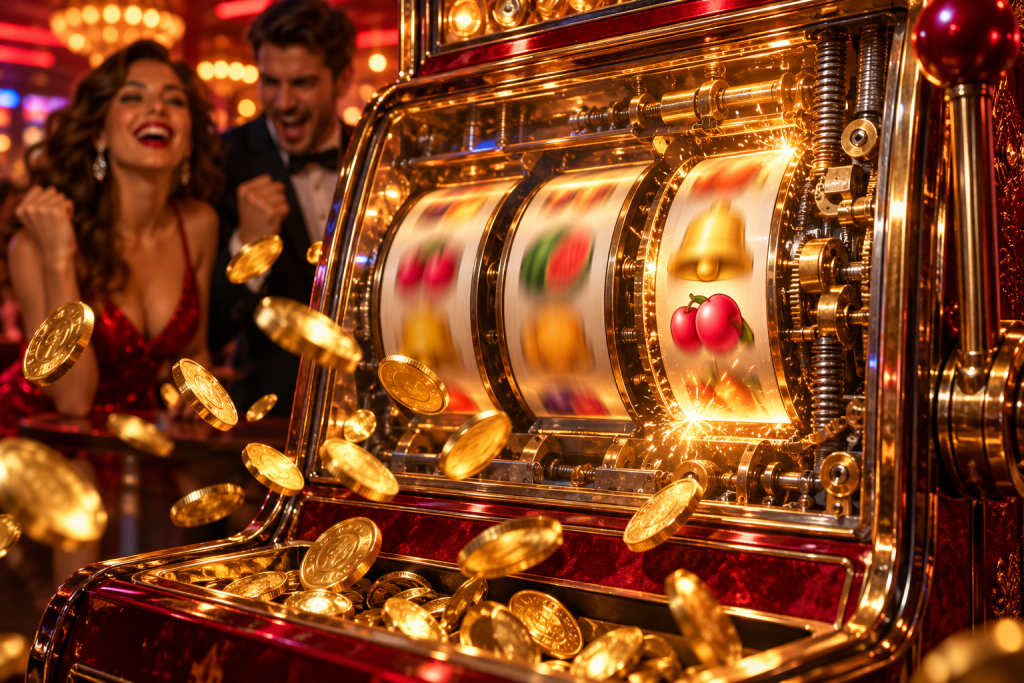
The question starts with a physical machine, not a computer
Someone asking how a mechanical slot machine produces random results is usually picturing a traditional three-reel cabinet with a side handle, spinning symbols and a coin tray. The key distinction is that a purely mechanical machine has no random number generator in the modern electronic sense. Its outcomes come from physical parts moving at different speeds and stopping at positions that are difficult for a player to predict in the moment.
This article stays with that purely mechanical design. It does not cover video slots, electromechanical hybrids with computer-controlled stops, or any machine where a processor decides the displayed result. Those are different devices with different mechanisms, and mixing them up is the most common source of confusion on this question.
No venue-specific facts are available for this article. It therefore makes no claims about any named casino, any machine count, any floor size, or any location. The explanation below is about the general mechanism shared by purely mechanical reel machines.
What parts move during a spin
A purely mechanical slot machine has a small set of core components. Understanding them makes the randomness question easier to follow, because each part has a specific job in producing and then stopping a spin.
- Reels: The vertical drums carrying symbols. Most purely mechanical machines have three reels, each with a fixed number of symbol positions around its circumference.
- Reel strips: The printed bands wrapped around each reel. The sequence of symbols on a strip is fixed at manufacture and is part of what determines which combinations are possible.
- Detent or stop mechanism: A physical device, often a notched disc and a spring-loaded pawl or kicker, that catches each reel and holds it at one of its fixed stopping positions.
- Drive mechanism: The spring, gears or motor that sets the reels spinning when the player pulls the handle or presses the button.
- Payout mechanism: The mechanical system that reads the final reel positions, identifies whether they match a paying combination on the payout table, and releases coins or credits accordingly.
Each reel stops only at one of its designed positions. The machine cannot show a symbol halfway between two positions, because the detent mechanism physically locks the reel into a notch.
Where the randomness comes from
In a purely mechanical machine, randomness is not generated by a code loop. It emerges from the interaction of several physical variables that the player cannot control precisely. The reels are set in motion at different speeds or with different amounts of force, and the stopping mechanism does not apply identical resistance on every spin.
The main variables are the speed of each reel at the moment the stop mechanism engages, the wear on the mechanical parts, the tension of the springs, and the exact point in the reel's rotation when the kicker or pawl catches the notch. These variables combine in ways that are hard to reproduce from spin to spin. A player cannot reliably time the pull of the handle to land a particular symbol, because the reels do not stop the instant the handle is released and because the three reels are not in a fixed relationship to one another.
This is a physical form of unpredictability rather than a mathematical guarantee of equal probability for every stop. The machine is designed so that the outcome is not under the player's control, but the exact distribution of outcomes is set by the reel strip layout and the mechanical tolerances of the cabinet.
What the payout table fixes in advance
The reel strips are not random. They are manufactured with a specific sequence of symbols, and that sequence is the same on every spin. What changes is where each reel stops. The payout table printed on the machine lists which combinations of symbols pay and what each combination returns.
Because the reel strips are fixed, the number of possible stopping positions for each reel is fixed. The total number of possible three-reel combinations is the product of the stopping positions on the three reels. Not every combination pays, and paying combinations appear with a frequency determined by how many times their symbols occur on each strip. The machine's long-run payout percentage is a consequence of that layout, not of an algorithm adjusting results after each spin.
The player sees a random-looking sequence of results. The machine's designer sees a fixed set of possible outcomes with known frequencies. Both perspectives are true at the same time, and the difference between them is the most useful thing to understand about mechanical slots.
Why a purely mechanical machine is not perfectly random
Perfect randomness would mean every stopping position on every reel has an exactly equal chance of occurring on every spin. A purely mechanical machine does not guarantee that. Small differences in spring tension, lubrication, temperature and wear can make some stopping positions slightly more likely than others over a long series of spins.
The machine is designed to be unpredictable to the player, not to meet a statistical definition of uniform randomness. Regulators and manufacturers address this through design tolerances, testing and maintenance, but the physical nature of the device means the randomness is approximate rather than mathematically exact. An electronic random number generator can be programmed to produce a uniform distribution; a mechanical reel assembly can only be built to approximate one.
This distinction matters because it explains why older purely mechanical machines behave differently from modern machines that use a processor to select outcomes and then display them on reels. The modern machine's randomness is digital. The mechanical machine's randomness is physical.
How the result is read after the reels stop
Once all three reels have locked into their detent positions, the machine reads the symbol showing on the payline. The payline is a fixed line across the reels, usually across the centre. The payout mechanism compares the three symbols on that line against the payout table.
If the combination matches a paying entry, the machine releases the corresponding number of coins or credits. If it does not match, no payout is made. The reading is mechanical in a purely mechanical machine: physical feelers, levers or pins detect the reel positions and trigger the payout slides. There is no screen logic involved.
The outcome of a spin is therefore the result of three separate physical events, one per reel, followed by a mechanical comparison against a fixed table. Nothing about the previous spin changes the next one. The reels do not remember what they showed before, and the machine does not adjust its behaviour based on how much it has paid out recently.
What changes when a machine becomes electromechanical
Many machines that look mechanical are electromechanical. They still have physical reels, but a motor drives each reel and a processor controls when each reel stops. In these machines, the outcome is selected electronically first, and the reels are then stopped to display that outcome.
The difference is important for the randomness question. In a purely mechanical machine, the physical stopping event is the source of the result. In an electromechanical machine, the processor's random number generator is the source, and the reels are a display. The player sees the same spinning reels either way, but the mechanism producing the result is different.
This article does not state which type any particular venue operates, because no venue facts are available. The distinction is presented only to prevent the two mechanisms from being treated as identical.
Where the authoritative details for a specific machine live
The general mechanism described here applies to purely mechanical reel machines as a category. The exact symbol layout, number of stopping positions, payout table and mechanical tolerances for a specific machine are not universal. They are set by the manufacturer's design and, where applicable, by the testing and approval process in the jurisdiction where the machine operates.
A reader who wants the precise payout structure for a particular machine should look at the payout table printed on the machine itself, the manufacturer's technical documentation for that model, or the published game rules made available by the gaming authority in the relevant jurisdiction. This article does not reproduce any such table, because no machine-specific facts are available and because payout tables differ between models and jurisdictions.
What to confirm before you rely on any specific claim
Machine designs change, older purely mechanical cabinets are increasingly rare on casino floors, and the term "mechanical slot" is sometimes used loosely to describe any machine with physical reels even when a processor controls the stops. Before drawing conclusions about a particular machine, confirm the following through the channels that hold the current answer.
| Item to confirm | Why it matters | Where the current answer lives |
|---|---|---|
| Whether the machine is purely mechanical or electromechanical | The source of the result is different in the two designs | Manufacturer model documentation; machine identification plate |
| The symbol layout on each reel strip | It fixes the possible combinations and their frequencies | Manufacturer technical sheet; jurisdiction game rules publication |
| The payout table and payline configuration | It determines which combinations pay and how much | Payout table printed on the machine; game rules publication |
| Any jurisdiction-specific testing or approval status | Requirements differ by location and change over time | Gaming authority for the relevant jurisdiction |
None of these items is stated in this article, because no machine-specific facts are available. The table above tells the reader what to check and which channel carries the authoritative current answer.
FAQ
Does a mechanical slot machine use a random number generator?
A purely mechanical machine does not. Its results come from physical reels, springs and stopping mechanisms whose interaction is hard to predict. An electromechanical machine with physical reels may use a processor and a random number generator to select the outcome, then stop the reels to display it. The two designs look similar but produce results differently.
Can a player time the handle to control the result?
No. The reels do not stop at the instant the handle is released, and the three reels are not in a fixed relationship to one another. The stopping mechanism catches each reel at a position the player cannot reliably time. The machine is designed so that the outcome is not under the player's control, regardless of pull timing or force.
Why do some symbols appear more often than others?
The reel strips are manufactured with a fixed sequence of symbols, and that sequence is the same on every spin. If a symbol appears more than once on a strip, it has more stopping positions and therefore appears more often over many spins. The payout table and the strip layout together set how frequently each combination occurs.
Play responsibly
Gambling should be treated as paid entertainment, never as a way to earn income or recover losses. 1-800-MY-RESET (1-800-697-3738)
18+ or 21+ depending on where you are; follow the minimum age that applies to you.
This article is general information about how these mechanics work. It is not legal advice and not a recommendation to gamble or to use any particular operator. Availability and legality differ by jurisdiction — check the rules that apply where you are.