


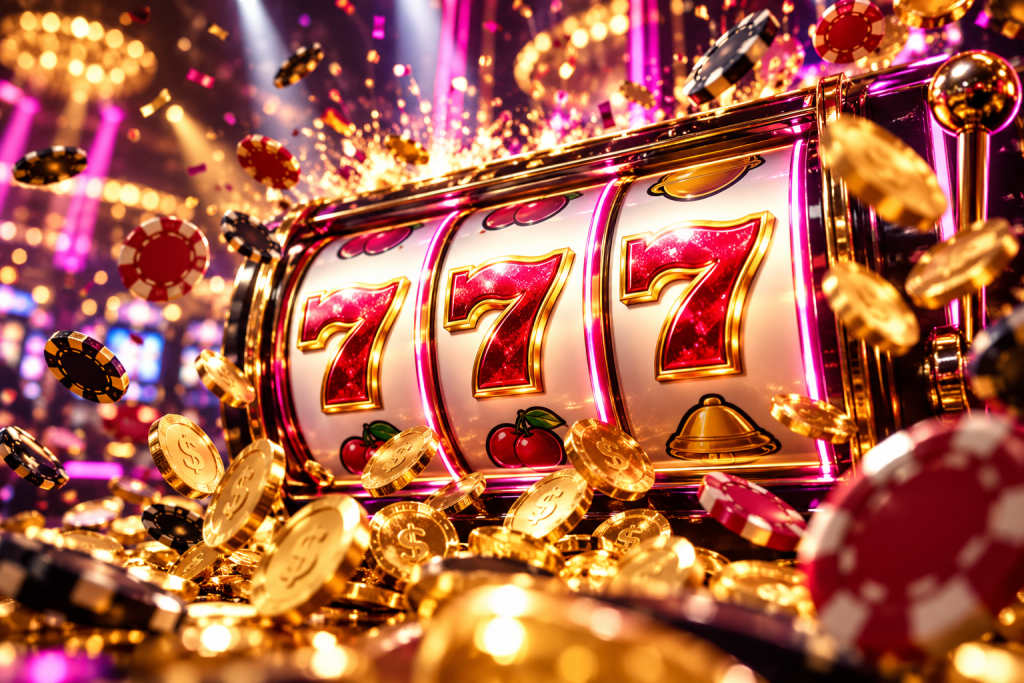
The machine already made its decision before you pressed the button
Most people picture a slot machine as a physical device that spins reels and then settles on a result. The mechanical picture is backwards. In a modern machine the outcome is chosen first, by a random number generator, and the spinning reels are a display that reveals a decision that already exists. The stop positions, the symbols that land, and whether the spin pays are determined in the instant the play is initiated, not by anything the reels do afterwards.
That ordering matters because it kills a whole family of superstitions about timing, rhythm and stopping the reels yourself. The button press or handle pull requests a number. The number maps to a reel position. The screen shows that position. Nothing the player does after the request changes the mapping.
What the random number generator does
The RNG is an algorithm that produces numbers at high speed, constantly, even when nobody is playing. Each number maps to a position on each virtual reel. When a spin is triggered, the machine grabs the current number and translates it into a symbol arrangement. The process is designed so that each outcome is independent of the last: a spin that just paid a jackpot does not make the next spin more or less likely to pay anything, and a long losing run does not make a win more likely.
Independence is the part players find hardest to accept, because human intuition expects short sequences to balance out. They do not. A coin does not remember that it landed heads five times. A slot does not remember that it has not paid in two hundred spins. The next spin draws from the same distribution as the one before it.
Independent testing laboratories commonly certify that an RNG behaves the way it should. That certification covers the mechanics of the game: whether outcomes are random and whether the displayed probabilities match the design. It does not cover an operator's financial conduct, and it is not a comment on whether a player will win.
RTP and house edge are two names for the same arithmetic
Return to Player is a theoretical percentage of total wagered money a game returns to players over a very large number of spins. It is a long-run statistical average, not a per-session guarantee. House edge is the mathematical advantage the operator holds on a given game, expressed as a percentage of each wager. They are complements: for the same game, RTP and house edge sum to 100%.
That relationship is the entire economic structure of a slot. Suppose a game published an RTP of R%. The house edge on that same game is 100 minus R, expressed as a percentage. If a player wagered a total of 1,000 units on that game, the expected loss over a very large number of spins would be 1,000 multiplied by the house edge, with the exact figure depending on the R value. The word expected is doing heavy work: it is the centre of a distribution, not a bill that arrives after one session.
Every operator publishes the RTP for its games somewhere, usually in the game's information panel or the help file. The figure a player should read is the one attached to the specific game they are playing, under the specific rule set in force, because the same title can carry different settings in different places.
Why a short session looks nothing like the long-run average
If a game returns R% over millions of spins, a player who makes a few hundred spins is not walking into a miniature version of that average. They are walking into variance. Some sessions end ahead, most do not, and the spread of possible outcomes is wide. The long-run average is an emergent property of enormous sample sizes. A single evening is a tiny sample, and tiny samples are noisy.
Volatility is the term for how payouts are distributed over time. High volatility means rarer but larger payouts; low volatility means more frequent but smaller ones. Volatility does not change a game's RTP. Two games can publish the same RTP and feel completely different, because one pays small amounts often and the other pays almost nothing for long stretches and then returns a large amount at once. The first drains a bankroll slowly. The second drains it in chunks, with occasional sharp recoveries that feel meaningful but are part of the same negative-expectation structure.
The practical consequence is that a player cannot judge a game's fairness, or its RTP, from what happened in their last session. A run of wins does not mean the game is loose. A run of losses does not mean it is tight. Both are ordinary draws from a distribution whose average is below break-even.
Decisions per hour change total exposure, not the edge
Slots are fast. A player can complete hundreds of spins in an hour, and every spin carries the same house edge. The edge is applied to each wager, so the expected loss scales with total coin-in: stake per spin multiplied by spins per hour multiplied by hours played. The edge itself does not change with speed, but the amount of money exposed to it does.
Suppose a player wagers one unit per spin and completes S spins in an hour. Total coin-in for the hour is S units. The expected loss for the hour is S multiplied by the house edge, whatever that edge is for the game in question. Double the spins, and the expected loss doubles, even though the edge per spin is identical. This is why session length and spin rate are the two variables a player genuinely controls.
Bet selection is the other one. Different games carry different edges, and within a game the edge is typically fixed per spin rather than varying by bet size. A larger stake does not buy a better edge; it buys more exposure per spin. The only way to reduce expected loss is to reduce total wagered, by playing fewer spins, at a lower stake, or on a game with a lower published house edge.
Why progression systems do not remove the edge
A progression system is any rule that changes the stake based on previous outcomes: double after a loss, raise after a win, or follow some fixed sequence of bet sizes. These systems feel like they impose structure on randomness, and they do change the shape of a session. What they do not change is the expected value of each individual spin.
The reason is that every spin is independent and carries the same edge. A larger bet after a loss is just a larger bet at the same negative expectation. A smaller bet after a win is just a smaller bet at the same negative expectation. The progression rearranges when the large and small bets happen, which changes the distribution of outcomes: more frequent small wins, rarer large losses, or the reverse. It does not change the sum of expected losses across all the bets placed.
To see this, suppose a player follows a doubling progression on a game with a fixed house edge. Each bet, whatever its size, has an expected loss equal to the stake multiplied by that edge. The total expected loss across the sequence is the sum of the individual expected losses, which is the house edge multiplied by the total amount wagered. The doubling rule changes the pattern of wins and losses, but the total wagered is what it is, and the edge applies to all of it. A progression redistributes outcomes; it does not manufacture a positive expectation.
The same logic applies to stopping rules. A rule like "quit after doubling the bankroll" or "quit after three losses" changes when a session ends, not the expectation of the spins that were played. The house edge is built into each bet, and no rule about when to stop or how much to bet alters the arithmetic of the bets themselves.
What varies under the player's control
Strip away the systems and the superstitions, and the levers are modest but real. A player can choose a game with a lower published house edge, which reduces the expected loss per unit wagered. A player can choose a lower stake, which reduces exposure per spin. A player can choose to play fewer spins per hour, which reduces total coin-in. A player can set a loss limit and a session length before starting, which bounds the worst case for a given evening.
None of these changes the fact that the game has a built-in edge. What they change is how much money is put in front of that edge, and for how long. That is the honest scope of player control in a slot machine: not the outcome, not the edge, but the pace and size of the exposure.
FAQ
Does stopping the reels myself change the outcome?
No. The outcome is determined when the spin is initiated, and the stop button only controls how quickly the display reveals it. The mapping from the random number to the reel positions is fixed before the reels finish animating.
Can a slot be due for a win after a long losing streak?
No. Each spin is independent, and the machine does not track or compensate for past results. A long losing streak does not increase the probability of a win on the next spin, and a recent jackpot does not reduce it.
Where do I find the RTP for a specific slot game?
Look in the game's information panel or help file, usually accessible from an icon on the game screen. The figure is specific to the game and the rule set in force, and it is the number to read rather than relying on a general category average.
Play responsibly
Gambling should be treated as paid entertainment, never as a way to earn income or recover losses. 1-800-MY-RESET (1-800-697-3738)
18+ or 21+ depending on where you are; follow the minimum age that applies to you.
This article is general information about how these mechanics work. It is not legal advice and not a recommendation to gamble or to use any particular operator. Availability and legality differ by jurisdiction — check the rules that apply where you are.