


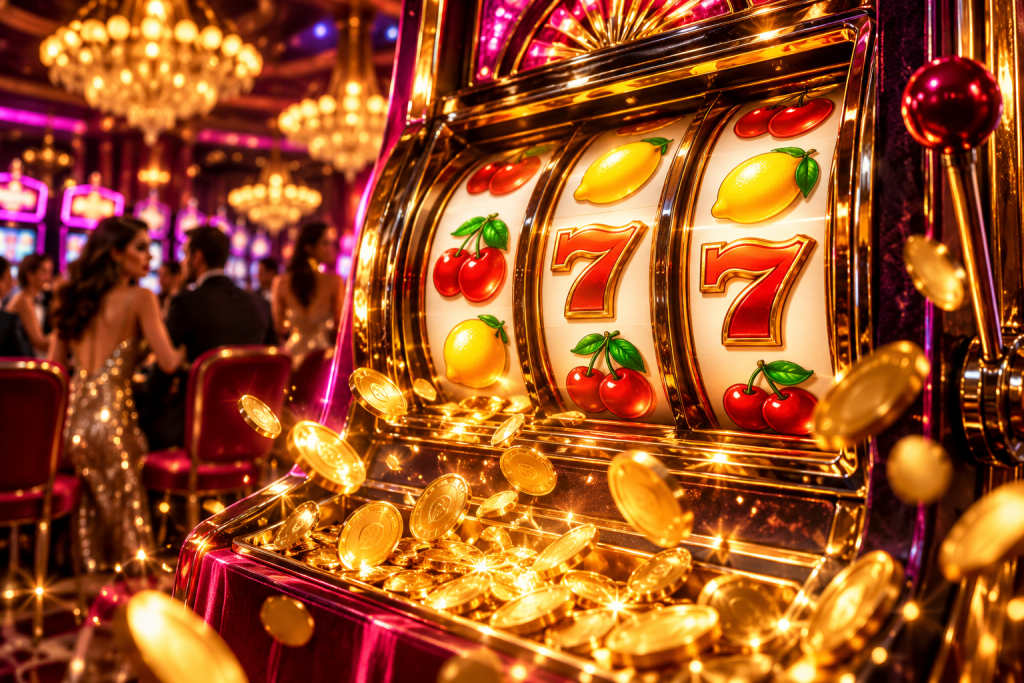
The reels stop where the machine already decided
When you press spin on a fruit machine, the symbols you see tumbling and settling are a presentation. The outcome was fixed the moment the spin began. A random number generator inside the game selected a number, and that number was mapped to a set of reel positions. The animation simply plays out the result the machine already holds.
This is the single most useful thing to understand about how fruit machines work, because it dissolves the idea that a player can influence the result by timing the button, stopping the reels early, or reading the symbols as they blur past. None of that changes the number that was already drawn.
The random number generator, or RNG, is the algorithm that determines game outcomes. Independent testing laboratories are commonly used to certify RNG behaviour; certification covers game mechanics, not an operator's financial conduct. In a physical cabinet or an online game, the RNG is generating numbers continuously, even when nobody is playing. The moment you press spin, the machine takes the next number in the stream and uses it.
From a number to a reel position
The number the RNG produces is not a symbol. It is a value that gets translated through a reel map. Each reel position on each reel is assigned a range of numbers. The RNG output falls into one of those ranges, and that determines which symbol stops on the payline. The reel map includes the blank spaces between symbols, which is why a reel can appear to stop just short of a jackpot symbol even though the machine was never close to paying it.
This mapping is fixed in the game's programming. The odds of any particular symbol landing are set by how many numbers in the RNG's range are assigned to that symbol, not by how many times that symbol appears on the visible reel strip. A symbol can appear twice on the strip but be assigned a narrow slice of the number range, making it rarer than it looks.
Because the mapping is fixed, the game's return percentage is fixed too. Return to Player, or RTP, is a theoretical percentage of total wagered money a game returns to players over a very large number of spins or hands. It is a long-run statistical average, not a per-session guarantee. The house edge is the mathematical advantage the operator holds on a given game, expressed as a percentage of each wager. House edge and RTP are complements: they sum to 100% for the same game.
Paylines and ways-to-win are different counting systems
Two fruit machines can look almost identical and still resolve wins by completely different rules. The distinction is between fixed paylines and ways-to-win formats.
Paylines are the patterns across reels that produce a paying combination. In a fixed-payline game, you are betting on every line every spin, and a win is only registered when matching symbols land on one of those specific patterns. A game might display twenty paylines, and the paytable will show a diagram of each one. If the symbols land one position off the line, they do not pay.
Ways-to-win formats pay on adjacent-symbol combinations instead of fixed lines. If the same symbol lands on consecutive reels starting from the leftmost reel, it counts, regardless of which row it occupies. The number of ways is calculated by multiplying the number of symbol positions on each reel. This produces a much larger number of possible winning arrangements, but each individual arrangement typically pays less than a fixed-line hit would.
| Feature | Fixed paylines | Ways-to-win |
|---|---|---|
| How a win is counted | Matching symbols on a specific printed line | Matching symbols on adjacent reels from the left |
| Number of winning patterns | Fixed, shown in the paytable | Multiplied from reel positions, can be hundreds or thousands |
| Stake structure | Bet covers all active lines | Single stake covers all ways |
| Typical payout per hit | Higher, because hits are rarer | Lower, because hits are more frequent |
Neither system is better in absolute terms. They distribute the same underlying return differently. A fixed-line game will tend to produce fewer but larger wins; a ways-to-win game will produce more frequent but smaller ones. The RTP is set by the game's programming and the reel map, not by which counting system is used.
What volatility changes and what it does not
Volatility, also called variance, describes how payouts are distributed over time. High volatility means rarer but larger payouts; low volatility means more frequent but smaller ones. Volatility does not change a game's RTP.
This is where a lot of fruit machine advice goes wrong. A high-volatility game is not a game that pays more. It is a game that pays less often, with the occasional larger hit. A low-volatility game is not a game that pays less overall. It is a game that returns smaller amounts more regularly. Over a very large number of spins, both can carry the same programmed return.
What volatility changes is the shape of your session. If you sit down with a fixed bankroll and play a high-volatility game, you are more likely to see your balance drain steadily between occasional spikes. If you play a low-volatility game, you are more likely to see a flatter line with smaller swings in either direction. Neither choice changes the long-run expected loss. Both games hold the same mathematical edge for the operator on every spin.
Stake size does not change the return either. Betting more per spin multiplies the amount you are wagering, and therefore the amount you are expected to lose on average, but it does not improve the percentage return. A game with a house edge keeps a small fraction of each wager whether that wager is one unit or one hundred units. The only thing stake size changes is the speed at which a given bankroll is exposed to that edge.
No betting pattern alters the programmed return. A progression system that raises the stake after losses, or lowers it after wins, redistributes the same expected loss across different spin sizes. It does not remove the edge. A fruit machine has no memory of previous spins, no sense of being due, and no mechanism by which a player's decisions after the spin begins can affect the outcome.
Fixed and progressive jackpots sit on top of the base game
Some fruit machines carry a jackpot display, and the way that jackpot is funded matters for how the game returns money.
Fixed jackpots pay a set amount. The amount is printed in the paytable or on the cabinet, and it does not change based on how many people have played. A progressive jackpot grows from a share of qualifying wagers and resets after a win. Progressive contributions are typically taken out of the game's return, and some progressives require a maximum-stake bet to qualify.
The key point about progressive contributions is that they come from somewhere. If a share of each wager is diverted to the progressive pool, that share is not being returned through the base game. The base game's return is lower than it would be without the progressive. The progressive is not free money added on top; it is a redistribution of money that would otherwise have been returned through regular wins.
Some progressives only qualify at maximum stake. The paytable or the jackpot rules panel will state this. If you are playing a progressive game at less than the qualifying stake, you are funding the jackpot without being eligible to win it. That is a materially worse expected return than the same game played at qualifying stake, and it is worth checking before you spin.
Reading the information panel and paytable
Every modern fruit machine, whether in a cabinet or online, carries the information you need to understand what you are playing. The two documents to read are the information panel and the paytable.
The information panel typically shows the game's RTP, the volatility rating if one is published, the jackpot type, and the rules for any bonus features. The RTP figure is a long-run average. It does not tell you what will happen in the next hour. It tells you the rate at which the game is programmed to return money over an extremely large number of spins.
The paytable shows what each symbol pays, how the paylines or ways are arranged, which symbols are wild or scatter, and what triggers the bonus features. It also shows the stake structure. If the game has fixed paylines, the paytable will show how many lines are active and what the total bet is. If it has ways-to-win, it will show how many ways are in play at each stake level.
| What to check | Where it appears | What it tells you |
|---|---|---|
| RTP | Information panel or game rules | The long-run programmed return percentage |
| Volatility | Information panel, sometimes the paytable | How payouts are distributed over time |
| Jackpot type and qualifying stake | Jackpot rules or paytable | Whether the jackpot is fixed or progressive, and what stake qualifies |
| Payline or ways count | Paytable | How winning combinations are counted |
| Bonus trigger conditions | Paytable or feature rules | What symbols or combinations start the bonus round |
If a game does not display its RTP or volatility, that information may still be available in the game's help file or on the operator's game information page. The absence of a published figure does not change how the game works; it just means the information is not being surfaced where you are looking.
Why the machine feels the way it feels
The experience of playing a fruit machine is shaped by three things working together: the RNG, the reel map, and the volatility setting. The RNG decides which numbers come up. The reel map decides what those numbers look like on the reels. The volatility setting decides how the game parcels out its return.
None of these are under player control. The choices a player does control are which game to play, what stake to set, how long to play, and when to stop. Those choices change the pace and the size of the exposure, not the programmed return.
When a fruit machine produces a long losing run, that is variance doing what variance does. When it produces a large win, that is also variance. Neither event tells you anything about what the next spin will do. The machine is not warming up, cooling down, or building toward anything. Each spin is an independent draw from the same fixed distribution.
FAQ
Can you stop the reels early to change the outcome?
No. The outcome is determined by the RNG at the moment the spin is initiated. The stop button, where one exists, only shortens the animation. It does not influence which number was drawn or which symbols will land.
Does a fruit machine pay more after a long losing streak?
No. Each spin is independent. The RNG has no memory of previous spins, and the game's programming does not compensate for losses. A long losing streak does not make a win more likely on the next spin.
What is the difference between a fruit machine's RTP and its volatility?
RTP is the long-run percentage of wagered money the game is programmed to return. Volatility describes how that return is distributed across individual sessions. Two games can have the same RTP but very different volatility, meaning one pays smaller amounts more often while the other pays larger amounts less often.
Please gamble responsibly. If you or someone you know needs support, contact local responsible gambling services.
Play responsibly
Gambling should be treated as paid entertainment, never as a way to earn income or recover losses. 1-800-MY-RESET (1-800-697-3738)
18+ or 21+ depending on where you are; follow the minimum age that applies to you.
This article is general information about how these mechanics work. It is not legal advice and not a recommendation to gamble or to use any particular operator. Availability and legality differ by jurisdiction — check the rules that apply where you are.