


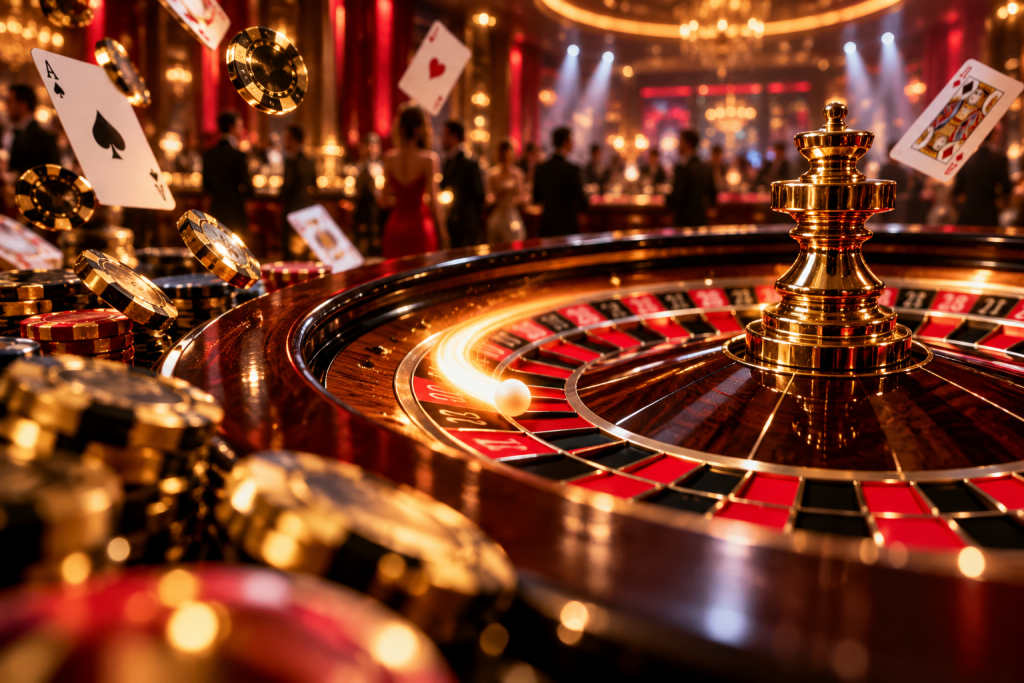
The Wheel Does Not Remember the Last Spin
A player watching a roulette wheel sees a long run of red and black numbers and starts to wonder when a green pocket will appear. The honest answer is that there is no point at which the wheel is due. The roulette wheel does not track its own history. Each spin is an independent event, and the probability of a green pocket is the same on the next spin as it was on the first spin of the session.
This is the single fact that changes how the rest of the question should be read. Asking how long roulette can go without green is not really a question about a maximum. It is a question about how streaks work, how probability distributes outcomes, and why a run that feels impossible is a normal part of a game with a built-in house advantage.
What a Green Pocket Is
On a European roulette wheel, the green pocket is the single zero. The wheel has 37 pockets in total, numbered 0 through 36. On an American wheel, there are two green pockets, the zero and the double zero, across 38 pockets. The green pockets are not just another colour. They are the mechanism through which the house edge is built into the roulette layout.
When a player bets on red or black, a green pocket is a losing outcome for that bet. The presence of the zero, or the zero and double zero, is what makes the payout on a winning colour bet slightly less than the true odds would require. The green pocket is the house's share of the wheel, and it appears on every spin with the same probability, regardless of how long it has been absent.
Probability of a Green Pocket on Any Single Spin
On a European wheel, the probability that any single spin lands on green is 1 in 37. On an American wheel, it is 2 in 38, which simplifies to 1 in 19. These are the only figures needed to think about streaks, and they come directly from the wheel's structure: one or two green pockets out of a fixed total.
The probability that a spin does not land on green is the complement. On a European wheel, 36 of 37 pockets are not green. On an American wheel, 36 of 38 are not green. Every spin that avoids green makes the current streak one spin longer, but it does not change the probability of the next spin. The wheel is not using up its green outcomes.
How to Calculate a Streak of Any Length
The probability of a streak is calculated by multiplying the probability of each individual spin. If the probability of not hitting green on one European spin is 36/37, then the probability of two consecutive spins without green is (36/37) times (36/37). The probability of ten consecutive spins without green is (36/37) raised to the tenth power.
As an example, suppose a player wants to know the chance of avoiding green for 20 consecutive spins on a European wheel. The calculation is (36/37) to the power of 20. This produces a figure a little below the small fraction the venue sets. The streak is more likely than not over 20 spins. The same calculation for fifty spins produces a small fraction of the total coin-in. For 100 spins, the figure drops to around 6.5%. These are hypothetical examples built from the wheel's structure, and they show that long green-free runs are not rare events. They are expected parts of the distribution.
The key point is that the probability of a streak gets smaller as the streak gets longer, but it never reaches zero. There is no spin count at which a green pocket becomes certain. A run of 200 spins without green is extraordinarily unlikely, but it is not impossible. The wheel can go without green for any length of time, in principle, because each spin resets the probability.
Short Sessions Look Nothing Like the Long-Run Average
Roulette's house edge is a long-run statistical property. It describes what happens over a very large number of spins, not what happens in an evening. A player who sits down for 50 or 100 spins is experiencing a tiny slice of the distribution, and that slice can look very different from the average.
This is the gap between expected value and variance. Expected value is the average outcome per spin over the long run. Variance is how much individual sessions bounce around that average. A green-free run is variance. It does not mean the wheel is broken, the game is rigged, or a green pocket is overdue. It means the player is observing one path through a random process, and that path can wander far from the average before it returns.
The house edge on a colour bet comes from the green pocket's existence, but the edge does not appear evenly. It accumulates across all players and all spins. A single player can win for a long time without seeing green, just as another player can see green several times in a row. Neither outcome changes the edge. It is built into the payout structure and the wheel's composition, and it operates regardless of the sequence.
What Decisions Per Hour Do to Total Exposure
The number of spins a player makes in an hour changes the total amount wagered, and total wagered changes the expected loss. A player making 60 spins per hour at a fixed stake wagers 60 times that stake. A player making 120 spins per hour wagers twice as much. The house edge applies to total wagered, not to time spent at the table.
As an example, suppose a player bets one unit per spin on red on a European wheel. The expected loss per spin is the house edge on that bet multiplied by one unit. Over 60 spins, the expected loss is 60 times that per-spin figure. Over 120 spins, it is 120 times that figure. The edge per spin has not changed. The exposure has doubled because the player made twice as many decisions. This is why game speed matters for bankroll outcomes even though it does not change the mathematics of any single spin.
A green-free streak can encourage a player to increase their stake, reasoning that the streak must end soon. This is the gambler's fallacy in action. The streak does not make green more likely on the next spin, so increasing the stake does not improve the expected value of the next bet. It increases the amount exposed to the same edge.
Why Betting Systems Do Not Remove the Edge
Progression systems are built on the idea that after a loss, a larger bet will recover the loss and produce a profit when a win eventually arrives. The most common version is doubling after a loss. The system feels safe because a win at any point in the sequence recovers all previous losses plus one unit.
The problem is that the system does not change the probability of any individual spin. A red bet on a European wheel still loses on the green pocket and on the black pockets, regardless of how large the bet is. The expected loss on each spin is the house edge multiplied by the amount wagered. When the bet size increases, the expected loss on that spin increases in proportion.
What a progression system does is redistribute outcomes. It creates many small wins and a small number of large losses. The small wins are frequent because the system recovers on the first win after a loss. The large losses are rare but severe, because a long losing streak forces the bet size up until the player hits a table limit or runs out of funds. The average outcome across all possible sequences is the same as flat betting at the same total exposure, minus the house edge on every unit wagered.
The green pocket is part of why the large loss arrives. A progression on red or black is vulnerable to any run of the opposite colour, and it is also vulnerable to green. A green pocket ends the progression just as a black pocket does. The system's designer may forget the green pocket, but the wheel does not.
American and European Wheels Compared for Green Streaks
| Feature | European wheel | American wheel |
|---|---|---|
| Total pockets | 37 | 38 |
| Green pockets | 1 (single zero) | 2 (zero and double zero) |
| Probability of green on one spin | 1 in 37 | 1 in 19 |
| Probability of avoiding green on one spin | 36 in 37 | 36 in 38 |
| House edge on a colour bet | Lower | Higher |
The American wheel produces green more often because it has twice as many green pockets. A green-free streak is therefore less likely to reach a given length on an American wheel than on a European wheel, all else equal. The American wheel's extra green pocket is also why its colour bets carry a higher house edge. The two facts are the same fact seen from different angles.
What the Player Can and Cannot Control
A player cannot control when green appears. They cannot influence the wheel, the ball, or the sequence of outcomes. What they can control is which wheel they play, which bets they place, how much they stake, how many spins they make, and when they stop. These choices change total exposure and the rate of expected loss, but they do not change the probability of any single spin.
Choosing a European wheel over an American wheel, where both are available, changes the house edge on a colour bet because the European wheel has one green pocket instead of two. Choosing a bet with a lower house edge changes the expected loss per unit wagered. Choosing to play fewer spins per hour changes total exposure. None of these choices makes green more or less likely on the next spin. They change the arithmetic of the session, not the physics of the wheel.
The question of how long roulette can go without green has no upper bound. The wheel can produce any finite streak of non-green outcomes. The probability of a long streak is small, but it is never zero. The player who understands this stops waiting for the wheel to correct itself and starts reading the session for what it is: a short sample from a long-run process with a built-in edge.
FAQ
Does a long run without green mean the wheel is biased?
A single long run is not evidence of bias. Random processes produce streaks as a normal part of their behaviour. Establishing bias would require a large sample of recorded spins and a statistical analysis comparing observed frequencies to expected frequencies. A run of 50 or 100 spins without green is well within the range of ordinary variance.
Is it better to bet on green after a long absence?
No. The probability of green on the next spin is unchanged by what happened before. Betting on green after a long absence does not improve the expected value of the bet. It simply places a wager on an outcome that has the same probability it always had, with the same house edge attached.
Can a betting progression survive a long green-free run?
A progression can survive until it meets a losing streak long enough to exhaust the bankroll or hit the table limit. A green-free run is not the only danger; any run of losing outcomes does the same work. The progression does not change the edge, and the large loss that ends the progression is part of the system's design, not an unlucky accident.
Gambling involves risk. Please play responsibly. If you or someone you know needs support, contact the helpline printed in the footer below.
Play responsibly
Gambling should be treated as paid entertainment, never as a way to earn income or recover losses. 1-800-MY-RESET (1-800-697-3738)
18+ or 21+ depending on where you are; follow the minimum age that applies to you.
This article is general information about how these mechanics work. It is not legal advice and not a recommendation to gamble or to use any particular operator. Availability and legality differ by jurisdiction — check the rules that apply where you are.