


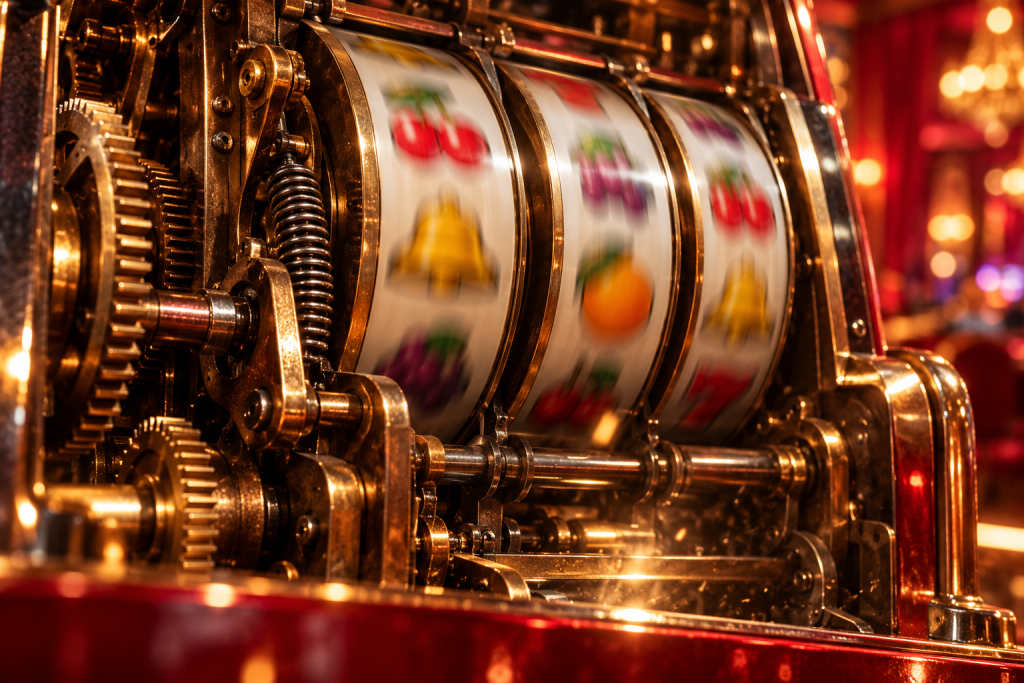
The machine you are picturing is mostly a cabinet
A mechanical slot machine is a device that turns a physical reel assembly with a spring-loaded handle and a set of internal stops. The reader who asks how one works is usually standing in front of either a preserved antique machine or a modern cabinet styled to look mechanical. The honest first answer is that the visible spinning reels are only one part of a larger mechanism, and the part that decides the outcome is not the part you watch.
This article explains the general mechanism shared by mechanical reel machines: how the reels are driven, how they stop, how the machine reads the result, and how a payout is triggered. It does not describe any specific manufacturer model, and it does not state payout percentages, reel strip layouts, or stop counts for any named venue or machine. Those figures are printed on the machine's own documents or held by the gaming authority where the machine is operated.
What a mechanical slot machine is
A mechanical slot machine is a gambling device in which the outcome is produced by physical reels that spin and stop under mechanical control. Each reel is a cylinder carrying a printed strip of symbols around its circumference. The reels are mounted on a common shaft or on separate shafts, and the player starts a play by pulling a handle or pressing a button that releases the mechanism.
The machine contains no computer in its pure mechanical form. The outcome is determined by where each reel physically stops, which is governed by the interaction of springs, gears, detents, and a braking or indexing system. Modern machines that look mechanical are usually electromechanical or fully digital, and they simulate this process with a random number generator. The distinction matters because the mechanical version has a finite, physical set of stopping positions, while the digital version can have a much larger virtual set.
The sequence from handle pull to stopped reels
When the player pulls the handle, a lever and cam assembly rotates the main drive shaft. This action tensions a spring or lifts a set of pawls that hold the reels in place. The reels are then free to spin, driven either by the initial impulse or by a separate motor in electromechanical versions. Each reel spins independently, and each has a set of notches or holes around its inner rim that correspond to the symbol positions on the outer strip.
As the reel spins, a spring-loaded indexing pin or kicker rides against the notched rim. When the reel's momentum falls below a threshold, the pin drops into the next available notch and locks the reel at that position. The order in which the reels stop is usually left to right, but the physical mechanism does not guarantee a uniform spin duration for every reel. Variations in spring tension, lubrication, and wear change how long each reel spins.
How the machine reads the result
Once all reels have stopped, the machine must determine whether the symbols on the payline form a winning combination. In a purely mechanical machine, this is done by a set of feeler pins or levers that press against the reel rims. Each symbol position has a corresponding hole or projection, and the pattern of holes tells the machine which symbol is showing on the payline.
This reading mechanism is connected to the payout slides or hopper. If the pattern matches a winning combination, the machine releases coins from a reserve tube or hopper. The number of coins released is set by the payout disc or payout cam, which is a physical template that rotates with the reels. The payout disc is one of the most important parts of the machine because it encodes the relationship between symbol combinations and coin amounts.
Where the house advantage sits in a mechanical machine
The house advantage in a mechanical slot machine is built into the physical layout of the reel strips and the payout disc. A reel strip has a fixed number of symbol positions, and not every symbol appears the same number of times. A high-paying symbol may appear once on a strip while a blank or low-paying symbol appears many times. The payout disc then awards less than the true odds of a combination would require for a break-even game.
The machine does not adapt, remember previous spins, or become due for a win. Each play is a separate mechanical event. The probability of any single combination is fixed by the physical construction of the reel strips and the number of stopping positions. The player cannot change these probabilities by pulling the handle harder, stopping the reels with a second button, or timing the pull.
| Component | Function | What it controls |
|---|---|---|
| Reel strip | Printed band of symbols around each reel | Which symbols can appear and how often |
| Indexing disc or notched rim | Ring with notches matching symbol positions | Where each reel can physically stop |
| Kicker or indexing pin | Spring-loaded part that drops into a notch | Locks the reel at one stopping position |
| Payout disc or cam | Template that rotates with the reel assembly | Which combinations release coins and how many |
| Feeler pins or levers | Read the reel position after stopping | Detect which symbols are on the payline |
Mechanical versus electromechanical versus digital
The term mechanical slot machine is often used loosely for any machine with physical reels. A true mechanical machine has no electronic components in the outcome path. An electromechanical machine uses motors to spin the reels and electrical switches to read the result, but the reels are still physical. A digital or video slot machine has no physical reels at all; it displays simulated reels on a screen and uses a random number generator to pick the outcome.
The difference matters for how the machine behaves. A true mechanical machine has a small, fixed number of stopping positions per reel, often around twenty, and the physical wear on the mechanism can change spin behaviour over time. A digital machine can have hundreds of virtual stopping positions per reel and is not affected by physical wear. The player cannot tell from the outside which type is inside a cabinet styled to look mechanical.
| Type | Reels | Outcome source | Stopping positions |
|---|---|---|---|
| Mechanical | Physical, driven by handle and springs | Physical stopping position of each reel | Fixed by notches on the reel rim |
| Electromechanical | Physical, driven by motors | Physical stopping position, read electrically | Fixed by notches or optical sensors |
| Digital or video | Simulated on screen | Random number generator | Virtual, often much larger set |
What a payout is
A payout on a mechanical slot machine is the release of coins or tokens from the machine's reserve. The machine holds a supply of coins in a hopper or tubes, and the payout mechanism pushes or drops the correct number into a tray. The number of coins for each winning combination is fixed by the payout disc and the machine's pay table, which is usually printed on the front glass or top box.
The pay table is the authoritative statement of what the machine pays for each combination. It is specific to that machine and that reel strip configuration. Two machines that look identical can have different pay tables if their reel strips or payout discs are different. The player should read the pay table on the machine before playing, because the same symbols can pay different amounts on different machines.
Why the odds are fixed and cannot be changed by play
The probability of any outcome on a mechanical slot machine is set by the physical construction of the reel strips and the number of stopping positions. If a reel has twenty stopping positions and a particular symbol appears once on the strip, the probability of that symbol landing on the payline is one in twenty for that reel. The probability of a combination across three reels is the product of the individual reel probabilities.
No method of play changes these probabilities. The handle pull does not influence where the reels stop beyond releasing the mechanism. Stopping the reels early with a button, where such a button exists, does not change the physical stopping position that the indexing system will select. The machine has no memory of previous outcomes, and the reels do not become more likely to show a particular symbol because it has not appeared recently.
What to confirm before you go
If you are planning to play a mechanical slot machine, the most useful things to confirm are the machine's pay table, the denomination, and whether the machine is a true mechanical device or a digital simulation. The pay table is printed on the machine itself and states the coin value, the winning combinations, and the payout for each. The denomination is also printed on the machine or shown on the screen.
The operating status and location of specific machines change, and this article does not state where any particular mechanical machine is currently installed. The venue's own floor staff or guest services desk can tell you which machines are on the floor and whether any are true mechanical devices. The gaming authority for the jurisdiction where the machine is operated publishes the rules that govern machine standards and payout requirements.
FAQ
Can a player influence where the reels stop on a mechanical slot machine?
No. The stopping position is set by the physical interaction of the reel's momentum, the spring tension, and the indexing pin or kicker. Pulling the handle harder or softer does not change the set of notches the pin can fall into, and the player cannot select a symbol. The outcome is fixed by the machine's construction, not by the player's action.
How does a mechanical machine know which symbols are showing?
The machine reads the reel position with feeler pins or levers that press against the reel rim. Each symbol position has a corresponding hole or projection, and the pattern of holes tells the payout mechanism which symbols are on the payline. The payout disc then compares that pattern with the winning combinations and releases the correct number of coins.
Why do two machines with the same symbols pay different amounts?
Because the pay table and reel strip configuration are specific to each machine. A symbol may appear more often on one reel strip than another, which changes the probability of each combination. The payout disc is also set differently. The printed pay table on the machine is the only reliable statement of what that machine pays.
Play responsibly
Gambling should be treated as paid entertainment, never as a way to earn income or recover losses. 1-800-MY-RESET (1-800-697-3738)
18+ or 21+ depending on where you are; follow the minimum age that applies to you.
This article is general information about how these mechanics work. It is not legal advice and not a recommendation to gamble or to use any particular operator. Availability and legality differ by jurisdiction — check the rules that apply where you are.