


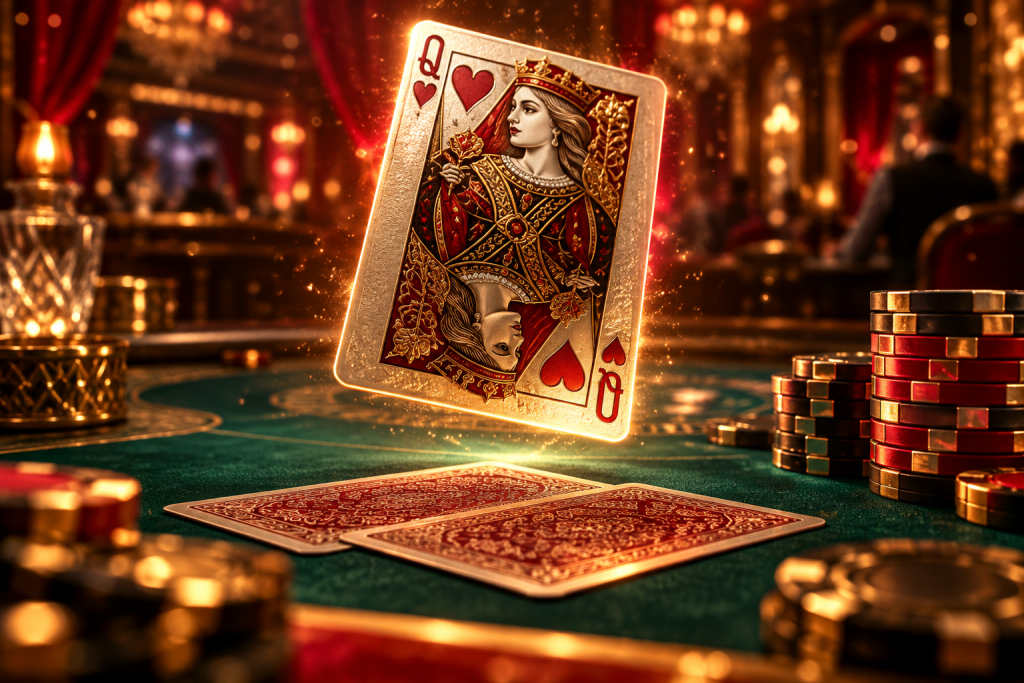
Why a Queen Is Worth Ten
You are sitting at the table, the dealer slides a queen across the felt, and for a second you are not sure what it does to your total. The answer is simple and fixed: a queen is worth 10 points. So is a king. So is a jack. In blackjack, every face card carries the same value, and that value never changes no matter what the dealer is showing or what you hold alongside it.
The only card with a flexible value is the ace, which counts as either 1 or 11 depending on which total keeps your hand alive. Every other card is static: 2 through 9 count at face value, and the three face cards plus the 10 all count as 10. A queen and a 6 is a 16. A queen and an ace is a natural blackjack, paid at the table's posted rate rather than played out as a normal hand.
What That Value Does Inside a Hand
Blackjack is a comparing game. Your objective is to finish with a hand total closer to 21 than the dealer's without going over. The queen's fixed 10-point value makes it one of the most common cards in the shoe, because four ranks out of thirteen—10, jack, queen, king—all behave identically. That density shapes nearly every decision you will make.
When you hold a queen and a low card, you are sitting on a total between 12 and 16, the range where the game gets uncomfortable. The queen gives you a strong starting number but leaves you vulnerable to busting if you draw another 10-value card. When you hold two queens, you have 20, the second-strongest hand in the game, and the correct play is almost always to stand and let the dealer try to beat it.
The queen's value also matters when the dealer shows one. A dealer queen means the dealer has 10, and your decisions shift accordingly. You know the dealer's hole card is more likely than not to be another 10-value card, which is why basic strategy tells you to hit a 16 against a dealer queen but stand on that same 16 against a dealer 6.
The Round, From Buy-In to Settlement
Before the cards matter, you need chips. You place cash on the table, never in the dealer's hand, and the dealer exchanges it for chips at the posted table minimum and maximum. You then place a bet in the betting circle before any cards are dealt.
The dealer gives each player two cards face up and takes two cards, one face up and one face down. If your first two cards total 21—a queen and an ace, for example—you have a natural blackjack and are paid immediately unless the dealer also has one. Otherwise, play proceeds around the table.
Each decision point is a choice about risk. You can hit to take another card, stand to keep your total, double down to take exactly one more card while doubling your wager, or split a pair into two separate hands. Some tables also offer surrender, which lets you forfeit half your bet and end the hand before playing it out. After all players act, the dealer reveals the hole card and follows a fixed rule, typically drawing to 16 and standing on 17, though the exact rule is printed on the table.
Settlement is immediate. Winning hands are paid at even money, a natural blackjack is paid at the table's posted rate, and losing bets are collected. The next round begins with a fresh bet.
How the House Edge Works on Each Bet
The queen's value does not change, but the house edge does change depending on how you play the hand it appears in. Blackjack is unusual among table games because the player's decisions affect the expected rate of loss. A player who follows a published basic-strategy chart for the exact rule set in use faces a different long-run cost than a player who guesses.
Basic strategy is not a system for winning. It is a set of mathematically derived decisions that minimise the house edge under a specific set of rules—how many decks are in the shoe, whether the dealer stands or hits on soft 17, whether doubling after splitting is allowed, and whether surrender is offered. The chart you memorise for one table may be wrong for the next table over.
| Decision point | What it means | What changes the correct play |
|---|---|---|
| Hit | Take another card | Your total, the dealer's upcard, and the rule set |
| Stand | Keep your current total | Same factors; standing on 16 against a 10 is correct, against a 6 it is not |
| Double down | Double the wager, take exactly one card | Allowed on any two cards or only certain totals, depending on the table |
| Split | Separate a pair into two hands | Which pairs may be split, and whether re-splitting or doubling after split is allowed |
| Surrender | Forfeit half the bet, end the hand | Offered at some tables, not others; late surrender is more common than early |
The queen appears in all of these decisions. A queen and a 5 is a 15, a hand you hit against a dealer 7 or higher but stand on against a dealer 2 through 6 under most rule sets. A pair of queens is a 20, and splitting it is a mistake because you are breaking up a near-certain winner for two weaker hands. The value is fixed; the correct response to it is not.
Where New Players Go Wrong
The first mistake is treating the queen as somehow different from a 10, a jack, or a king. It is not. All four cards are identical in blackjack, and thinking of them as separate ranks leads to hesitation and errors. A hand of queen-6 is a 16, exactly the same as 10-6 or king-6.
The second mistake is splitting a pair of queens. New players see two high cards and imagine two winning hands. In reality, 20 is the second-best total in the game, and splitting it creates two hands that each start at 10 with no guarantee of improvement. The only time splitting queens is defensible is never; the chart says stand, and the chart is right.
The third mistake is misunderstanding what a queen does to a soft hand. A queen and an ace is a blackjack, not a soft 11 or a soft 21. A queen and an ace and a 6, however, is a hard 17, because the ace can no longer count as 11 without busting. The presence of a 10-value card often turns a flexible soft hand into a rigid hard one, and the correct play changes with it.
What the Queen Cannot Do
No card value, including the queen's 10, changes the built-in edge of the game. Blackjack remains a negative-expectation game: over a very large number of hands, the house edge applies to every wager regardless of what you hold. The queen makes certain totals more common and certain decisions more frequent, but it does not make any hand a guaranteed winner.
Short-run results will swing. You will see a queen and a 2 lose to a dealer drawing to 21, and you will see a queen and a 6 win when the dealer busts. Those outcomes are variance, not a signal about the next hand. The only thing the queen guarantees is that your total is 10 higher than the other card you hold, nothing more.
FAQ
Is a queen worth 10 or 11 in blackjack?
A queen is worth exactly 10 points, never 11. Only the ace has a flexible value of 1 or 11, and every other card—including all face cards and the 10—has a single fixed value.
Does a queen and an ace always pay the same as any other blackjack?
A queen and an ace is a natural blackjack, the same as any ace paired with any 10-value card. The payout is set by the table rules, typically posted on the felt, and applies equally whether the 10-value card is a queen, king, jack, or 10.
Should I ever split a pair of queens?
Under published basic-strategy charts for standard rule sets, no. A pair of queens is a total of 20, the second-strongest hand in blackjack, and splitting it replaces a near-certain winner with two weaker starting hands. The exact chart for your table's rule set is the authority, but no common rule set recommends splitting queens.
Play responsibly
Gambling should be treated as paid entertainment, never as a way to earn income or recover losses. 1-800-MY-RESET (1-800-697-3738)
18+ or 21+ depending on where you are; follow the minimum age that applies to you.
This article is general information about how these mechanics work. It is not legal advice and not a recommendation to gamble or to use any particular operator. Availability and legality differ by jurisdiction — check the rules that apply where you are.