


The Wheel Decides the Frequency Before the Ball Drops
A player watching a roulette wheel might see green come up twice in ten spins, then not at all for the next hour. That unevenness is the whole point of the question. The frequency of green is not a rhythm the wheel falls into; it is a property of the wheel's physical layout, and every spin is a fresh sample from that layout.
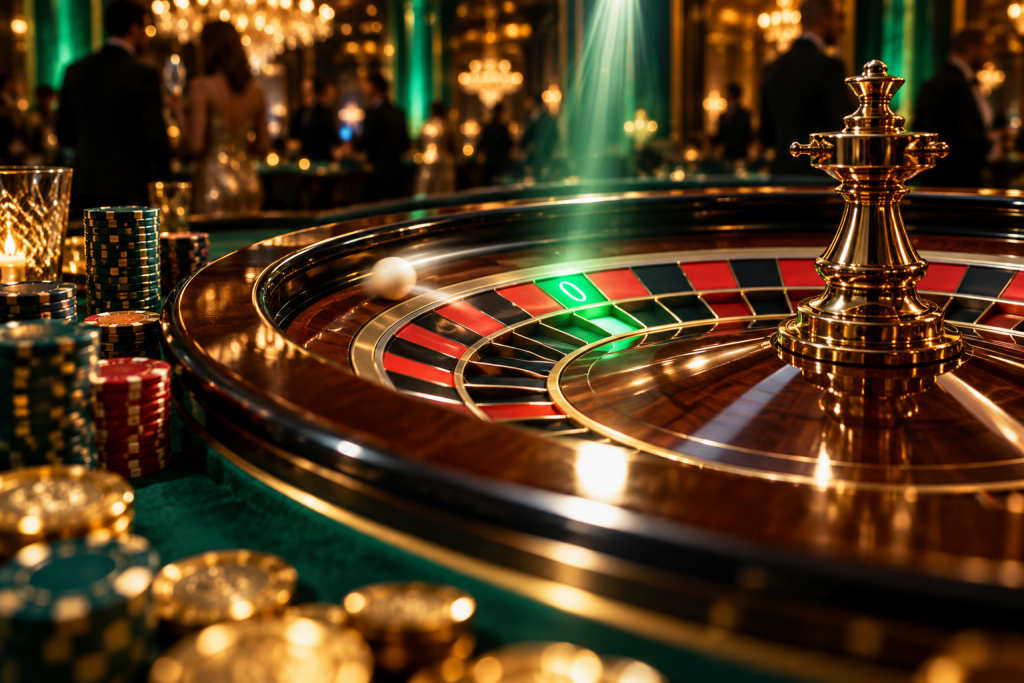
The wheel has a fixed number of pockets. A European wheel carries 37 pockets with a single zero. An American wheel carries 38 pockets with a single zero and a double zero. The green pockets are the zeros. On the European layout, one pocket in 37 is green. On the American layout, two pockets in 38 are green. That is the long-run frequency: the proportion of spins that would land on green if the wheel were spun an enormous number of times under fair conditions.
What a player experiences in a short session is something else. A proportion is not a schedule. The wheel does not owe anyone a green pocket after a run of reds and blacks, and a green pocket that just appeared does not make another one less likely on the next spin. Each spin is an independent trial against the same set of pockets.
Why the Green Pocket Is the House's Edge in Physical Form
Roulette's payouts are built around the non-zero numbers. A straight-up bet on a single number pays at odds that would be fair if the wheel had only the 36 numbered pockets and no zero. The green pocket is the extra outcome that breaks the symmetry. When the ball lands in zero, bets on red, black, odd, even, and most other outside wagers lose under standard rules. The zero does not belong to red or black, odd or even, high or low. It sits outside the categories players are paid on.
This is how the house edge is built into the game. The player is paid as though the wheel had fewer losing outcomes than it does. The operator's advantage comes from the gap between the payout and the true odds created by the green pocket. On a European wheel, the single zero creates that gap. On an American wheel, the double zero widens it, because there are now two pockets that defeat the standard outside bets while the payouts remain unchanged.
RTP and house edge are complements for the same bet under the same rule set. They sum to 100%. If a bet returns a certain percentage to players over the very long run, the house edge is the remainder. The green pocket is the mechanism that produces that remainder on the standard outside bets. It does not change from spin to spin; it is a fixed property of the wheel.
What a Short Session Looks Like Next to the Long-Run Average
The long-run frequency of green is a statistical average, not a per-session guarantee. Over a very large number of spins, the observed proportion of green outcomes will tend toward the wheel's layout proportion. Over a hundred spins, it can drift far from that proportion in either direction. That drift is variance.
Suppose, as an example, a player watches 100 spins on a European wheel. The layout would predict roughly one green pocket in every 37 spins on average, but a run of 100 spins could easily contain no green pockets at all, or five, or eight. None of those outcomes contradicts the wheel's design. They are all plausible draws from the same distribution. The player who sees no green for an hour has not found a wheel that never lands on green. The player who sees green four times in twenty spins has not found a wheel that lands on green too often. Both are seeing short-run variance around a fixed long-run proportion.
This is the core of expected value. The expected value of a bet is the average result per unit wagered over the very long run. It does not describe what happens on the next spin, or the next ten. A single spin has no average; it has one outcome. The house edge is a property of the bet, not a prediction of the next result.
How Decisions Per Hour Change Total Exposure
The house edge is expressed as a percentage of each wager. What it costs a player over time depends on how much is wagered in total. That total is the product of the stake per spin and the number of spins. A player who bets the same amount on every spin and plays fast will wager more in an hour than a player who plays slowly, and will therefore put more total money through the same edge.
Roulette is a fast game. A live table can complete many spins in an hour, and an online game can complete far more. The green pocket's effect is not felt as a single dramatic loss on most spins; it is felt as a slow leakage across many spins, because the player is paid slightly less than the true odds on every outside bet. The player who understands this can see why session length and spin rate matter as much as the bet size. A lower edge on a slower game can cost less in total than a higher edge on a fast one, because total exposure is what multiplies the edge.
No betting pattern changes this. A player who doubles a bet after a loss is not removing the green pocket from the wheel. The zero is still there on every spin, and the payout is still short of the true odds. A progression system redistributes outcomes: it creates many small wins and occasional large losses, or the reverse, depending on the pattern. It does not change the expected value of the underlying bets. The total expected loss across all spins is the sum of the expected losses on each individual spin, and each individual spin still carries the same edge.
Where the Numbers for a Specific Wheel Are Posted
The frequency of green on a given wheel is not a secret. It is determined by the wheel's layout, which is visible on the table or in the game's information panel. A European wheel shows one zero. An American wheel shows a zero and a double zero. The player can count the pockets and read the payout table to see how the zero is treated for each bet type.
The game information panel in an online roulette game typically states the wheel type and the theoretical return for the game. The table rules in a live venue state which bets lose on a zero and whether any special rule applies, such as a rule that returns half a stake on certain outside bets when the ball lands in zero. That rule changes the house edge on those specific bets, and the player should read it before assuming the standard edge applies.
What the player cannot get from the wheel is a prediction of the next spin. The layout gives the long-run proportion. The next spin is a single draw from that layout, and no amount of watching the previous spins changes the pockets on the wheel.
Comparing the Two Main Wheel Types
The difference between a European and an American wheel is the number of green pockets. That single difference changes the odds on every bet that loses on zero. The table below compares the two layouts on the points that matter for the green-pocket question.
| Feature | European wheel | American wheel |
|---|---|---|
| Total pockets | 37 | 38 |
| Green pockets | 1 (single zero) | 2 (single and double zero) |
| Proportion of green pockets | 1 in 37 | 2 in 38 |
| Effect on outside bets | Zero defeats red, black, odd, even, high, low under standard rules | Both zeros defeat those bets under standard rules |
| House edge on standard outside bets | Lower, because fewer pockets defeat the bet | Higher, because an extra pocket defeats the bet |
The table shows the structural difference, not a prediction. A player facing an American wheel is playing against a layout with one more losing pocket on the standard outside bets. That does not make the next spin more or less likely to land on green; it makes the long-run proportion of green outcomes higher than on a European wheel.
What the Player Controls
The player does not control where the ball lands. The player controls which bets to place, how much to stake, how many spins to play, and when to stop. Those choices determine total exposure, which is what the house edge multiplies.
Bet selection matters because different bets on the same table carry different edges. A straight-up bet on a single number has a different expected value from an outside bet on red, because the payout and the true odds differ. The green pocket affects them differently. A player who wants to understand the cost of a session should compare the edge on the specific bets they intend to place, not assume every bet on the table carries the same edge.
Stopping rules matter because the edge is applied per spin. A player who sets a fixed number of spins or a fixed loss limit before sitting down has bounded their total exposure. A player who keeps playing to recover a loss has increased it. The wheel does not know the player is chasing; the green pocket is still there on every spin, and the expected loss on each additional spin is unchanged.
FAQ
Does the green pocket come up more often after a long run of reds and blacks?
No. Each spin is an independent trial against the same wheel layout. The previous spins do not change the number of green pockets on the wheel, and the wheel has no memory. A long run of reds and blacks makes a green outcome neither more nor less likely on the next spin.
Is the green pocket the only reason the house has an edge in roulette?
For the standard outside bets, the green pocket is the main mechanism. The payouts are set as though the zero did not exist, and the zero defeats those bets. On inside bets, the edge comes from the gap between the payout and the true odds for the specific bet, which is also shaped by the wheel's total number of pockets. Different bets carry different edges.
Can I use the frequency of green to choose a better roulette table?
You can use the wheel type to compare the long-run edge on the bets you plan to place, because an American wheel has an extra green pocket that defeats standard outside bets. You cannot use the recent frequency of green on a given table to predict the next spin. The layout is a fixed property; the recent results are variance.
Gamble responsibly. If you or someone you know has a gambling problem, call the helpline printed in the footer below.
Play responsibly
Gambling should be treated as paid entertainment, never as a way to earn income or recover losses. 1-800-MY-RESET (1-800-697-3738)
18+ or 21+ depending on where you are; follow the minimum age that applies to you.
This article is general information about how these mechanics work. It is not legal advice and not a recommendation to gamble or to use any particular operator. Availability and legality differ by jurisdiction — check the rules that apply where you are.