


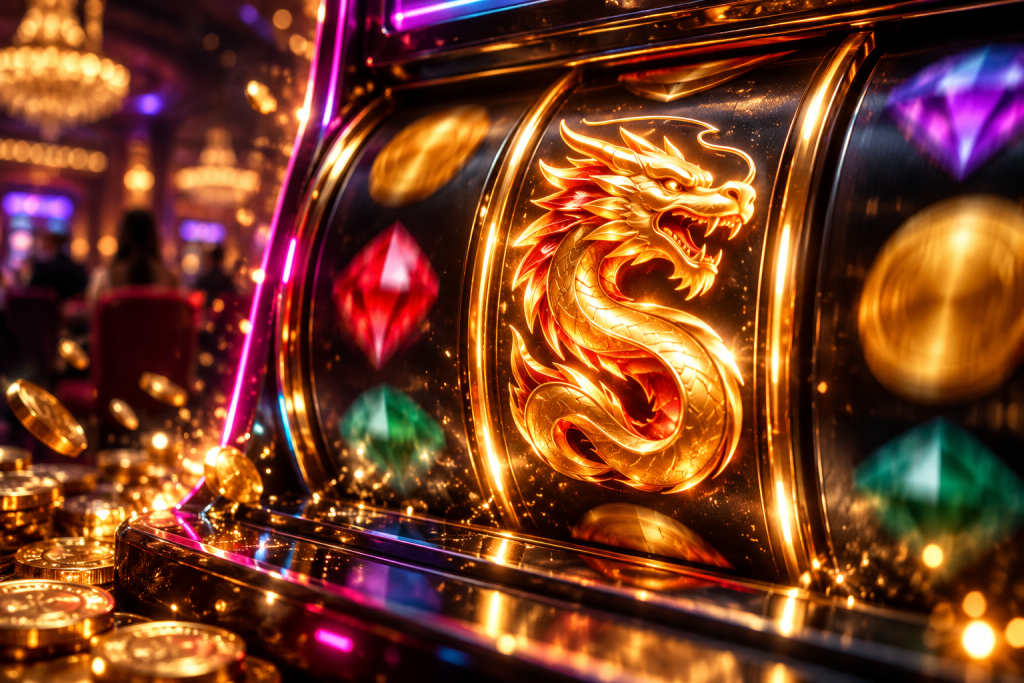
Start with the reel strip, not the sketchbook
A character symbol on a slot machine is not simply a piece of art. It is a graphic assigned to one or more positions on a virtual reel strip, and every position carries a weight inside the game's random number generator. The moment the player presses spin, the RNG selects numbers that map to reel positions. The symbol you design is the visual label for some of those positions. If you design the art first and attach it to the maths later, you are designing a logo, not a slot symbol.
The practical starting point is the reel map. A modern slot is a set of virtual reels, each a long list of positions. A character symbol may appear once on a reel, several times, or on only some reels. Its frequency on the strip determines how often it can land, and its placement relative to other symbols determines which combinations are possible. The same character artwork can be used for a high-paying symbol that appears rarely or a low-paying symbol that appears often; the art does not decide that, the strip does.
What the RNG does with your symbol
A random number generator is the algorithm that determines game outcomes. It produces numbers continuously, and each spin is a snapshot of numbers that get mapped to reel positions. Your character symbol is one of the possible outcomes at certain positions. The RNG does not know what the symbol looks like, what it is named, or whether it is a character, a fruit, or a gem. It only knows positions and weights.
This matters for design because the symbol must read clearly at the size it will appear, in the position it will occupy, and next to the symbols it will sit beside. A character symbol that looks wonderful as a full-screen illustration may become unreadable when it is one of fifteen symbols on a five-by-three grid. The design constraint is legibility at reel-cell size, not beauty at poster size.
Independent testing laboratories are commonly used to certify RNG behaviour. Certification covers game mechanics, not an operator's financial conduct. From a designer's perspective, that means the symbol artwork is not what gets certified; the mapping, weighting, and outcome distribution are.
Paylines versus ways-to-win change the symbol's job
A payline is a fixed pattern across reels that produces a paying combination. A ways-to-win format pays on adjacent-symbol combinations instead of fixed lines. Your character symbol behaves differently in each system, and the design should reflect that.
| Design consideration | Fixed paylines | Ways-to-win |
|---|---|---|
| Where the symbol must read | On the specific line pattern only | On any adjacent reel position |
| Visual emphasis | Can be stronger, since line hits are explicit | Needs to read clearly in many positions at once |
| Symbol frequency on the strip | Often tuned per line | Often tuned per reel |
| Player expectation of the character | Appears as part of a line story | Appears as part of a cluster or adjacency story |
In a fixed-payline game, the character symbol may be the hero that completes a line. In a ways-to-win game, the same character may need to work as one element in a row of adjacent symbols. The art direction should account for how often the character appears alongside copies of itself.
Volatility decides how the character feels, not what it returns
Volatility, also called variance, describes how payouts are distributed over time. High volatility means rarer but larger payouts; low volatility means more frequent but smaller ones. Volatility does not change a game's RTP. Your character symbol can be the rare, high-paying anchor of a high-volatility game, or a frequent, modest-paying symbol in a low-volatility game. The same artwork can serve either role, but the player's emotional relationship to the character will differ.
If the character symbol is rare and pays heavily, players will learn to watch for it. The design should make it instantly distinguishable from the other symbols, even in peripheral vision. If the character is common and pays modestly, it should feel friendly and familiar, part of the game's texture rather than its climax. Neither choice changes the programmed return; both choices change how the game is experienced.
Fixed and progressive jackpots attach to symbols differently
Some character symbols are tied to jackpots. Fixed jackpots pay a set amount. Progressive jackpots grow from a share of qualifying wagers and reset after a win. Progressive contributions are typically taken out of the game's return, and some progressives require a maximum-stake bet to qualify. If your character symbol is the jackpot trigger, the design must communicate that role without promising an outcome.
| Jackpot type | What the symbol represents | Design implication |
|---|---|---|
| Fixed jackpot | A set payout amount | Symbol can carry a fixed value label or colour code |
| Progressive jackpot | A growing prize pool | Symbol should feel rare and event-like, but the amount is usually shown in a separate meter |
| No jackpot | A standard paying symbol | Symbol competes on clarity with all other symbols |
The jackpot amount itself is not part of the symbol design. The symbol marks the trigger; the meter or information panel carries the number. A designer who puts a specific jackpot figure inside the symbol artwork creates a maintenance problem, because the figure changes.
Read the paytable before finalising any character
The paytable is the document that states what each symbol pays, in what combinations, and under what rules. A character symbol design is not finished until it has been checked against the paytable. The paytable tells you whether the character is a scatter, a wild, a bonus trigger, or a standard paying symbol. Each role changes the design requirements.
A scatter may need to read as a special event, often with its own animation. A wild may need to visually replace other symbols without confusing the player about what it is substituting for. A bonus trigger may need to feel like a door opening. A standard paying symbol may need to recede slightly so the special symbols stand out. The paytable also tells you the symbol's payout values, which should influence how prominent the character is in the hierarchy.
The game's own information panel is where the player sees the RTP, the volatility description, and the rules for the specific title. The symbol design should not contradict what that panel says. If the panel describes a high-volatility game, the character should not look like a cosy low-stakes mascot. If the panel describes a fixed-payline game, the character should not imply ways-to-win adjacency.
What stake size does and does not change
Stake size changes the amount wagered per spin, and therefore the absolute size of any payout that occurs. It does not change the RTP, the volatility profile, or the probability of the character symbol landing. A player who increases the stake is not making the character more likely to appear. A player who decreases the stake is not making it less likely. The reel weights are fixed in the game's maths; the stake is a multiplier applied to the outcome.
For a designer, this means the character symbol should not visually imply that a higher stake makes it more attainable. The art should not suggest that the character is "closer" or "more likely" at certain stakes. The character is a fixed part of the reel map, and the stake is a separate decision the player makes before the spin.
No play pattern alters the programmed return
A slot machine's return to player is a theoretical percentage of total wagered money a game returns to players over a very large number of spins or hands. It is a long-run statistical average, not a per-session guarantee. No betting pattern, no stop-and-start rhythm, no stake adjustment, and no symbol-watching strategy changes that programmed return. The character symbol you design is part of a fixed mathematical model. Players can choose when to spin and how much to stake, but they cannot choose the distribution of outcomes.
This is worth stating plainly because it shapes the design brief. The character symbol is not a tool the player can use to win. It is a visual marker for a set of positions on a reel strip, each with a fixed probability. The design should be honest about that. The character can be exciting, charming, mysterious, or funny, but it should not imply control the player does not have.
FAQ
Does a character symbol need to be unique across all slots?
No. Operators and studios reuse visual themes and character archetypes across many titles. What must be unique is the mapping: the same character art can appear in different games with different reel weights, paytable values, and volatility profiles. The symbol is a graphic asset; the game is the mathematical model around it.
Can a character symbol be both a wild and a jackpot trigger?
That depends on the game's rules. Some titles assign multiple roles to one symbol, while others keep roles separate to avoid player confusion. The paytable states what each symbol does in that specific game. If a character is both a wild and a jackpot trigger, the design must make both roles legible without one overwhelming the other.
How do I know if my character symbol reads well at reel size?
Test it at the smallest size it will appear, next to the symbols it will sit beside, on the background it will sit on. If the silhouette, colour, and key features are still distinguishable at that size, the symbol works. If it needs full-screen detail to be understood, it is an illustration, not a reel symbol.
Play responsibly
Gambling should be treated as paid entertainment, never as a way to earn income or recover losses. 1-800-MY-RESET (1-800-697-3738)
18+ or 21+ depending on where you are; follow the minimum age that applies to you.
This article is general information about how these mechanics work. It is not legal advice and not a recommendation to gamble or to use any particular operator. Availability and legality differ by jurisdiction — check the rules that apply where you are.