


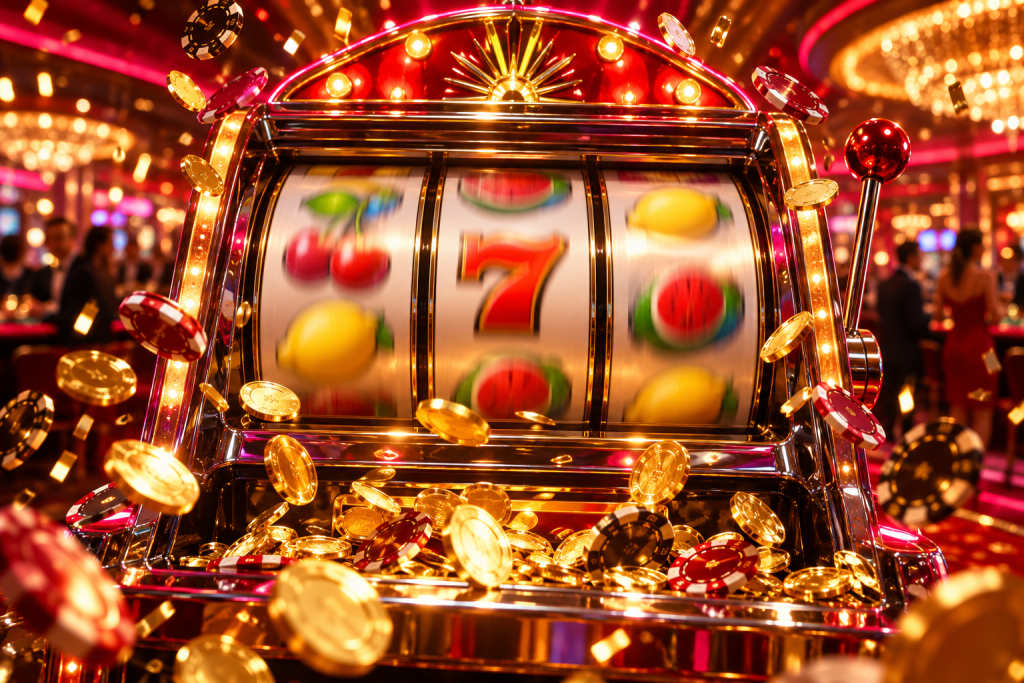
What happens between pressing spin and seeing cherries
A fruit slot looks simple: press a button, watch reels spin, see if symbols line up. The part that surprises most new players is that the outcome is already fixed before the reels stop moving. The spin animation is a presentation layer. Underneath it, a random number generator has already selected the result.
The RNG produces numbers continuously, even when nobody is playing. When you press spin, the game takes the next number in that stream and maps it to a reel position. Each position on each reel corresponds to a range of numbers. The mapping is fixed in the game's programming, so the same number always produces the same symbol on the same reel. What you watch on screen is the game slowing down to show you the position that was already chosen.
This matters because it means there is no timing skill, no stopping the reels at the right moment, and no pattern you can read from previous spins. Each spin is independent. A machine that has not paid for an hour is not closer to paying now. The RNG does not remember what it did before.
Fruit symbols and how a win is counted
Fruit slots borrow their symbols from the old mechanical machines: cherries, lemons, oranges, plums, bells, bars and sevens. Each symbol carries a different payout value, and the paytable lists every winning combination the game recognises. A win is not just any three matching symbols. It is a specific combination on a specific payline, or in a specific pattern under a ways-to-win format.
There are two main formats, and they work differently enough that you should check which one a game uses before you spin.
| Format | How a win is formed | What you control |
|---|---|---|
| Fixed paylines | A paying combination must land on one of the game's printed lines, which run across the reels in set patterns. | You usually bet on all lines at once; the stake per line is what changes when you adjust your bet. |
| Ways-to-win | Matching symbols on adjacent reels pay regardless of their exact row position, often from left to right. | You bet a single amount per spin; the number of ways is fixed by the reel layout. |
On a fixed-payline fruit slot, the game requires you to wager on every line. The paytable shows a diagram of each line so you can see exactly where a cherry or a bell has to land for the combination to count. On a ways-to-win game, the paytable instead tells you how many ways the layout produces and what adjacent-symbol combinations pay.
Scatter symbols, when a fruit slot has them, are the exception to the line rule: they usually pay or trigger a feature from any position. Wild symbols substitute for other symbols to complete a line. Not every fruit slot has either, and the paytable states which symbols act in which way.
Reading the information panel and paytable
Every modern slot carries two documents inside the game itself. The paytable is the long list of symbol values, line diagrams, feature rules and jackpot conditions. The information panel, usually opened with a small "i" or gear icon, holds the technical details: the return to player percentage, the volatility setting where the maker publishes one, and the rules that govern the bonus features.
Return to Player is a theoretical percentage of total wagered money a game returns to players over a very large number of spins or hands. It is a long-run statistical average, not a per-session guarantee. A game's RTP and its house edge are complements: they sum to 100% for the same game. If the information panel states an RTP, the house edge is simply the remainder. If it does not state one, the operator's game page or help section usually carries it.
Volatility, sometimes labelled variance, describes how payouts are distributed over time. High volatility means rarer but larger payouts; low volatility means more frequent but smaller ones. Volatility does not change a game's RTP. Two fruit slots can carry the same published return while one pays small amounts often and the other stays quiet for long stretches before a large hit. The information panel is where you check which behaviour a particular game is built for.
Fixed and progressive jackpots on fruit slots
Some fruit slots top the paytable with a jackpot. There are two structures, and they behave very differently.
| Jackpot type | How the prize is funded | What changes as you play |
|---|---|---|
| Fixed | A set amount printed in the paytable, paid when the required combination lands. | Nothing. The prize is the same on every spin. |
| Progressive | A share of qualifying wagers is added to a pool that grows until someone wins it, then resets. | The displayed prize rises over time. Progressive contributions are typically taken out of the game's return. |
A progressive fruit slot usually requires a specific combination, often tied to a maximum-stake bet, to qualify for the top prize. The paytable states this plainly. If you are not betting at the qualifying level, you are playing the base game but not the full jackpot feature. Some progressives are local to one game, while others pool across many machines, but the principle is the same: every qualifying wager feeds the displayed total, and the prize resets after a win.
Fixed jackpots are simpler. The amount is part of the paytable, and hitting the required combination pays exactly that sum regardless of how long the machine has been running or how much has been wagered on it.
What stake size and spin speed do and do not change
Your stake sets the size of each win relative to the paytable. A combination listed as paying a certain multiple of the line bet returns more in absolute terms when the line bet is larger, and less when it is smaller. That is the entire relationship between stake and outcome. The stake does not alter which numbers the RNG produces, does not change the probability of any symbol landing, and does not make a bonus round more likely to trigger.
Spin speed works the same way. Using a fast-spin or turbo setting shortens the animation but does not change the RNG stream or the mapping. You will see more spins per hour, which means more decisions per hour against the same house edge. The expected loss over a session is a function of total wagered, not of how quickly you wager it, but a faster pace compresses the same amount of play into less time. If you want a session to last longer, the lever you control is total wager per hour, not the spin button's speed setting.
No play pattern alters the programmed return. Stopping the reels manually, changing stake after a win, moving to a different machine, or waiting for a machine to go quiet all leave the underlying mathematics unchanged. A fruit slot is a negative-expectation game on every spin, and the RTP is a statement about the very long run, not about what the next ten spins will do.
How to approach a fruit slot you have never seen before
Open the paytable first. Check the line format, note which symbols pay the most, and find the feature rules. Then open the information panel and read the RTP and volatility. Those two numbers together tell you more about what a session will feel like than any review or forum post.
Set a session limit before you spin, in an amount you are prepared to lose. Fruit slots are built for pace, and the gap between spins is short enough that a session can consume a bankroll quickly. The limit is yours to set; the game will not enforce it for you.
If a game offers a progressive jackpot, read the qualifying conditions before you assume you are eligible. If it offers free spins or a bonus round, the paytable states whether winnings from those features are credited as withdrawable cash or as bonus funds subject to wagering requirements. That distinction determines whether a feature win can leave your account.
FAQ
Do fruit slots pay out more after a long losing streak?
No. Each spin is independent, and the RNG does not track previous outcomes. A machine that has just paid a jackpot and a machine that has been quiet for an hour have the same probability distribution on the next spin. The idea that a machine is due is a misreading of how random processes behave in the short run.
What is the difference between a fruit slot's RTP and its volatility?
RTP is the theoretical long-run return, expressed as a percentage of total wagers. Volatility describes the shape of the payout distribution: how often wins arrive and how large they tend to be. Two games can share the same RTP while one pays small frequent wins and the other pays rare large ones. Neither setting makes one game better at returning money over the long run.
Can I tell when a fruit slot is about to hit a bonus round?
No. Bonus triggers are determined by the same RNG mapping as every other outcome. The reels, the sounds and the near-miss animations are presentation. Nothing visible on screen before a spin tells you what the next result will be, and no betting pattern changes the probability of a feature triggering.
Play responsibly
Gambling should be treated as paid entertainment, never as a way to earn income or recover losses. 1-800-MY-RESET (1-800-697-3738)
18+ or 21+ depending on where you are; follow the minimum age that applies to you.
This article is general information about how these mechanics work. It is not legal advice and not a recommendation to gamble or to use any particular operator. Availability and legality differ by jurisdiction — check the rules that apply where you are.