


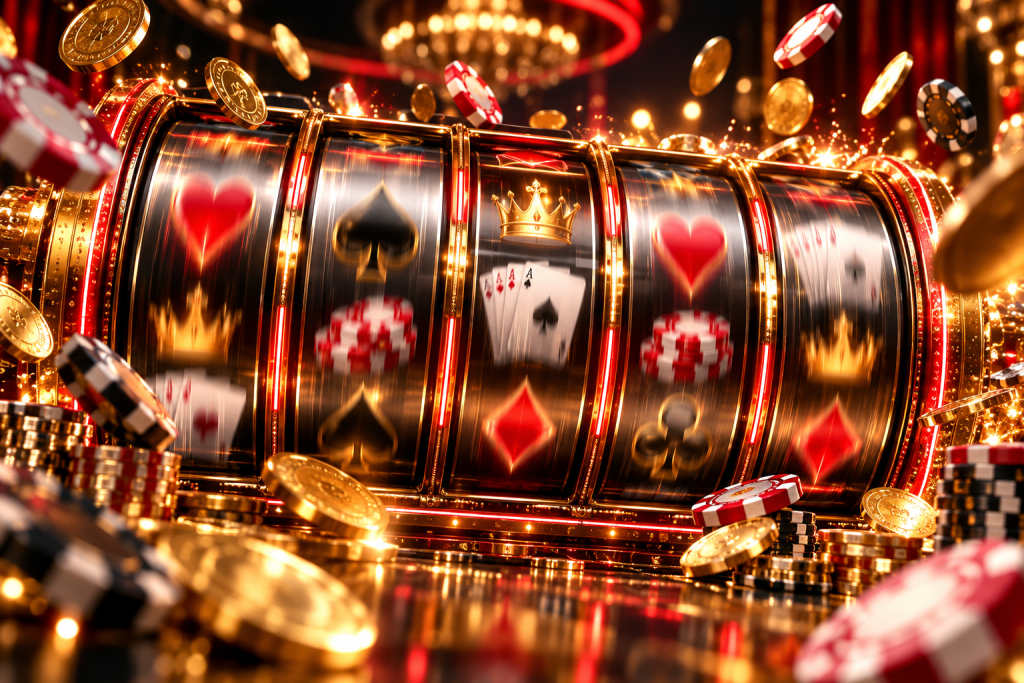
The Spin Decides First, the Cards Are Just a Display
You press the button and five reels blur past. A few seconds later they stop on a row of card symbols: a pair of jacks, a king, an ace, maybe a ten. It looks like a poker hand, and the machine pays you according to poker rankings. But the machine did not deal you cards. It generated a random number, mapped that number to a set of reel positions, and only then drew the symbols you see. The poker hand is a presentation of an outcome that was already fixed the moment the spin began.
This matters because it changes how you should read the game. In a live poker game, you make decisions after seeing your cards. In a poker-themed slot, you make exactly one decision: how much to stake and when to press spin. Everything after that is the machine resolving a predetermined result and dressing it up as a hand of cards.
What the RNG Does on Every Spin
A random number generator (RNG) is the algorithm that determines game outcomes. It runs continuously, producing numbers at a rate far faster than anyone can press a button. When you hit spin, the game samples the RNG at that exact moment. The number it pulls is then translated, through a process called reel mapping, into a stopping position for each reel.
Independent testing laboratories are commonly used to certify RNG behaviour. That certification covers game mechanics, not an operator's financial conduct. What it means in practice is that the mapping from random number to reel position is designed to be uniform: every stopping position on every reel has the same chance of being selected as any other. The symbols on the reels are weighted by how often they appear on each reel strip, which is what creates the odds of landing any particular combination.
Nothing you do before the spin changes the number that gets sampled. The machine does not remember that you have lost eight spins in a row. It does not become due for a win. Each spin is an independent event, and the RNG has no memory of the last one.
Paylines Versus Ways-to-Win in Poker Slots
Poker slots come in two structural families, and the difference determines how a winning combination is even defined. A fixed-payline game requires betting all lines. A ways-to-win format pays on adjacent-symbol combinations instead of fixed lines. The table below lays out what changes between them.
| Feature | Fixed Paylines | Ways-to-Win |
|---|---|---|
| How a win is formed | Symbols must land on a specific printed line | Matching symbols on adjacent reels, starting from the leftmost, pay regardless of position |
| Number of bet lines | Fixed; all lines are active on every spin | No lines; the number of ways is calculated from reel heights |
| What the paytable shows | A line-by-line payout schedule | A symbol-value schedule multiplied by ways hit |
| Stake structure | Total bet is line bet multiplied by line count | Total bet is a single amount covering all ways |
| How poker hands appear | Hands must align on an active line | Hands can be formed by symbols in any row across adjacent reels |
In a poker slot, the symbols themselves carry the poker rankings. A pair of jacks might pay a small multiple of your line bet, two pair a bit more, three of a kind more again, and a royal flush the top fixed prize. The game does not use a 52-card deck in the way a table game does. The reels are populated with card symbols according to a reel strip layout, and the frequency of each symbol on that strip is what sets the odds of completing any poker hand.
Reading the Paytable and Information Panel
Every poker slot carries two documents inside the game client: the paytable and the information panel. The paytable lists every paying combination, how many of each symbol it takes to trigger a payout, and what that payout is expressed as. The information panel carries the game's rules, its return to player (RTP) figure where the operator publishes one, and the volatility description if the studio provides it.
Return to Player (RTP) is a theoretical percentage of total wagered money a game returns to players over a very large number of spins or hands. It is a long-run statistical average, not a per-session guarantee. House edge is the mathematical advantage the operator holds on a given game, expressed as a percentage of each wager. House edge and RTP are complements: they sum to 100% for the same game. If a poker slot publishes an RTP, that means the house edge on that game, under its specific rule set, is the remainder of the return. It does not mean you will get back the same small fraction of what you put in tonight.
The paytable tells you what each poker hand is worth. A typical layout lists the hands from highest to lowest: royal flush, straight flush, four of a kind, full house, flush, straight, three of a kind, two pair, and a high pair such as jacks or better. The payout for each is shown as a multiple of your stake. The key thing to check is whether the game pays on any pair or only on jacks or better, because that single rule changes how often a winning spin occurs.
Volatility Decides the Rhythm, Not the Return
Volatility, also called variance, describes how payouts are distributed over time. High volatility means rarer but larger payouts; low volatility means more frequent but smaller ones. Volatility does not change a game's RTP. A high-volatility poker slot and a low-volatility poker slot can both publish the same RTP, but they will feel completely different to play.
A low-volatility poker slot pays small amounts often. You will see pairs and two-pair hits regularly, and your balance will drift downward slowly. A high-volatility version pays almost nothing for long stretches, then delivers a four of a kind or a straight flush that resets the session. Neither version is better at returning money. They are different rhythms for different bankroll preferences, and the information panel is where the studio usually states which one you are looking at.
Stake size changes the absolute amounts at risk and the absolute amounts won, but it does not change the probability of any outcome. Betting twice as much per spin doubles the size of every payout and every loss. It does not make a royal flush more likely to appear. The RNG and reel mapping are identical at every stake level.
Fixed and Progressive Jackpots in Poker Slots
Some poker slots include a jackpot layer on top of the standard poker-hand payouts. Fixed jackpots pay a set amount. Progressive jackpots grow from a share of qualifying wagers and reset after a win. The table below separates the two formats.
| Feature | Fixed Jackpot | Progressive Jackpot |
|---|---|---|
| Prize amount | Set and printed in the paytable | Grows with qualifying wagers until won |
| Funding source | Built into the game's standard return | Contributions are typically taken out of the game's return |
| Qualifying condition | Usually a specific hand at any stake | Some progressives require a maximum-stake bet to qualify |
| Reset behaviour | No reset; prize stays constant | Resets to a seed amount after a win |
| Where the terms are stated | Paytable | Jackpot rules screen and information panel |
If a poker slot carries a progressive, read the jackpot rules screen before you play. The key question is whether you must bet the maximum stake to be eligible for the progressive prize. On some games a non-maximum bet still pays the fixed poker-hand schedule but cannot trigger the progressive. On others the progressive is available at any stake. The rules screen states this explicitly, and it is the only place where the condition is defined for that specific game.
Free Play Uses the Same Resolution Path
When you play a poker slot in free or demo mode, the game resolves outcomes through the same RNG and reel mapping as the real-money version. The only difference is that the stake is virtual and no withdrawal is possible. That makes free play a useful way to read a paytable, understand how often the game pays, and see what volatility feels like over a few hundred spins without risking money.
What free play cannot tell you is how a session will go when real money is on the line. The RNG does not behave differently, but your perception of it will. A run of twenty dead spins is easy to ignore in demo mode and much harder to sit through when your balance is falling. Free play is a learning tool for mechanics, not a predictor of results.
No play pattern alters the programmed return. Holding the button longer, stopping the reels manually where the game allows it, changing your stake between spins, or switching between free and paid mode does not change the RNG, the reel mapping, or the house edge. Those actions change only how you experience the game.
FAQ
Do poker slots use a real deck of cards?
No. The card symbols are printed on reel strips, and the frequency of each symbol on those strips is what sets the odds of completing a poker hand. The game is a slot with poker-themed symbols, not a card game with a shuffled deck.
Can I win real money from a free poker slot?
Free play uses virtual credits and has no withdrawal path. Some operators grant no-deposit bonuses or free spins that carry wagering requirements and maximum-cashout caps, but a pure demo mode pays nothing withdrawable.
Does betting max increase my chances on a poker slot?
Betting max increases the absolute size of every payout and every loss, but it does not change the probability of any outcome. The exception is a progressive jackpot that explicitly requires a maximum-stake bet to qualify, which the jackpot rules screen will state.
Play responsibly
Gambling should be treated as paid entertainment, never as a way to earn income or recover losses. 1-800-MY-RESET (1-800-697-3738)
18+ or 21+ depending on where you are; follow the minimum age that applies to you.
This article is general information about how these mechanics work. It is not legal advice and not a recommendation to gamble or to use any particular operator. Availability and legality differ by jurisdiction — check the rules that apply where you are.