


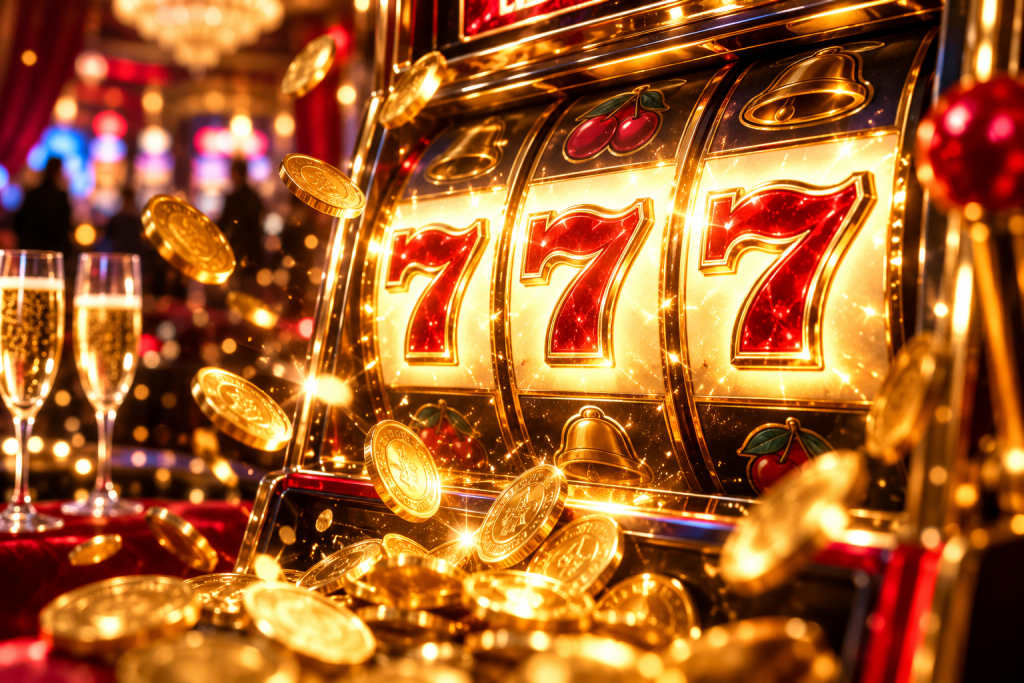
The outcome is fixed before the reels finish spinning
When you press the spin button on a slot machine, the animation you watch is a presentation of a decision that has already been made. The random number generator inside the game has produced a value, and that value has been mapped to a reel position. The spinning reels, the near-miss symbols that land just above or below the payline, and the sounds that accompany them are all part of how the result is displayed, not part of how it is chosen.
This is the single most important thing to understand about any slot game, including a classic title like Top Dollar. Nothing you do after the spin begins changes the outcome. The speed at which you press the button, the force of your tap, the time of day, the size of your previous bet, and whether you stopped the reels manually are all irrelevant to the result. The machine is not building toward a win, and it is not recovering from a loss.
What the random number generator does
A slot machine's random number generator is an algorithm that produces values continuously, even when nobody is playing. When you press spin, the game samples the current value and uses it to determine where each reel stops. The process is designed so that each spin is independent of the one before it and the one after it.
Independence matters because it defeats the most common intuition players bring to a machine. A slot that has not paid out in an hour is not due for a win. A slot that just paid a jackpot is not cold. Each spin is a fresh event drawn from the same set of probabilities. The machine does not remember what happened before, and it does not owe anyone anything.
Independent testing laboratories are commonly used to certify RNG behaviour. That certification covers game mechanics, not an operator's financial conduct, and it does not mean a machine is more likely to pay. It means the randomness is working as designed.
How the paytable defines the game
The paytable is the document that tells you what any combination of symbols is worth. It is usually accessible from a button on the game screen, often labelled "info," "paytable," or "help." Reading it before you play answers most of the questions players ask about a specific title.
The paytable shows you the symbol values, the payline patterns, and the rules for special symbols like wilds and scatters. It also states the minimum and maximum bet, and it explains whether the game uses fixed paylines or a ways-to-win format. Fixed-payline games require betting all lines; ways-to-win formats pay on adjacent-symbol combinations instead of fixed lines.
What the paytable does not show you is the probability of any symbol landing. A symbol that pays a large multiple is not necessarily rarer than one that pays a small multiple, and the paytable alone does not tell you how often a bonus round triggers. That information is embedded in the game's maths, and it is not published on the screen.
Volatility changes the shape of a session, not the return
Volatility, also called variance, describes how payouts are distributed over time. High volatility means rarer but larger payouts; low volatility means more frequent but smaller ones. A high-volatility game can go through long stretches of small or zero wins and then produce a large payout. A low-volatility game tends to return smaller amounts more regularly.
Volatility does not change a game's RTP. Return to Player is a theoretical percentage of total wagered money a game returns to players over a very large number of spins. It is a long-run statistical average, not a per-session guarantee. A high-volatility game and a low-volatility game can have the same RTP and feel completely different to play.
Your stake size also does not change the programmed return. Betting more per spin increases the amount you can win or lose on that spin, but it does not make a win more likely. The only thing stake size changes is how quickly your bankroll moves through the game.
| What it is | What it changes | What it does not change |
|---|---|---|
| Volatility | How often wins tend to occur and how large they tend to be | The long-run return percentage |
| Stake size | The amount won or lost per spin | The probability of any given outcome |
| Paytable | What each combination pays | The underlying frequency of combinations |
| RNG | Which outcome occurs on each spin | The house edge built into the game |
Fixed and progressive jackpots on a Top Dollar-style game
Jackpot types matter because they change what you are playing for. Fixed jackpots pay a set amount. Progressive jackpots grow from a share of qualifying wagers and reset after a win. A game like Top Dollar typically presents a top prize that is fixed, but the same title can appear in different formats depending on where it is installed.
Progressive contributions are typically taken out of the game's return. That means a portion of each wager funds the growing jackpot rather than the regular paytable. Some progressives require a maximum-stake bet to qualify for the top prize. If you are playing a progressive version of a game, the paytable or a separate jackpot panel will state whether your current bet qualifies.
When a progressive jackpot grows large, the game's return does not become favourable in the short run. The probability of hitting the top prize is unchanged. What changes is the size of the prize if it hits.
What the information panel tells you
Most modern slot games include an information panel that goes beyond the basic paytable. It usually contains the game rules, the payline diagrams, the bonus trigger conditions, and sometimes the theoretical return percentage for that specific title. Where a return figure is published, it applies to the game as configured, not to your session.
The panel is also where you will find the game's denomination and the total bet per spin. On a multi-denomination machine, the total bet is the denomination multiplied by the number of credits per line and the number of lines. A game that looks like it costs one credit per spin may be wagering several credits per line across many lines.
If the panel does not show a return percentage, that does not mean the game is hiding something. Publication practices vary by operator and jurisdiction, and the absence of a figure on screen does not change the maths underneath.
Why no play pattern alters the programmed return
Every slot game is built with a house edge. House edge is the mathematical advantage the operator holds on a given game, expressed as a percentage of each wager. House edge and RTP are complements: they sum to 100% for the same game. That edge is built into the probabilities of the symbol combinations, and it is the same on every spin, regardless of what you do.
Betting patterns do not change it. Doubling your bet after a loss, lowering it after a win, pausing between spins, switching machines, or cashing out and reinserting your ticket do not alter the edge. These patterns redistribute outcomes across your session, but they do not remove the built-in advantage. A progression system can change the shape of your wins and losses, but it cannot turn a negative-expectation game into a positive one.
The honest way to think about a slot session is as a purchase of entertainment with a known long-run cost. The house edge is the price of the game. Volatility is the shape of the ride. Neither is under your control, and no strategy changes either one.
What you can choose
What is under your control is how you engage with the machine. You choose the game you play, and you can read its paytable and information panel before you commit. You choose your stake size, which determines how quickly your bankroll moves. You choose your session length, and you choose a stopping point before you start.
You can also choose a game whose volatility matches the session you want. If you want frequent small wins and a longer session, a lower-volatility game is the better fit. If you are willing to accept long dry stretches for a chance at a larger payout, a higher-volatility game provides that shape. Neither choice changes the long-run return, but both change how the session feels.
Bankroll sizing is a method of controlling how long you play, not a way to win. Setting a loss limit and a win limit before you start, and sticking to both, keeps a session within the bounds you set. It does not change the maths, but it changes what the maths can do to you.
FAQ
Does stopping the reels manually change the outcome?
No. The outcome is determined when you press spin, before the reels begin moving. The stop button only shortens the animation. It does not influence which symbols land.
Is a Top Dollar machine more likely to pay after a long losing streak?
No. Each spin is independent. The machine does not track your results, and a long losing streak does not make a win more likely on the next spin. The probabilities are the same on every spin.
How do I find the return percentage for a specific machine?
Check the game's information panel or paytable. If the figure is not shown on screen, the operator's website or the regulatory authority that oversees the venue may publish return ranges for the games it permits. The figure, where published, is a long-run theoretical average, not a prediction for your session.
Play responsibly
Gambling should be treated as paid entertainment, never as a way to earn income or recover losses. 1-800-MY-RESET (1-800-697-3738)
18+ or 21+ depending on where you are; follow the minimum age that applies to you.
This article is general information about how these mechanics work. It is not legal advice and not a recommendation to gamble or to use any particular operator. Availability and legality differ by jurisdiction — check the rules that apply where you are.