


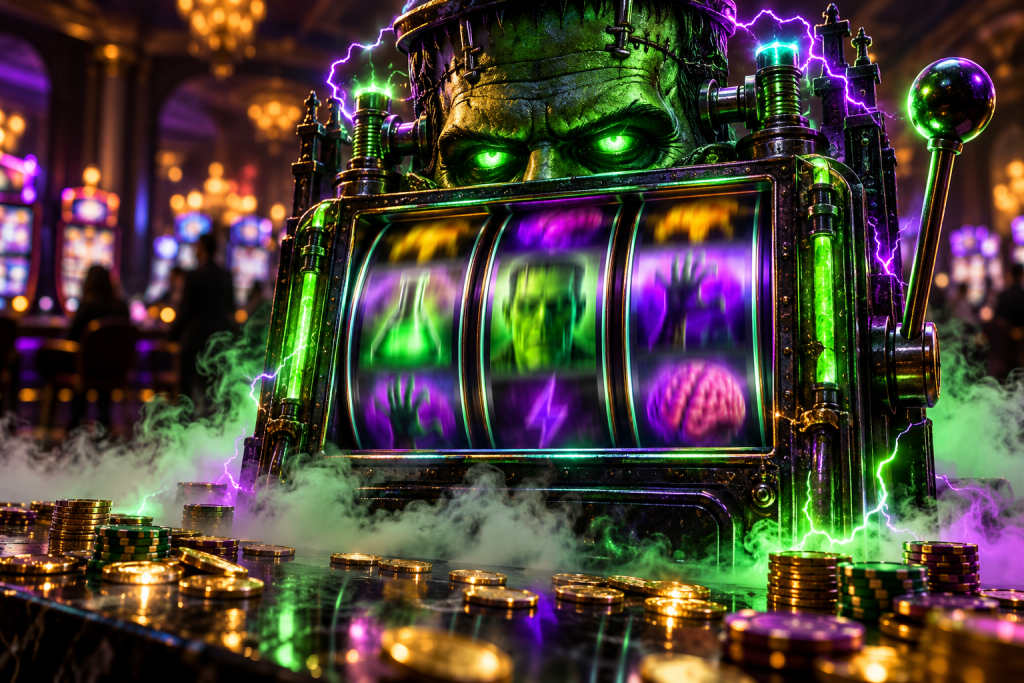
What a themed slot is
A Frankenstein slot machine is a standard video slot wearing a horror-movie skin. The reels, symbols, bonus rounds and jackpot rules are built on the same engine as any other slot from the same developer. The theme changes the artwork and the sound; it does not change the mathematics underneath. When a reader asks how to win on a specific themed machine, the honest starting point is that the theme is decoration. The machine's behaviour is governed by a random number generator, a paytable, and a set of rules that were fixed before you ever sat down.
The random number generator, or RNG, is the algorithm that determines game outcomes. Independent testing laboratories are commonly used to certify RNG behaviour; certification covers game mechanics, not an operator's financial conduct. What this means in practice is simple: every spin is independent of the last one. The machine does not remember that it has gone a hundred spins without a bonus. It does not know that you have been playing for an hour. It does not become due, warm, or ready to pay. Each spin draws a fresh outcome from the same fixed probability distribution.
The number that matters more than the theme
Return to Player, or RTP, is a theoretical percentage of total wagered money a game returns to players over a very large number of spins or hands. It is a long-run statistical average, not a per-session guarantee. The house edge is the mathematical advantage the operator holds on a given game, expressed as a percentage of each wager. House edge and RTP are complements: they sum to 100% for the same game.
For any specific Frankenstein slot, the RTP is a fixed property of that game build. It is usually printed in the game's information panel, the paytable screen, or the help section accessible from the main game screen. The operator's terms page may also state it. The number you find there applies to the game as a whole, across millions of spins. It does not tell you what your next ten spins will do. A game with a higher RTP returns a smaller share of each wager to the house over the very long run, but that is a statement about averages, not a promise about your session.
Volatility, also called variance, describes how payouts are distributed over time. High volatility means rarer but larger payouts; low volatility means more frequent but smaller ones. Volatility does not change a game's RTP. Two versions of the same Frankenstein title could carry the same RTP but feel completely different to play, because one pays out small amounts steadily and the other goes quiet for long stretches before a large hit. Neither is more winnable. They are different shapes of the same expected loss.
What a spin decides
A slot spin is a single random draw. The RNG selects an outcome from the set of all possible reel positions, weighted according to the game's design. The symbols that land are then displayed as if the reels had physically spun to those positions. The animation is a presentation layer. Nothing you do during the spin changes the result that was already selected.
This has a direct consequence for every piece of advice about how to win on a Frankenstein slot. Stopping the reels manually does not change the outcome. Betting one line instead of all lines does not change the outcome of the lines you did bet, though it does change which payline patterns are active and therefore which combinations can pay. Changing your stake between spins does not influence the RNG. Pressing the button at a particular moment does not capture a better time. The machine has no timing window to exploit because the draw is not tied to the clock in a way the player can observe or predict.
The payline and ways-to-win formats matter for what counts as a paying combination. Fixed-payline games require betting all lines; ways-to-win formats pay on adjacent-symbol combinations instead of fixed lines. A Frankenstein slot may use either structure. What you can verify is which structure the game uses, what the paytable lists for each symbol, and whether any feature requires a particular stake level to be active. Some progressive jackpots require a maximum-stake bet to qualify. That is a rule of the specific game, printed in its information panel, not a secret you discover by feel.
Why no betting system changes the edge
The most common answer to "how to win" on any slot is a progression system: raise your stake after a loss, lower it after a win, or follow some fixed sequence of bet sizes. These systems all share one property. They change the size and timing of your individual bets, but they do not change the expected loss on each bet. The house edge applies to every unit wagered, at every stake level, on every spin.
Suppose a game returns R% over the long run, meaning the house keeps the remaining share. If you wager one unit on a spin, your expected loss on that spin is the house edge applied to one unit. If you wager ten units, your expected loss is the house edge applied to ten units. A progression that doubles your stake after a loss simply moves you to a higher expected loss per spin. It redistributes outcomes: you will have more sessions that end with a small win and fewer sessions that end with a large loss, or the reverse, depending on the pattern. What it cannot do is turn a negative-expectation game into a positive-expectation one.
No betting pattern changes the built-in edge of a negative-expectation game. This is not a matter of opinion or a lack of imagination. The edge is a property of the game's payout structure, which is fixed in the game build. The only variables under a player's control are which game to play, which stake to use, how many spins to take, and when to stop. Those choices change the pace and the session shape, not the underlying mathematics.
What genuinely varies under your control
None of this means the player has no decisions. The decisions just operate on a different level than the machine's outcome.
| Player choice | What it changes | What it does not change |
|---|---|---|
| Game selection | RTP, volatility, feature rules, jackpot type | The fact that the game has a house edge |
| Stake size | Expected loss per spin, session length for a given bankroll | The percentage edge on each unit wagered |
| Number of spins | Total amount wagered, total expected loss | The per-spin probability of any given outcome |
| Stopping rule | Whether a session ends at a predetermined point | The outcome of the next spin |
| Reading the paytable | Knowing which symbols pay, which features exist, which stakes qualify for jackpots | The underlying payout structure itself |
Reading the paytable before you play is the single most useful thing you can do on a themed slot. It tells you what the game is: how many paylines or ways, what the top symbol pays, whether there is a bonus round and how it triggers, whether a progressive jackpot exists and what stake qualifies, and what the RTP is if the game publishes it. A player who reads the paytable knows more about the machine than a player who has spun it five hundred times without looking.
Jackpot types matter here. Fixed jackpots pay a set amount; progressive jackpots grow from a share of qualifying wagers and reset after a win. Progressive contributions are typically taken out of the game's return, and some progressives require a maximum-stake bet to qualify. A Frankenstein slot with a progressive jackpot is a different proposition from the same theme with a fixed top prize. The progressive's contribution comes from somewhere, and where it comes from is the game's return structure. The information panel states the qualification rule. If you are not betting the qualifying stake, you are not eligible for the progressive, regardless of what the reels show.
What a session looks like
Short-run results on a slot are dominated by variance. A player can win on a high-house-edge machine and lose on a low-house-edge one. The reverse is equally true. Over a single session, the RTP is almost invisible; what you experience is the volatility. This is why two players on the same Frankenstein slot can have completely opposite sessions, and why one of them will conclude the machine is paying out more often and the other will conclude it is paying out less often. Both conclusions are wrong. The machine is doing exactly what its design says it does.
The long-run average only asserts itself over a very large number of spins. The more you play, the closer your personal result tends to move toward the expected value, but there is no guarantee it arrives there on any particular timeline. A player who stops early may end ahead. A player who keeps spinning to chase a bonus round may give back a win. The machine does not care which one you are.
This is the honest answer to "how to win frankenstein slot machine." You cannot make the machine pay. What you can do is understand the machine, choose whether to play it at all, set a stake and a stopping point you can live with, and treat any win as a short-run event rather than evidence that you have found a method. The only reliable method is to read the game's own published information and decide, before the first spin, what the session is for and when it ends.
FAQ
Does the Frankenstein slot have a bonus round I should wait for?
Many themed slots include a bonus round, but whether a specific Frankenstein title has one, how it triggers, and what it pays is stated in that game's paytable. The bonus round is not more likely to trigger because the machine has gone a long time without one. Each spin's outcome is independent, so a bonus trigger is as likely on the next spin as it was on any previous spin, regardless of the gap since the last trigger.
Can I tell when a slot is about to pay by watching the reels?
No. The reel animation is a display of an outcome the RNG has already selected. Watching the reels, the symbol positions, or the near-misses does not reveal information about the next spin. Near-misses are a designed visual event, not a signal that a win is approaching.
Does betting more on a Frankenstein slot improve my odds?
Betting more increases the amount you wager on each spin, which increases your expected loss in absolute terms. It does not improve the probability of any particular outcome or reduce the house edge. The only stake-related rule that changes eligibility is a progressive jackpot that requires a maximum-stake bet to qualify, and that rule is printed in the game's information panel.
Gambling should be entertainment, not a way to make money. Set a budget before you play and stop when it is gone. If gambling stops being fun, help is available through the resources listed below.
Play responsibly
Gambling should be treated as paid entertainment, never as a way to earn income or recover losses. 1-800-MY-RESET (1-800-697-3738)
18+ or 21+ depending on where you are; follow the minimum age that applies to you.
This article is general information about how these mechanics work. It is not legal advice and not a recommendation to gamble or to use any particular operator. Availability and legality differ by jurisdiction — check the rules that apply where you are.