


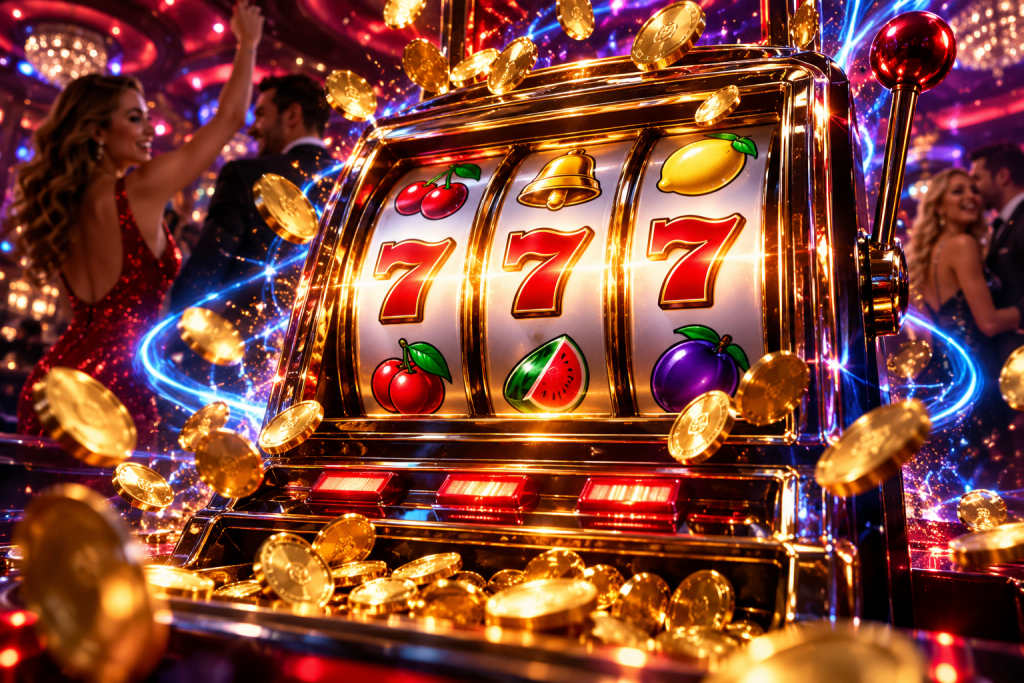
The Reels Stop Where the RNG Says They Stop
When you press spin on a slot machine, you are not interacting with a physical reel that has momentum. You are asking a random number generator to pick a result. The RNG is a piece of software producing numbers continuously, even when nobody is playing. The moment you hit the button, the current number is mapped to a position on each reel, and the screen shows you that outcome. The spinning animation is a presentation layer. The result already exists before the reels appear to stop.
This matters because it removes the two most common beliefs about winning on a slot. The first is that a machine can be due. It cannot. The RNG has no memory of the last spin, the last hundred spins, or the last jackpot. Each result is independent. A machine that has not paid in an hour is no closer to paying than it was on the first spin. The second belief is that stopping the reels yourself, or timing your press, changes anything. It does not. The outcome was fixed at the instant the RNG was sampled, which happens before the animation plays. Every spin has the same probability structure as the one before it.
Where the House Edge Lives in a Slot
Every slot machine is built around a payout table. That table lists every winning combination and what it pays. The machine's designer also sets a probability for each combination. The house edge is what is left over when you multiply every possible payout by its probability and compare the total to the money taken in.
Return to Player, or RTP, is the flip side of that calculation. RTP is a theoretical percentage of total wagered money a game returns to players over a very large number of spins or hands. It is a long-run statistical average, not a per-session guarantee. House edge and RTP are complements: they sum to 100% for the same game. If a game is designed to return a certain percentage over millions of spins, the house keeps the remainder. That remainder is collected on every spin, including the spins that pay out. The payout table does not sit outside the math; it is the math, expressed as symbols and numbers.
None of this is visible on the screen. A player cannot read a machine's RTP from its graphics, its theme, or how often it seems to hit. The figure is set in the game's configuration, and where it is published depends on the operator and the jurisdiction. The game information panel on the machine, the operator's terms page, or the game's help screen is where that figure appears when it is shown at all.
Short Sessions Look Nothing Like the Long-Run Average
The most important gap in how people think about slots is the gap between a session and the statistical long run. RTP is a property of a very large number of spins. A single session is a tiny sample. In a small sample, almost anything can happen. A player can double their bankroll in twenty minutes. A player can lose the same bankroll in ten. Neither outcome tells you anything about the machine's true RTP, because the variance swamps the average.
Volatility is the term for how payouts are distributed over time. High volatility means rarer but larger payouts; low volatility means more frequent but smaller ones. Volatility does not change a game's RTP. Two machines can have the same RTP and completely different session experiences. A high-volatility game will produce long dry spells and occasional large hits. A low-volatility game will produce a steadier drip of small wins. The long-run average is the same; the path to it is not.
This is why a player who wins on a short session has not beaten the machine. They have experienced the favourable side of variance. The machine's edge was still applied to every spin. Over enough spins, the average result moves toward the RTP. The question is never whether the edge is there; it is always there. The question is only whether the random walk of a particular session happens to land above or below the average.
What Decisions Per Hour Do to Total Exposure
Slots are the fastest game in a casino. There is no decision time, no dealer, no other players to wait for. A player can complete a spin every few seconds. That speed is a design feature, and it has a direct mathematical consequence. The house edge is applied per spin. The more spins you take, the more times the edge is applied to your money.
Suppose a game has a house edge of 5%, and a player wagers 100 units per spin. That is an expected loss of 5 units per spin, on average, over a very large number of spins. If the player takes 500 spins in an hour, the expected loss for that hour is 2,500 units. If the same player slows down to 200 spins, the expected loss is 1,000 units. The edge did not change. The exposure did. This is the only lever a slot player genuinely controls: how much money is put through the machine, and how fast.
Bankroll sizing works the same way. A player who brings a fixed amount and plays minimum stakes will see more spins and more time before the expected loss consumes the bankroll. A player who plays maximum stakes will see fewer spins. Neither choice changes the edge. Both change the speed at which the edge is applied. The machine's math is indifferent to your session length. It only cares how many times you press the button.
Why Progression Systems Do Not Remove the Edge
Every betting system for slots, and for casino games generally, is a rearrangement of when and how much is wagered. A progression system might double the bet after a loss, or raise it after a win, or follow some pattern of increases and decreases. None of these systems change the probability of any individual spin. The RNG does not know what you bet last time. The payout table does not shift in response to your stake. The house edge is a property of the game's design, and the design is fixed.
What a progression system does is redistribute outcomes. It creates more small wins and fewer large losses, or the reverse, depending on the pattern. But the expected loss over a large number of spins is the same as if the player had bet a flat amount. The system changes the shape of the session, not its average. A doubling system, in particular, produces many small recoveries and occasional catastrophic losses. The catastrophic loss is not bad luck; it is the system working as designed. The edge was never removed. It was just concentrated into fewer, larger events.
The honest framing is this: no betting pattern changes the built-in edge of a negative-expectation game. A player can choose a lower-volatility game, play fewer spins, or bet less per spin. Those choices change the expected rate of loss. They do not create a route to profit. The machine is not a puzzle to be solved. It is a random process with a price attached to every spin.
What the Machine Shows You, and What It Does Not
A slot screen is dense with information, but almost none of it helps a player calculate the edge. The paytable shows what each combination pays, but it does not show the probability of each combination. The help screen may show the RTP, or it may not. The machine's denomination, its jackpot size, and its theme are all presentation choices. They have no bearing on the underlying math.
One thing that does matter is the difference between fixed and progressive jackpots. Fixed jackpots pay a set amount. Progressive jackpots grow from a share of qualifying wagers and reset after a win. Progressive contributions are typically taken out of the game's return, and some progressives require a maximum-stake bet to qualify. That means a player betting less than the maximum may be funding a jackpot they cannot win. The base game's RTP is lower because part of each wager is being diverted to the progressive pool. The machine's information panel is where a player can check whether the jackpot they are chasing requires a specific stake.
Free spins and bonus features are also part of the payout table. Free spins are spins granted at a fixed stake on specified slot titles. Winnings are commonly credited as bonus funds subject to wagering requirements rather than as withdrawable cash. A bonus round is not a gift sitting outside the math. It is a payout event with its own probability and its own contribution to the game's overall RTP. The game is designed so that the base game and the bonus features together produce the configured return.
Reading the Game Information Panel
Every slot machine, whether physical or online, has a set of rules and payout information accessible to the player. On a physical machine, it is usually a button or a touchscreen option labelled information, help, or paytable. On an online slot, it is typically an icon in the corner of the screen. That panel is the only place where the game's actual parameters are stated. It will show the paytable, the rules for bonus features, and sometimes the RTP.
What the panel will not show is a strategy. There is no strategy for a slot. The player makes no decisions after the spin begins. The only decisions are made before the spin: which game to play, how much to wager, and how many spins to take. Those decisions do not change the edge, but they determine how much money is exposed to it. A player who wants to minimise expected loss plays fewer spins at a lower stake on a game with a lower house edge. A player who wants a chance at a large payout accepts higher volatility and a faster expected loss. Both are legitimate choices. Neither is a way to win.
FAQ
Can you tell when a slot machine is about to hit?
No. Each spin is independent. The random number generator does not track previous outcomes, and a machine that has not paid recently is no more likely to pay on the next spin than it was on the first. The idea of a machine being due is a misreading of how the RNG works.
Does betting more per spin increase your chances of winning?
Betting more increases the amount wagered, not the probability of any given outcome. On some progressive machines, a maximum bet is required to qualify for the top jackpot, which changes what you can win if the jackpot hits. But the probability of hitting it is the same regardless of stake, and a higher stake means a higher expected loss per spin.
What is the best way to play slots if you want to lose less?
Choose a game with a lower house edge if that figure is published, bet the minimum stake you are comfortable with, and take fewer spins per hour. Slowing down does not change the edge, but it reduces the number of times the edge is applied to your money, which lowers total expected loss for a given session.
Play responsibly
Gambling should be treated as paid entertainment, never as a way to earn income or recover losses. 1-800-MY-RESET (1-800-697-3738)
18+ or 21+ depending on where you are; follow the minimum age that applies to you.
This article is general information about how these mechanics work. It is not legal advice and not a recommendation to gamble or to use any particular operator. Availability and legality differ by jurisdiction — check the rules that apply where you are.