


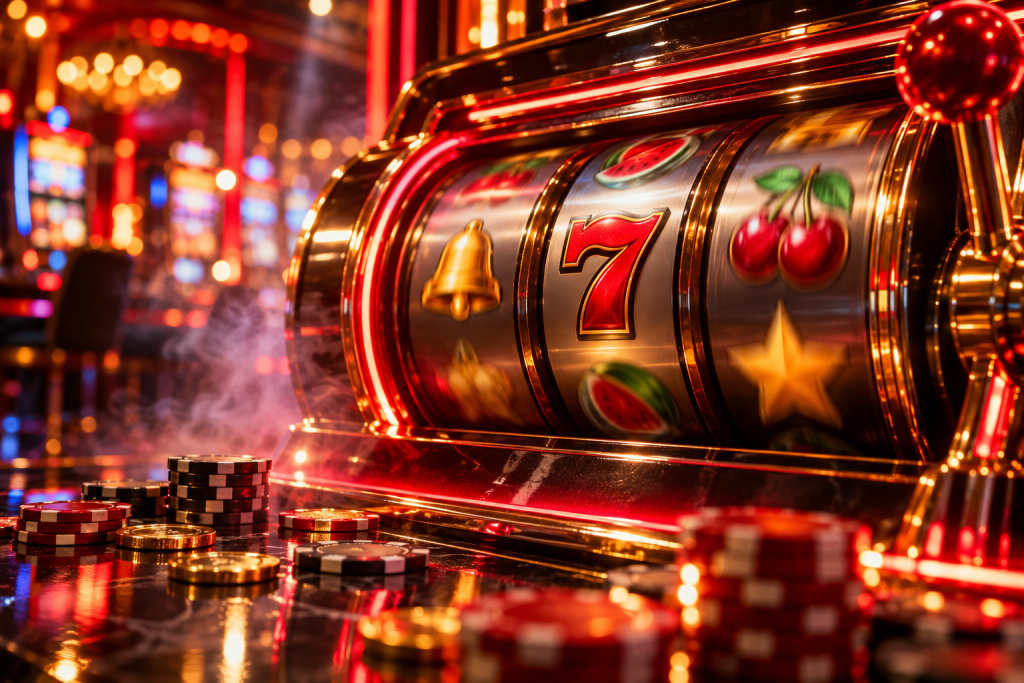
The question starts from a machine that is not built to be beaten
A reader searching for how to win on store slot machines is usually standing in front of a machine, or remembering one, and wondering whether anything about the way they press the button or time their spin changes what comes next. The honest answer is that it does not. A store slot machine is a device whose outcome on every spin is settled by a random process inside the machine, and that process is built so the house keeps a fixed share of all the money played through it over time.
That does not make the machine dishonest. It makes it a gambling device with a known, permanent mathematical structure. Understanding that structure is the only reliable thing a player can take away from the question, because no playing method, timing pattern, bankroll routine, or symbol-watching habit alters the edge.
What decides a spin
Every modern store slot machine resolves each spin through a random number generator. The generator runs continuously, producing values at a rate far faster than any human can press a button. The instant the spin is initiated, the machine reads the value that happens to be current and maps it to a set of reel positions. The symbols that land are a translation of that value, not the result of the reels physically slowing down in a way a player could influence.
Two spins are independent. What landed on the previous spin, how long the machine has gone without a particular symbol, or whether the player just inserted a fresh note has no effect on the next value the generator produces. The machine does not remember, and it does not become due.
The house advantage is built into the mapping, not the session
The machine's return is set by how many of the generator's possible values map to winning symbol combinations and how many map to losing ones. The manufacturer configures that mapping so that, across a very large number of spins, the machine returns a set percentage of the money wagered and retains the rest. The retained portion is the house edge.
This edge is not something a player can see on any single spin. A short session can end ahead, behind, or anywhere in between, because the variance around the long-run average is large. What stays fixed is the long-run expectation: the more spins played, the more closely the player's result approaches the machine's programmed return, and the more certain the retained share becomes.
What the symbols and the paytable can and cannot tell you
The paytable printed on the machine or shown on its screen lists the symbol combinations that pay and what each pays relative to the bet. It does not state the probability of any combination, and it does not state the machine's overall return percentage. A player can read the paytable and know what a winning line is worth; they cannot read the paytable and know how often that line is expected to land.
Some jurisdictions require machines to display a theoretical return or a volatility class. Where that information is shown, it is the closest a player gets to seeing the edge. Where it is not shown, the only authoritative source is the machine's own documentation or the gaming authority for the jurisdiction where the machine operates.
What a player can control
There are only a few variables a player genuinely controls on a store slot machine, and none of them changes the house edge. The table below separates what is fixed from what is chosen.
| Element | Who sets it | What the player can do |
|---|---|---|
| House edge | Machine manufacturer and configuration | Nothing; it is fixed per machine |
| Outcome of any spin | Random number generator | Nothing; no timing or pattern changes it |
| Bet size per spin | Player | Choose within the machine's allowed range |
| Number of spins played | Player | Choose when to start and when to stop |
| Which machine to play | Player | Choose, but edge differences are usually not visible |
Choosing a smaller bet or fewer spins reduces the total amount wagered, which reduces the expected loss in absolute terms. It does not improve the player's odds. A player who wagers less loses less on average; a player who wagers more loses more on average. The percentage retained stays the same either way.
Why no strategy changes the outcome
Slot machines differ from card games in one decisive way. In a card game, the player makes decisions after seeing some information, and those decisions can change the probabilities of later events. On a store slot machine, the player makes exactly one decision per spin: whether to initiate it and at what bet. After that, nothing the player does affects the result.
There is no skill component in the spin itself. There is no optimal time to press the button, no pattern of bet changes that influences the generator, and no way to read the reels to predict the next value. Any claim that a particular method can beat a store slot machine is describing something other than how the machine works.
Where the machine's own rules are printed
The authoritative source for a specific store slot machine is the machine itself. The paytable, the bet range, the denomination, and any displayed return information are printed on the cabinet or available through the machine's on-screen help. A player who wants to know what a specific machine pays should read that display before playing.
For the machine's configured return percentage, where the jurisdiction requires disclosure, the figure appears on the machine or in the venue's published materials. Where it does not appear, the reader should ask the venue operator or check the gaming authority's public register for the jurisdiction. This article does not publish any specific machine's figures, because they differ per machine and per configuration.
What to confirm before you play
Before spending money on a store slot machine, a player should confirm several things that this article cannot state because they are machine-specific and changeable. The list below names each item and where the current answer lives.
- Paytable and payouts: printed on the machine cabinet or shown on its screen; read it before the first spin.
- Bet range and denomination: shown on the machine; the allowed range differs per machine.
- Theoretical return, if disclosed: on the machine or in the venue's materials where the jurisdiction requires it; otherwise not publicly stated.
- Jurisdiction and applicable rules: the gaming authority for the state or territory where the machine operates publishes the rules that apply to machines in that area.
- Venue-specific policies: the operator's own posted rules govern machine use, payouts, and dispute handling.
What the phrase "win" can and cannot mean here
A player can leave a store slot machine with more money than they put in. That happens regularly in the short run, because the machine's variance produces winning sessions as well as losing ones. What a player cannot do is change the long-run expectation. The machine is configured so that the house retains a fixed share of total wagers, and no method of play, timing, or machine selection changes that share.
The most accurate way to describe the situation is that a player is buying a series of random outcomes at a known disadvantage. The entertainment value is real, but the expected financial result of continued play is a loss equal to the house edge multiplied by the total amount wagered. No article, system, or method can alter that arithmetic.
FAQ
Can pressing the button at a certain time change a store slot machine's outcome?
No. The machine's random number generator runs continuously and the spin reads whichever value is current at the instant the spin is initiated. The player cannot time the press to select a favorable value, because the generator produces values far faster than any human can act and the mapping to reel positions is fixed.
Does a machine that has not paid out in a while become more likely to pay?
No. Each spin is independent of every previous spin. The machine does not track how long it has been since a payout, and the probability of any given outcome is the same on every spin. A machine that has just paid out is exactly as likely to pay out again on the next spin as a machine that has not paid out for hours.
Where can I find a specific store slot machine's payout percentage?
If the jurisdiction requires disclosure, the figure appears on the machine cabinet, on its screen, or in the venue's published materials. If it does not appear, the reader should ask the venue operator or check the gaming authority's public register for the jurisdiction. This article does not publish specific machine figures because they differ per machine and are revised as configurations change.
Play responsibly
Gambling should be treated as paid entertainment, never as a way to earn income or recover losses. 1-800-MY-RESET (1-800-697-3738)
18+ or 21+ depending on where you are; follow the minimum age that applies to you.
This article is general information about how these mechanics work. It is not legal advice and not a recommendation to gamble or to use any particular operator. Availability and legality differ by jurisdiction — check the rules that apply where you are.