


The Shoe Decides, Not the Dealer
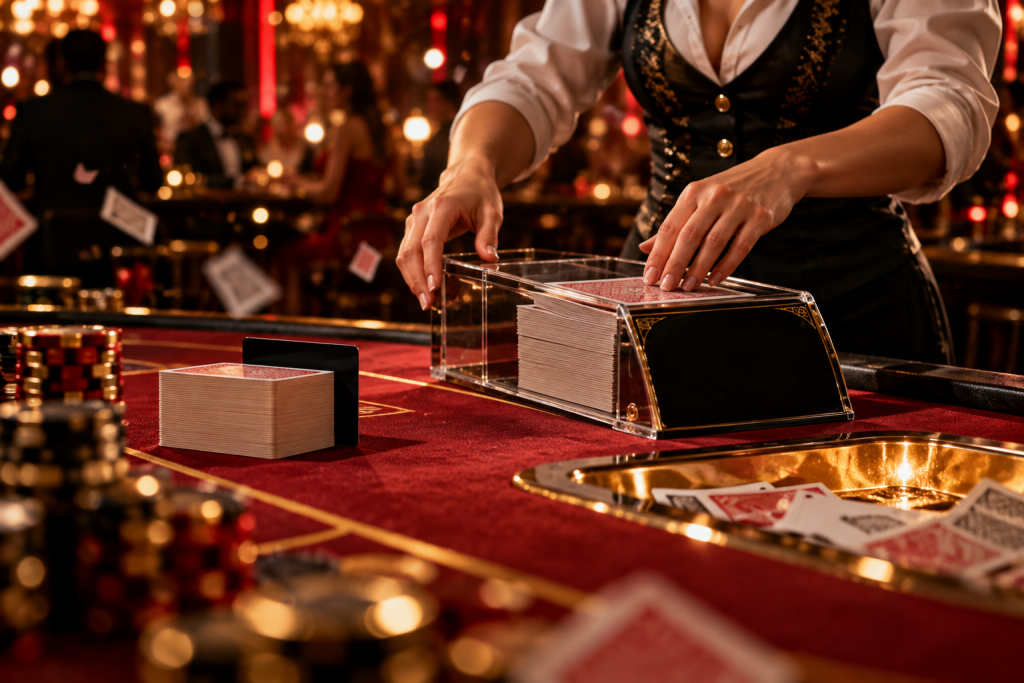
You sit down at a blackjack table, buy in, and watch the dealer pull cards from a plastic box on their left. That box is the shoe, and it holds more than one deck. The dealer does not stop to shuffle after every hand. They deal until a marker card appears near the back of the shoe, then they gather everything and shuffle. The question is not whether shuffling happens every game, but how far into the shoe the house lets the deal run before that marker shows up.
Two physical setups produce very different rhythms. A traditional shoe holds multiple decks, commonly six or eight, and the dealer works through them until the cut card arrives. A continuous shuffling machine, by contrast, feeds discards back into the mechanism after every round, so the dealer is effectively drawing from a constantly remixed pool. The first setup gives you long stretches of play between shuffles. The second removes the pause almost entirely but also removes any sense of a shoe running low.
How a Standard Shoe Round Works
Before the first hand, the cards are shuffled and a player is offered a plastic cut card to insert somewhere near the back of the stack. Where that card lands sets the penetration: how much of the shoe gets dealt before the shuffle. The house chooses the permitted range, and the dealer positions the cut card inside it. When the deal reaches that card, the current round finishes, the dealer announces the shuffle, and the whole process starts again.
Penetration is a house decision, not a game rule. One venue may cut off a deck and a half from the back of a six-deck shoe. Another may cut off only three-quarters of a deck. The deeper the penetration, the more hands you see before the pause. The shallower it is, the more often the table stops for a shuffle.
None of this changes the objective of the game. You are still trying to finish with a hand total closer to 21 than the dealer's without exceeding it. The shuffle schedule only changes the rhythm of the session and how much of the shoe you see before the cards are mixed again.
What the Cut Card Controls
The cut card is a solid-coloured plastic rectangle, usually red or yellow, that has no value in play. Its only job is to tell the dealer when to stop dealing. When it slides out of the shoe, the dealer finishes the hand in progress and then shuffles. In many venues the dealer also places the cut card back into the shoe a fixed distance from the end after each shuffle, so the penetration stays consistent across shoes.
The cut card also prevents a player from seeing the final cards of the shoe. If the dealer dealt to the very last card, a player counting cards would know exactly which cards remain. Cutting off a portion of the shoe keeps that information incomplete. That is the structural reason the card exists, whatever else a player might do with the information they do see.
Continuous Shufflers Change the Tempo
Some tables use a continuous shuffling machine, often called a CSM. The dealer places the discards back into the machine after each round, and the machine mixes them with the cards still inside. The dealer then draws the next hand from the front of the machine. There is no cut card, no shoe penetration, and no long pause for a shuffle.
A CSM table deals more hands per hour because the shuffle break disappears. That is the main practical difference for a recreational player. The house edge on the game itself is set by the rule set in play, not by the shuffling device. A CSM does not make the game fairer or less fair in itself; it changes the pace and removes the shoe structure.
The table below lays out the two setups side by side.
| Feature | Standard shoe | Continuous shuffler |
|---|---|---|
| Decks in play | Commonly six or eight | Commonly four to six, constantly remixed |
| Shuffle point | When the cut card appears | After every round, automatically |
| Cut card used | Yes | No |
| Hands per hour | Fewer, because of shuffle breaks | More, because dealing is continuous |
| Player sees shoe composition | Partially, up to the cut card | Only the current round |
What the Shuffle Schedule Does Not Change
The shuffle schedule has no effect on the house edge of the bets you make. A blackjack hand played from the top of a fresh shoe has the same expected loss as the same hand played from the middle of a deeply penetrated shoe, assuming the same rule set. The shuffle only determines when the cards are mixed, not the mathematics of the game.
Rule set matters far more than shuffle timing. The number of decks, whether the dealer stands or hits on soft 17, whether doubling after splitting is allowed, and whether surrender is offered all shift the edge on your decisions. Published basic-strategy charts derive from the exact rule set in use. A chart built for a dealer who stands on soft 17 will not be correct at a table where the dealer hits it. Before you rely on any chart, check the felt and the table placard for the rules that table runs.
What genuinely varies under your control is the pace of your play and the decisions you make at each hand. A CSM table deals faster, so you make more decisions per hour. More decisions per hour at a negative-expectation game means more total wagered, and more total wagered means a larger expected loss over the same session length. That is not a reason to avoid CSM tables; it is a reason to size your bets and your session to the pace of the table you are sitting at.
Reading the Table Before You Buy In
You can tell which setup a table uses before you put money down. A standard shoe sits on the dealer's left, and you will see the cut card inserted near the back after each shuffle. A CSM sits on the dealer's right or directly in front of them, and the dealer feeds discards into it after every round. The table placard states the number of decks and the key rules.
If you want to know how deep the penetration runs, watch one full shoe. Note where the cut card sits when the dealer slides it in after a shuffle, and count roughly how many decks remain behind it when the card appears. You do not need to count cards to observe this; you only need to watch where the plastic card sits relative to the back of the shoe. That observation tells you how long your stretches of uninterrupted play will be.
If you prefer longer dealing runs between shuffles, a standard shoe with deep penetration gives you that. If you prefer a faster game with no pauses, a CSM table gives you that. Neither choice changes the built-in edge of the game. It changes the rhythm of your session, and rhythm is a legitimate thing to choose.
Procedural Mistakes New Players Make
The first mistake is treating the shuffle as a strategy event. New players sometimes leave a table when the shoe is shuffled, believing the new shoe is somehow "cold" or that the previous shoe was "hot." The shuffle resets nothing about the mathematics of the next hand. The cards have no memory, and the house edge on the next hand is the same as it was on the last hand of the previous shoe.
The second mistake is touching the cards. In most shoe-dealt games, players never touch the cards at all. The dealer handles everything, and your only job is to signal your decision. On a hand-held game, typically single or double deck, you may be allowed to hold the cards, but you must keep them above the table and in view. Touching your bet after the cards are dealt is a procedural error that will draw a correction from the dealer.
The third mistake is signalling unclearly. A hand wave means stand, a tap on the felt means hit, and a second bet placed beside the original means double. New players sometimes say the word while making no gesture, or make a gesture that contradicts the word. The dealer acts on the gesture, and the cameras act on the gesture. Decide, then signal once, clearly, and keep your hands away from the betting circle until the hand is settled.
FAQ
Does the dealer shuffle after every hand in blackjack?
At a standard shoe table, no. The dealer deals through the shoe until the cut card appears, then shuffles. At a table with a continuous shuffling machine, the discards are fed back into the machine after every round, so the cards are effectively remixed constantly without a visible shuffle break.
Can I ask the dealer to shuffle early?
You can ask, but the dealer will not shuffle on request. The shuffle point is set by the house procedure and the position of the cut card. A dealer who shuffled early on a player's request would be changing the game conditions for everyone at the table, and no venue permits that.
Does a continuous shuffler change the house edge?
No. The house edge comes from the rule set in force at the table, not from the shuffling device. A CSM changes the pace of play and removes the shoe structure, but the expected loss on each hand is the same as the identical rule set dealt from a standard shoe.
Play responsibly. If you or someone you know is struggling with gambling, contact local support services. 18+ only. Terms and conditions apply to all offers.
Play responsibly
Gambling should be treated as paid entertainment, never as a way to earn income or recover losses. 1-800-MY-RESET (1-800-697-3738)
18+ or 21+ depending on where you are; follow the minimum age that applies to you.
This article is general information about how these mechanics work. It is not legal advice and not a recommendation to gamble or to use any particular operator. Availability and legality differ by jurisdiction — check the rules that apply where you are.