


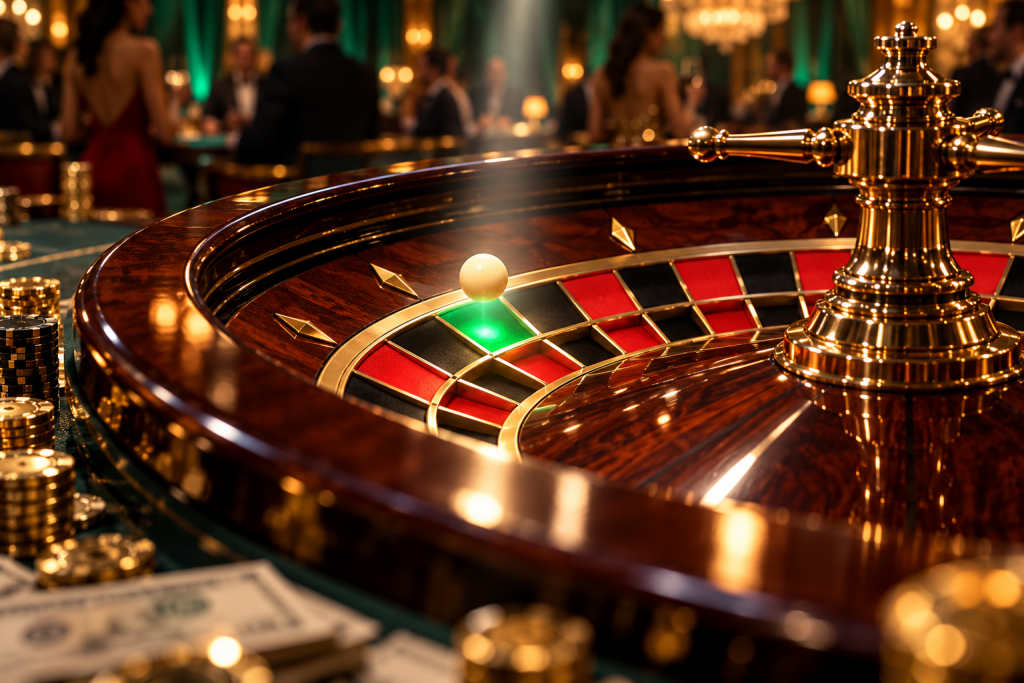
The pocket you cannot bet on red or black
Walk up to a roulette table and the first thing most people notice is the alternating red and black numbers. The second thing is the one or two pockets that are neither. They are green, they carry a zero, and they sit on the wheel for a reason that has nothing to do with the colour scheme. The green pocket is the mechanism by which the house keeps an edge on every wager placed on red, black, odd, even, high or low.
On a European wheel there are 37 pockets in total: the numbers 1 through 36 plus a single green zero. On an American wheel there are 38: the same 36 numbers plus a green zero and a green double zero. The extra pocket on the American layout is not a cosmetic difference. It changes the arithmetic of the game for every player at the table.
When you place a bet on red, you are not getting an even chance of winning, because the green pockets are not red. The payout for a winning red bet is 1 to 1, but the probability of that win is slightly less than 50%. The gap between the payout and the true odds is the house edge, and the green pocket is what creates that gap.
What the zero does to the other bets
Every bet on the roulette layout is priced as if the wheel contained only the numbers that bet covers. The zero breaks that pricing. A straight-up bet on a single number pays 35 to 1, which would be fair if the wheel had 36 pockets. On a European wheel it has 37, so the player is paid as if one pocket did not exist. On an American wheel it has 38, so the player is paid as if two pockets did not exist. The house keeps the difference over time.
The same logic applies to the even-money bets. Red pays 1 to 1, but red occupies 18 of 37 pockets on a European wheel and 18 of 38 on an American one. The green pockets are the missing slots. They do not belong to red, black, odd, even, high or low, so every one of those bets loses when the ball lands in green.
Some tables offer a rule that softens this for even-money bets on European wheels. When the ball lands in zero, certain even-money wagers may be held until the next spin or returned as half the stake instead of being collected in full. Whether that rule applies, and how it is applied, is printed on the table layout or in the venue's posted rules. It changes the effective edge on those specific bets, which is why you should read the layout before you sit down.
| Wheel type | Pockets | Green pockets | Effect on even-money bets |
|---|---|---|---|
| European | 37 | 1 (single zero) | 18 winning numbers out of 37; zero is a losing number for red, black, odd, even, high and low |
| American | 38 | 2 (zero and double zero) | 18 winning numbers out of 38; both green pockets are losing numbers for even-money bets |
Can you bet on the green pocket itself?
Yes. The zero is a number like any other on the layout, and you can place a straight-up bet on it. You can also include it in split bets, street bets, corner bets and other combinations, depending on how the layout is arranged. On an American wheel, the zero and double zero sit next to each other and can be bet as a split.
Betting on the zero does not give you an advantage. A straight-up zero bet pays 35 to 1, the same as any other single number, but the probability of the ball landing there is 1 in 37 on a European wheel or 1 in 38 on an American wheel. The payout has not been adjusted for the green pocket any more than it has been adjusted for any other number. The house edge on a straight-up zero bet is the same as the house edge on a straight-up bet on any other single number on that wheel.
What the zero does change is the edge on the bets that do not include it. A bet on red, for example, is affected by the zero precisely because the zero is not red. A bet on the zero is not affected by the existence of the zero in the same way, because the bet includes the pocket that creates the edge for the other bets.
Single zero versus double zero: why the wheel matters
Before you buy in, check which wheel you are sitting at. The difference between 37 and 38 pockets is small in absolute terms, but it is the difference between two distinct games. On an American wheel, the double zero adds a second pocket that pays no even-money bet and is not covered by any of the outside bets. Every spin carries an additional chance that the ball lands somewhere that pays no one on those bets.
This is not a matter of one wheel being fair and the other unfair. Both wheels pay the same odds for the same named bets. The difference is that the American wheel has one more pocket that belongs to the house's side of the arithmetic. A player choosing between tables is choosing between two different house edges, and the wheel type is the single largest determinant of that difference.
Some venues run European wheels, some run American wheels, and some run both in the same room. The wheel type is usually printed on the layout or visible on the wheel itself. If you cannot tell, look for the double zero. If it is there, you are on an American wheel.
What the green pocket does not do
The green pocket does not make the wheel predictable. It does not make the ball more likely to land near zero after a run of red numbers, and it does not make a zero "due" after a long absence. Each spin is an independent event, and the wheel has no memory. The green pocket sits there on every spin with the same probability as on the spin before.
It also does not change the payout on any winning bet. A winning red bet pays 1 to 1 on both wheel types. What changes is how often that bet wins, not what it pays when it does. The house edge is a property of the gap between probability and payout, and the green pocket is the source of that gap.
New players sometimes assume that because the zero is green, it must be a special bonus pocket or a wild card. It is not. It is a losing number for every bet that does not include it, and a paying number at standard odds for the bets that do.
FAQ
Why is the zero green in roulette?
The zero pockets are coloured green to distinguish them from the red and black numbered pockets. This makes it immediately visible that they are not part of the red or black betting groups, and it signals to the player that the zero is a separate category on the layout.
Does the green pocket change the payout on red or black?
No. A winning red or black bet pays 1 to 1 on both European and American wheels. The green pocket changes how often that bet wins, not what it pays when it does. The payout stays the same while the probability of winning drops.
Is it better to play on a wheel with one green pocket or two?
A wheel with one green pocket has fewer losing numbers for the even-money bets and a smaller gap between the payout and the true odds across the layout. A wheel with two green pockets gives the house a larger edge on the same bets. The wheel type is the first thing to check before you sit down.
Play responsibly
Gambling should be treated as paid entertainment, never as a way to earn income or recover losses. 1-800-MY-RESET (1-800-697-3738)
18+ or 21+ depending on where you are; follow the minimum age that applies to you.
This article is general information about how these mechanics work. It is not legal advice and not a recommendation to gamble or to use any particular operator. Availability and legality differ by jurisdiction — check the rules that apply where you are.