


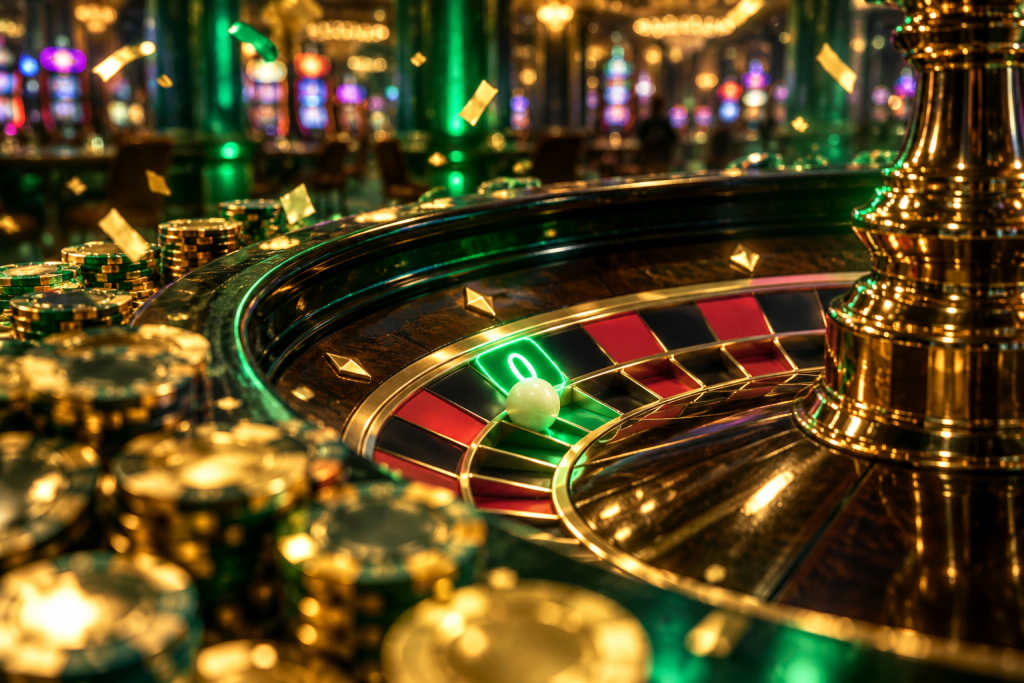
The green pocket that changes every bet on the table
Most roulette players spend their first few spins watching red and black, odd and even, high and low. Then the ball settles into the green pocket, and the whole table seems to pause. The zero is not a tiebreaker or a technicality. It is the single most important number on the wheel, because it is the one result that loses for nearly every outside bet while paying nothing to the players who backed it.
In roulette, zero is neither even nor odd. It is also neither red nor black, and it is neither high nor low. It sits outside every even-money proposition on the layout. That placement is deliberate. The zero is the mechanism that gives the house its mathematical advantage on a game that would otherwise be a perfectly fair coin flip dressed up as a wheel.
What zero is on the wheel and the layout
A European roulette wheel has 37 pockets: the numbers 1 through 36, plus a single zero. An American wheel has 38 pockets: the same 1 through 36, plus a zero and a double zero. The zeros are coloured green on both wheel types, which is why players refer to them collectively as the green pockets.
On the betting layout, the zero has its own box. You can bet on it directly as a single number, the same way you would bet on 17 or 23. You can also include it in certain combination bets, depending on the table. But the zero is excluded from every outside bet category: red or black, odd or even, high or low. When the ball lands in a green pocket, all of those even-money wagers lose outright. They do not push, and they do not get a second chance.
This is the structural difference between roulette and a simple coin toss. A fair coin has two outcomes and pays even money. A European wheel has 37 outcomes, but the even-money bets still pay 1 to 1. The zero is the extra outcome that is not covered by either side of the proposition, and that is where the house edge comes from.
How the zero creates the house edge
House edge and Return to Player (RTP) are complements: they sum to 100% for the same bet under the same rule set. On a European wheel, the even-money bets are settled as if there were 36 pockets instead of 37. The one uncovered outcome, the zero, means the player wins slightly less often than the payout implies they should.
The comparison between wheel types is worth seeing side by side, because the extra green pocket on the American layout changes the arithmetic on every bet.
| Feature | European wheel | American wheel |
|---|---|---|
| Total pockets | 37 | 38 |
| Zero pockets | 1 (single zero) | 2 (single and double zero) |
| Even-money bets covered | 18 of 37 outcomes | 18 of 38 outcomes |
| Uncovered green outcomes | 1 | 2 |
| Effect on house edge | Lower | Higher |
The American layout does not change what the even-money bets pay. It simply adds a second uncovered outcome, which increases the house edge on those bets. This is why the wheel type matters more than any betting pattern: the edge is built into the number of pockets, not into how you arrange your chips.
What happens to each bet type when zero lands
The zero does not treat all wagers equally. Some bets lose, some win, and some tables have a rule that softens the blow for even-money players. Understanding the difference before you sit down prevents the most common procedural confusion at a roulette table.
| Bet type | Result when zero lands | What it means |
|---|---|---|
| Straight-up bet on zero | Wins | Pays as a single-number win at the table's posted odds |
| Red or black | Loses | Zero is green, so neither colour covers it |
| Odd or even | Loses | Zero is classified as neither odd nor even |
| High or low | Loses | Zero sits outside the 1-18 and 19-36 ranges |
| Split, street, or corner including zero | Wins if zero is part of the covered group | Pays at the odds for that combination bet |
Some European tables offer a rule called "la partage" or "en prison" that changes what happens to even-money bets when zero lands. Under la partage, the player receives half the stake back. Under en prison, the stake is held for the next spin and returned if the next spin wins. These rules reduce the house edge on even-money bets, but they apply only where the table explicitly offers them. The rule is printed on the layout or stated in the table's posted terms, and it is worth checking before you place an even-money wager.
The sequence of a round, from buy-in to settlement
Sitting down at a roulette table is straightforward once you know the order of events. The croupier controls the wheel and the ball, but every decision about your money happens before the spin.
You buy in by placing cash on the table, never into the croupier's hand. The croupier counts it and gives you roulette chips, which are different from the chips used at other table games. Roulette chips have no denomination printed on them; their value is assigned when you buy in, and each player at the table receives a different colour so the croupier can tell stacks apart. These chips are only valid at the roulette table and must be exchanged for cash-value chips before you leave.
Once the croupier opens betting, you place chips on the layout. Inside bets go on individual numbers or small groups of numbers. Outside bets go in the boxes around the edge of the layout: red, black, odd, even, high, low, dozens, and columns. You can place multiple bets on the same spin.
The croupier announces that no more bets are allowed, launches the ball, and the wheel spins. When the ball settles, the croupier places a marker on the winning number, clears all losing bets, and pays winners. The marker stays on the layout until the next spin is settled, which is why you should never touch your chips while the marker is down.
What you control and what you do not
Roulette is a game of independent spins. The wheel has no memory, and no sequence of previous results changes the probability of the next one. A zero that has not appeared for thirty spins is not due. A zero that appeared three times in a row is not less likely to appear again. Each spin starts from the same set of pockets.
What you control is bet selection and session management. The house edge differs materially between bet types on the same table. A straight-up bet on a single number pays much more than an even-money bet, but it wins far less often and carries a different expected rate of loss. The even-money bets, the dozens, and the columns each carry their own edge under the same wheel. Choosing a European wheel over an American one, where both are available, changes the edge on every bet you place. Choosing a table with la partage or en prison changes the edge on even-money bets specifically.
What you do not control is the outcome of any given spin, and no progression system changes that. Doubling a bet after a loss does not remove the zero from the wheel. It redistributes outcomes: you win back small amounts often and lose large amounts rarely, but the underlying edge remains on every spin.
Procedural mistakes that cost new players
The most common errors at a roulette table are not about picking the wrong number. They are about how the table operates.
The first is touching chips after the croupier has called no more bets. Once the ball is in motion, the layout is frozen. Reaching in to adjust a stack will get your hand pulled back, and on a busy table it can be read as an attempt to change a bet after the outcome is known.
The second is walking away with roulette chips. Those coloured chips have no value at the cashier's cage. You must exchange them at the table for cash-value chips before you leave. Leaving with them means leaving with plastic that cannot be redeemed anywhere else.
The third is assuming the zero behaves like a push. It does not. On most tables, an even-money bet loses outright when the ball lands in a green pocket. The only exception is a table that explicitly offers la partage or en prison, and even then the rule applies only to the bets the table specifies.
FAQ
Is zero considered an even number in roulette?
No. Zero is classified as neither even nor odd in roulette. It sits outside the odd and even betting boxes on the layout, and a bet on either side loses when the ball lands in the green pocket.
Does betting on zero pay the same as other single numbers?
Yes. A straight-up bet on zero is a single-number bet and pays at the same posted odds as a straight-up bet on any other number. On an American wheel, zero and double zero are two separate single-number bets.
Why does the American wheel have two green pockets?
The American layout adds a double zero alongside the single zero, giving the wheel 38 pockets instead of 37. The second green pocket adds another uncovered outcome for even-money bets, which increases the house edge on those wagers compared with a European wheel.
Play responsibly
Gambling should be treated as paid entertainment, never as a way to earn income or recover losses. 1-800-MY-RESET (1-800-697-3738)
18+ or 21+ depending on where you are; follow the minimum age that applies to you.
This article is general information about how these mechanics work. It is not legal advice and not a recommendation to gamble or to use any particular operator. Availability and legality differ by jurisdiction — check the rules that apply where you are.