


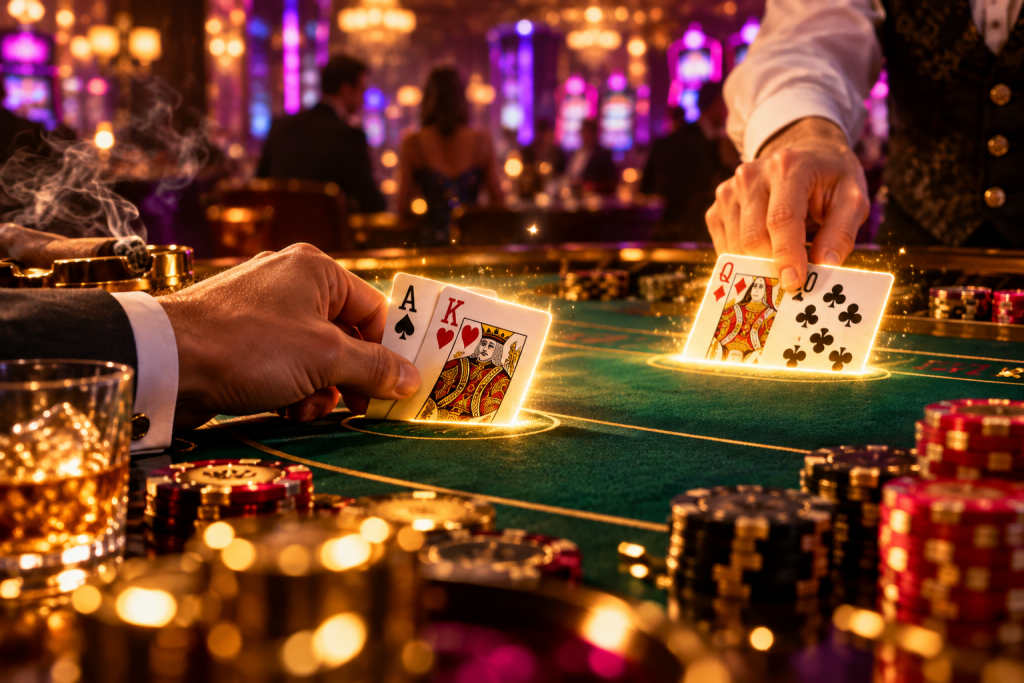
The moment the second 21 appears
You have a king and an ace showing. The player to your left flips over a ten and an ace. The dealer has been sitting on a six, draws a five, and now turns a queen. Three hands on the same table all read 21, and the outcome is not what most new players expect. One of those hands wins outright, one pushes, and one simply loses. The difference comes down to who holds the 21 and how many cards it took to get there.
Blackjack resolves each hand against the dealer alone. What the player beside you holds matters only because it changes which cards the dealer receives, never because your two hands compete. When two players both reach 21, each is settled independently against the dealer's total. The word "both" in the question hides a second distinction that matters more: a 21 made from the first two cards is a blackjack, and a 21 made from three or more cards is just a total of 21. They are not the same hand.
How a round settles when 21s collide
Each seated hand is compared with the dealer's hand under one fixed order of operations. A player's two-card 21, called a natural or blackjack, is the strongest outcome a player can hold. It pays at a premium, and it beats any dealer total except the dealer's own two-card 21. A player's 21 built from three or more cards is an ordinary total. It beats any dealer total below 21, loses to a dealer blackjack, and pushes a dealer total of 21 made from three or more cards.
The dealer's hand follows the same split. A dealer blackjack is a two-card 21. A dealer total of 21 reached by drawing is an ordinary 21. The table below lays out the four possible collisions.
| Your hand | Dealer's hand | Result |
|---|---|---|
| Two-card 21 (blackjack) | Two-card 21 (blackjack) | Push: your stake is returned |
| Two-card 21 (blackjack) | Three-or-more-card 21 | You win at the blackjack payout |
| Three-or-more-card 21 | Two-card 21 (blackjack) | You lose |
| Three-or-more-card 21 | Three-or-more-card 21 | Push: your stake is returned |
A push returns your original wager and nothing else. No win, no loss, no payout. The hand is over and the next round begins. A blackjack payout is a premium over a standard win, and the exact multiple is printed on the table layout where you sit. Most layouts state it directly on the felt, but the number is a table rule, not a universal constant, so read the printed text before you bet.
Why the two-card 21 outranks the drawn 21
The distinction exists because the two hands carry different risk profiles for the operator. A natural blackjack is settled immediately, before the dealer draws, and it cannot bust. A hand that reaches 21 by drawing has survived additional decisions and additional cards, and it is paid at the ordinary even-money rate rather than the premium. The premium exists to compensate for the fact that the player's best possible result is locked in before the dealer acts.
This also explains the most common procedural confusion at the table. A new player who reaches 21 with three cards sometimes expects the premium payout and is surprised when the dealer pays it as a standard win. The dealer is not shorting the hand. The premium belongs only to the two-card natural, which is why the hand has a separate name.
What the dealer does with a 21
The dealer has no decisions to make. The house follows a fixed drawing rule printed on the table: the dealer stands on a specified total, often 17, and draws below it. A dealer who reveals an ace with a ten-value card checks for blackjack immediately, before players act on their hands, because a dealer blackjack ends the round for every hand that is not itself a blackjack. If the dealer shows an ace and offers insurance, that offer is a side bet on the dealer holding a ten underneath, and it settles independently of your main hand.
When the dealer's upcard is an ace and the hole card is a ten, the dealer turns the blackjack at once. Every player hand that is not a natural loses. Every player natural pushes. There is no drawing, no second chance, and no opportunity to improve a three-card hand to 21 first. The order of revelation is fixed, and it is the single most important sequencing rule for understanding why your drawn 21 lost to a dealer's two-card 21.
Where the house edge sits in this hand
A blackjack is a favourable outcome for the player, but it is not a strategy. The edge on the main bet comes from the structure of the game: the player acts first and can bust before the dealer draws, while the dealer only draws after every player hand has resolved. That asymmetry is what the house edge measures, and it persists no matter how many 21s appear in a given round.
Different side bets and rule variants change the edge on specific wagers. The main bet under a given table's rules has one house edge; the insurance bet has another; any side bet has its own. None of them become positive-expectation because a 21 just landed. A push returns your stake, which feels like a reprieve, but it is still a hand in which the player's expected loss on that wager was priced in before the cards were dealt.
Basic strategy and the exact rule set
Published blackjack strategy charts tell a player when to stand, hit, double, split, or surrender. Those charts are not universal. They are derived from a specific rule set: the number of decks, whether the dealer stands or hits on a soft 17, which hands may be doubled, whether doubling after splitting is allowed, and whether surrender is offered. Change one rule and some chart entries change with it.
This matters directly to the 21 question. Some rule sets allow a player to double on certain totals, and some allow surrender. A player holding an eleven against a dealer's six faces a decision that a chart answers one way under one rule set and differently under another. The chart you memorised for one table is not necessarily correct at the next. Find the chart that matches the printed rules on the felt where you are sitting.
Procedural mistakes that cost players at the table
The first mistake is touching the cards. In a shoe-dealt game, players do not touch the cards at all; in a pitch game, they handle them under strict rules. Reaching for a card, moving chips after the dealer has begun to act, or placing a second bet after the round starts will draw an immediate correction. The second mistake is signalling unclearly. A hand wave means stand, a tap means hit, and a vague gesture can be read as either. The dealer will ask, but the ambiguity slows the table and can lead to a decision you did not intend.
The third mistake is treating a drawn 21 as a blackjack and expecting the premium. It is the most common misunderstanding this article addresses, and it is the one that most often produces a dispute at the table. The dealer's payout is correct. The hand is an ordinary win at even money, and the premium belongs only to the two-card natural.
What the round looks like from buy-in to settlement
You buy chips at the table, placing cash on the felt rather than handing it to the dealer. The dealer spreads the cash, calls the amount, and pushes chips toward you. You place a wager in the betting circle before the cards are dealt. The dealer deals each player two cards and takes two, one face up. If the dealer shows an ace, insurance is offered before play continues. If the dealer has a blackjack, the round ends immediately. Otherwise, each player acts in turn, and the dealer draws last according to the fixed rule.
When the dealer's hand is complete, the dealer settles each bet in order: blackjacks are paid at the premium, winning totals are paid at even money, pushes are returned, and losing bets are collected. Only then does the next round begin. The entire sequence is designed so that no bet is settled until the dealer's hand is final, and no player's hand is compared with another player's hand at any point.
FAQ
Does a player's 21 beat another player's 21?
No. Player hands never compete with each other. Each hand is settled only against the dealer's hand, so two players holding 21 are each paid, pushed, or collected according to what the dealer holds.
What if the dealer and I both have a two-card 21?
That is a push. Your stake is returned with no payout. A dealer blackjack and a player blackjack cancel each other, which is why the hand is sometimes called a standoff.
Is a 21 made with five cards worth more than a normal 21?
Not under standard table rules. A five-card 21 is still an ordinary total of 21, paid at even money, unless the specific table publishes a bonus for it. Some older or promotional rule sets include such a bonus, so check the printed layout before assuming it applies.
Play responsibly
Gambling should be treated as paid entertainment, never as a way to earn income or recover losses. 1-800-MY-RESET (1-800-697-3738)
18+ or 21+ depending on where you are; follow the minimum age that applies to you.
This article is general information about how these mechanics work. It is not legal advice and not a recommendation to gamble or to use any particular operator. Availability and legality differ by jurisdiction — check the rules that apply where you are.