


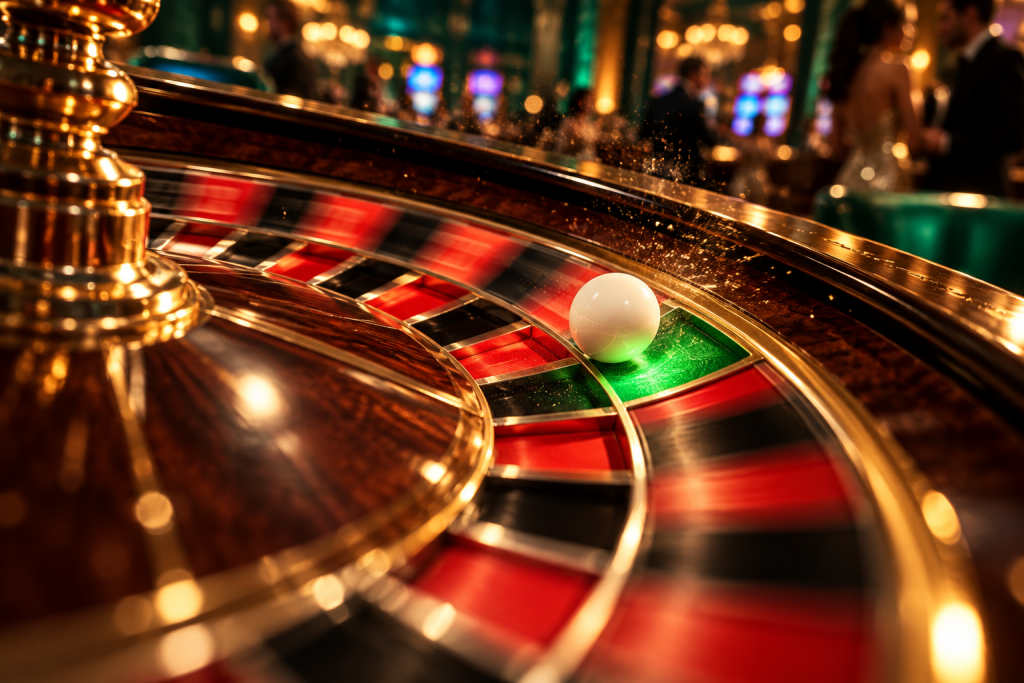
The Green Pocket Is Where the Edge Lives
Most roulette bets are built around red, black, odd, even, and the numbered pockets. The green pocket — or pockets — sits outside those even-money categories, and that is precisely where the house builds its advantage. When you bet red or black, the green pocket is the outcome that makes you lose. When you bet a straight number, the green pocket is just another number, but it is an extra number the wheel carries beyond the thirty-six you are used to thinking about.
So the question "what are the odds of landing on green" is really two questions. The first is the simple probability of the ball settling in a green pocket on the next spin. The second is what that green pocket does to every other bet on the table. Both answers depend on which wheel you are playing.
One Wheel, Two Wheel, Green Pockets
A European-style wheel carries thirty-seven pockets: the numbers one through thirty-six, plus a single zero. The single zero is green. An American-style wheel carries thirty-eight pockets: the same one through thirty-six, plus a single zero and a double zero. Both zeroes are green. The extra green pocket on the American layout is not a cosmetic difference. It changes the probability of every spin and the edge on every bet.
| Wheel type | Total pockets | Green pockets | Probability of green on one spin |
|---|---|---|---|
| European (single zero) | 37 | 1 | 1 in 37 |
| American (single and double zero) | 38 | 2 | 2 in 38, which is 1 in 19 |
Those fractions are the whole answer to the literal question. On a single-zero wheel, the ball lands in the green pocket once in every thirty-seven spins on average. On a double-zero wheel, it lands in one of the two green pockets once in every nineteen spins on average. That is a long-run average, not a promise about the next spin. The wheel has no memory, and a green pocket is no more or less likely after a run of reds, blacks, or other greens.
What Green Does to an Even-Money Bet
Imagine you bet on red. On a European wheel, red covers eighteen pockets, black covers eighteen, and the single green zero covers one. If the wheel had no green pocket, red and black would each cover half the wheel, and a winning red bet would pay exactly even money with no built-in disadvantage to either side. The green pocket breaks that symmetry. Red still pays even money, but red no longer covers half the wheel. It covers eighteen of thirty-seven.
Suppose, as an example, you place one unit on red for thirty-seven spins and every number comes up once. You win on the eighteen red numbers and collect eighteen units in profit. You lose on the eighteen black numbers and on the single green zero, for nineteen losing units. You finish one unit down after thirty-seven units wagered. That one unit is the house edge, and it exists because the green pocket pays out as if it were not there while still taking your bet when it lands.
On an American wheel the same example runs worse. Red still wins eighteen times in thirty-eight spins, but now you lose on eighteen black numbers and two green pockets, twenty losses against eighteen wins. The extra green pocket doubles the gap between what an even-money bet covers and what it pays.
Straight Bets on the Green Pocket Itself
You can also bet directly on the green pocket, or on both green pockets where the wheel has two. A straight bet on zero pays at the standard straight-up rate for a single number. The probability of hitting it is one in thirty-seven on a single-zero wheel and one in thirty-eight on a double-zero wheel, but the payout is the same fixed multiple of your stake on both wheels. That mismatch is the edge on the straight bet: the payout is set as if the wheel had thirty-six numbers, while the wheel carries one or two extra pockets.
Suppose a straight-up bet pays thirty-five units for a one-unit stake, as an example. On a European wheel, a winning straight bet returns your stake plus thirty-five, but a fair payout for a one-in-thirty-seven chance would be higher. The difference between the actual payout and the fair payout is the house edge on that bet. On an American wheel, the same thirty-five-unit payout is attached to a one-in-thirty-eight chance, which widens the gap further. Betting on green does not escape the edge; it is a straight-number bet like any other, with the same payout structure and the same built-in disadvantage.
RTP and House Edge Are Two Sides of One Coin
Return to Player and house edge describe the same relationship from opposite directions. For the same bet under the same rule set, the two figures sum to one hundred percent. If a given bet returns a certain percentage to players over a very large number of spins, the house keeps the remainder. The green pocket is the mechanical reason the remainder is not zero on an even-money bet. The wheel pays red or black as if the green pocket did not exist, but the green pocket still collects losing bets when it appears.
What changes between wheels is the size of that remainder, not the mechanism. A single-zero wheel gives the house a smaller edge on most bets than a double-zero wheel, because there is one fewer pocket that pays out as if it were not there. The relationship is structural: more green pockets, larger edge, lower RTP, all else equal. Volatility does not change any of this. A high-volatility session may produce long winning or losing streaks, but the green pocket's share of the long-run average stays fixed by the wheel layout.
Why a Short Session Looks Nothing Like the Average
The one-in-thirty-seven or one-in-nineteen figure is a long-run average. In a single evening of fifty or a hundred spins, the actual number of green hits can be far above or far below that average. A player can go an entire session without seeing a green pocket, or see it three times in ten spins. Neither outcome signals that the wheel is biased, due, or hot. Each spin is an independent event, and the probability of green on the next spin is the same fraction of the wheel it always was.
This is the gap between expected value and observed results. Expected value describes the average outcome over an enormous number of trials. A short session is a small sample, and small samples produce wide variation around the average. The house edge does not guarantee a loss on any given night, and it does not need to. It operates on the aggregate of every bet placed, over time, across every player. The green pocket collects its share quietly, one spin at a time, whether or not any individual player notices it in the moment.
What Decisions Per Hour Do to Total Exposure
The edge is built into each bet, but the total amount you are exposed to depends on how many bets you make and how large they are. A roulette table moves at a steady pace, and the number of spins per hour is largely outside your control. What you control is the stake per spin and the length of the session. Suppose, as an example, you wager one unit per spin and the table produces sixty spins in an hour. Your total coin-in for the hour is sixty units. The house edge applies to that total, not to your starting bankroll. The same edge applied to a larger stake or a longer session produces a larger expected loss in absolute terms, even though the percentage is unchanged.
This is why the green pocket matters more the longer you play. The probability of any single spin landing on green is small, but the probability of seeing green at least once across a long session is far higher. The more spins you play, the more opportunities the green pocket has to collect, and the closer your actual results tend to drift toward the long-run average. Short sessions are dominated by variance. Long sessions are dominated by the edge.
Why Progression Systems Redistribute Outcomes Instead of Removing the Edge
A common response to the green pocket is to change bet size after a loss, doubling after red or black misses in the hope of recovering the lost unit when the colour finally hits. The arithmetic of the wheel does not change when the stake changes. The green pocket still occupies the same fraction of the wheel, and the payout on red or black still ignores its existence. A progression system changes the size and timing of wins and losses, not the underlying probability of any spin.
What a progression does is concentrate risk. A doubling sequence recovers one unit when the colour hits, but the stake required to keep the sequence alive grows quickly, and a run of green or the opposite colour can exhaust the table limit or the bankroll before the recovery spin arrives. The system produces many small wins punctuated by rare, large losses. The expected loss over a large number of spins is the same as flat betting, because every unit wagered carries the same edge. The progression has redistributed the losses into fewer, larger events, not removed them.
No betting pattern changes the built-in edge of a negative-expectation game. The green pocket is a physical feature of the wheel. It is present on every spin, it collects on every losing even-money bet, and it does not care whether the stake on the table is one unit or sixty-four.
Which Wheel You Are Playing Determines Your Figure
Before you can answer the odds question for your own session, you need to know which wheel is in front of you. The wheel itself shows the answer. A single-zero wheel has one green pocket marked with a zero. A double-zero wheel has two, marked zero and double zero. The table layout repeats the same information, and the game rules panel or the operator's game information screen will state the wheel type where the game is played online. The probability of green on the next spin follows directly from the pocket count: one in thirty-seven on a single-zero wheel, one in nineteen on a double-zero wheel.
The payout for a straight bet on green is printed on the table layout or shown in the game's paytable. The house edge for any given bet is not printed, but it follows from the wheel type and the payout. If you want the precise edge for a specific bet on a specific wheel, the game's rules or help screen is the place to look, and the relationship is always the same: the payout assumes thirty-six numbers, while the wheel carries more.
FAQ
Does the green pocket come up more often after a long run of red or black?
No. Each spin is independent, and the wheel has no memory. The probability of green on the next spin is the same fraction of the wheel it always was, regardless of what the previous ten or fifty spins produced.
Is betting on green a better bet than betting on red or black?
It is a different bet, not a better one. A straight bet on green pays at the standard straight-up rate, but the payout is set as if the wheel had thirty-six numbers. The green pocket carries the same built-in disadvantage as any other straight-number bet, and on a double-zero wheel the disadvantage is larger than on a single-zero wheel.
How do I know whether the wheel I am playing is single-zero or double-zero?
Look at the wheel itself. A single-zero wheel has one green pocket marked zero. A double-zero wheel has two green pockets marked zero and double zero. Online games state the wheel type in the game rules or information panel, and the table layout mirrors the wheel.
Gamble responsibly. If you or someone you know has a gambling problem, call or text the helpline printed in the footer below.
Play responsibly
Gambling should be treated as paid entertainment, never as a way to earn income or recover losses. 1-800-MY-RESET (1-800-697-3738)
18+ or 21+ depending on where you are; follow the minimum age that applies to you.
This article is general information about how these mechanics work. It is not legal advice and not a recommendation to gamble or to use any particular operator. Availability and legality differ by jurisdiction — check the rules that apply where you are.