


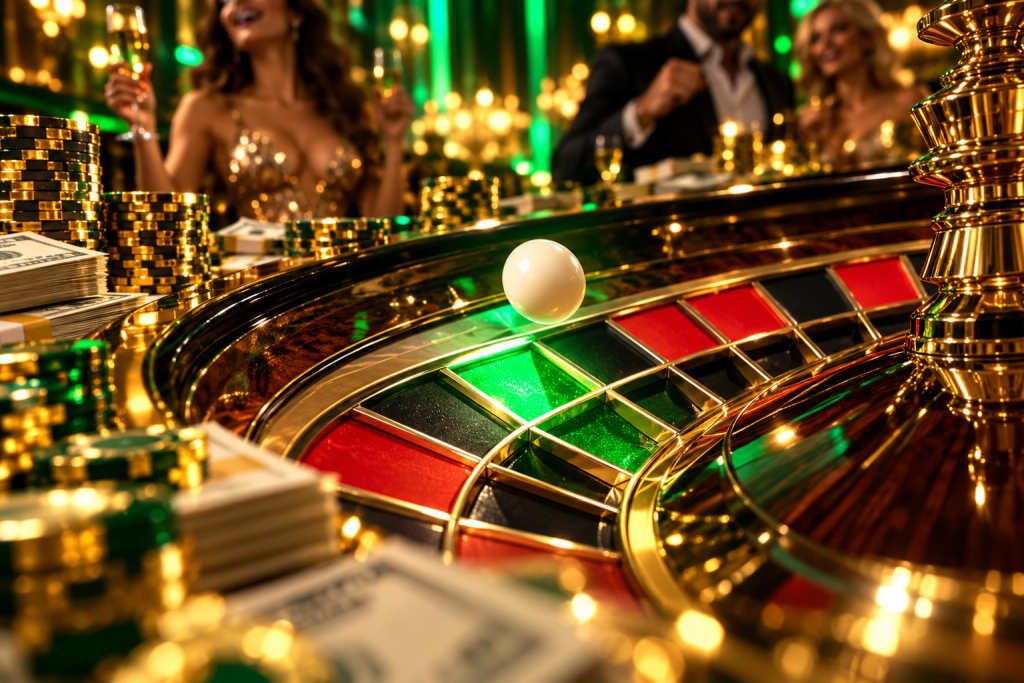
The number that matters before you put a chip on green
A straight-up bet on the green zero pays 35 to 1. That is the multiplier you will see printed on the table layout and in the game's paytable. If you put one unit on the single zero and it lands, you receive 35 units in winnings plus your original unit back, for 36 units returned in total. The multiplier sounds generous, and it is the same multiplier paid on any other single number, but the green pocket is not a normal number. It is the pocket that creates the gap between what the casino pays and what the bet is mathematically worth.
What confuses most new players is that a payout is not the same thing as the true odds. The true odds of hitting any single number on a European wheel are 36 to 1, because there are 37 pockets and only one of them is yours. The casino pays 35 to 1. That one-unit shortfall, repeated over a very large number of spins, is the house edge on the bet. The green zero is the physical reason the shortfall exists.
How the green pocket works on each wheel
Every roulette wheel has at least one green pocket. What changes is how many green pockets there are, and that single difference changes the arithmetic of every bet on the table, including bets that have nothing to do with the zero.
| Wheel type | Number of pockets | Green pockets | Straight-up payout | True odds against a single number |
|---|---|---|---|---|
| European / single-zero | 37 | 1 (the zero) | 35 to 1 | 36 to 1 |
| American / double-zero | 38 | 2 (0 and 00) | 35 to 1 | 37 to 1 |
The American layout pays the same 35 to 1 on a straight-up bet, but now there are 38 pockets, so the true odds against any single number are 37 to 1. The extra green pocket widens the gap between the payout and the true odds. That is why the same bet on an American wheel carries a higher house edge than on a European wheel. The green pockets are not an optional side feature; they are the built-in advantage that funds the game.
When a player asks how much green multiplies on roulette, they are usually asking about the straight-up payout. But the zero also affects every other bet on the layout. Red or black, odd or even, high or low: these bets pay even money, yet they are not true 50/50 propositions, because the green pocket belongs to neither colour, neither parity, and neither half of the board. When the zero lands, those outside bets lose in most rule sets. The green pocket is the reason an even-money bet is not an even chance.
What happens to your bet when the zero lands
The green pocket does not multiply every bet on the table. It only multiplies the bets that include it. A straight-up chip placed directly on the zero wins at 35 to 1. A split bet that covers the zero and one neighbouring number pays 17 to 1 if either lands. A street or basket bet that includes the zero pays according to its own printed odds. But a chip on red, on odd, on the first dozen, or on any other outside section simply loses when the green pocket appears, unless the table rules state otherwise.
Some European tables apply a rule that softens this for even-money bets when the zero lands. Under that rule, half of an even-money wager is returned to the player, or the bet is held in place for the next spin. The exact treatment is printed in the table's rule set, and it changes the effective edge on those outside bets. If the rule is in force, it will be stated on the layout or in the game information panel. It is not something to assume.
The practical point for a new player is that the green pocket is not a bonus number. It is the number that makes every other bet slightly worse than its payout suggests. The multiplier on green itself is fixed and printed, but the cost of the green pocket is spread across the entire table.
Why the same green bet costs more on one wheel than another
House edge and RTP are complements: they sum to 100% for the same game. When a wheel adds a second green pocket, the house edge on every bet rises, and the RTP falls by the same amount. The straight-up bet on a European wheel and the straight-up bet on an American wheel look identical on the layout, but they are not the same wager. One is a 1-in-37 proposition paid at 35 to 1; the other is a 1-in-38 proposition paid at the same 35 to 1.
This is the comparison that matters when you choose a table. The wheel type is printed on the layout or shown in the game information panel. If you cannot see it, look at the wheel itself: a single green pocket means European, two green pockets mean American. The difference is not cosmetic. It changes the expected rate of loss on every chip you place, including chips that never touch the green.
Volatility does not change any of this. A straight-up bet on the zero is a high-volatility wager: it loses almost every spin, and occasionally pays 35 to 1. That pattern of rare, larger payouts is what volatility describes. It does not alter the house edge, and it does not make the green pocket more or less likely on the next spin. The wheel has no memory, and the green pocket is not due after a run of other numbers.
What to check before you put a chip on the zero
Three things determine what a green bet is worth to you, and all three are visible before you bet. First, the wheel type: single-zero or double-zero. Second, the payout, which should be printed on the layout as 35 to 1 for a straight-up number. Third, any special rule that applies to even-money bets when the zero lands, if you also plan to play those sections.
None of these require you to trust a summary or a review. The layout itself carries the payout, the wheel itself shows the pocket count, and the table rules or game information panel carries any zero-related rule. If you are playing online, the same information is usually one tap away in the game's paytable or help section. If a table does not make the wheel type obvious, that is a reason to look more carefully, not a reason to guess.
The green pocket is the clearest single example of how roulette pays less than the true odds. The multiplier is real, it is fixed, and it is printed. But the cost of the bet is the difference between that printed multiplier and the true odds, and that difference is set by how many green pockets the wheel carries.
FAQ
Does the green zero pay more than other single numbers?
No. On a standard layout, a straight-up bet on the green zero pays 35 to 1, the same as a straight-up bet on any other single number. The zero is not a higher-paying number; it is the number that shifts the true odds against every bet on the table.
What is the difference between a payout and the true odds on green?
The payout is what the table promises if you win: 35 to 1 on a straight-up bet. The true odds are the actual chance against that number landing: 36 to 1 on a single-zero wheel, 37 to 1 on a double-zero wheel. The gap between the two is the house edge on the bet.
Does the zero affect bets that are not on the zero?
Yes. Even-money bets such as red or black, odd or even, and high or low lose when the zero lands in most rule sets, because the green pocket is outside all of those categories. Some European tables apply a rule that returns half of an even-money bet when the zero lands, but that rule must be stated in the table's rule set.
If you or someone you know is struggling with gambling, help is available. Contact the National Problem Gambling Helpline at the helpline printed in the footer below for confidential support, or visit a responsible gambling resource in your area. Gambling should always be approached as entertainment, never as a way to make money.
Play responsibly
Gambling should be treated as paid entertainment, never as a way to earn income or recover losses. 1-800-MY-RESET (1-800-697-3738)
18+ or 21+ depending on where you are; follow the minimum age that applies to you.
This article is general information about how these mechanics work. It is not legal advice and not a recommendation to gamble or to use any particular operator. Availability and legality differ by jurisdiction — check the rules that apply where you are.