


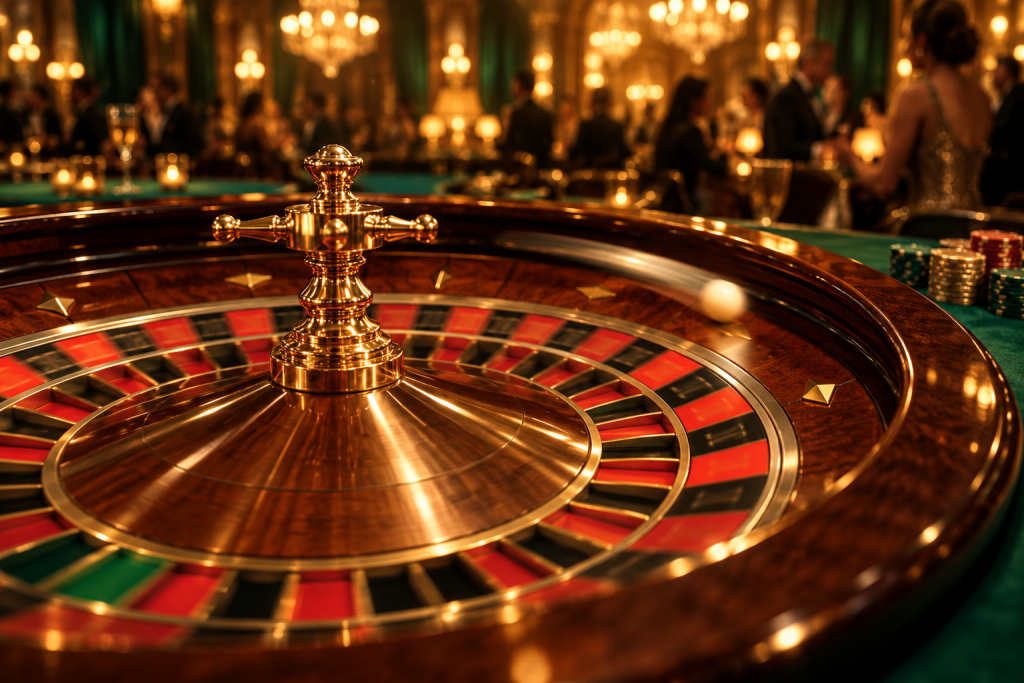
The Wheel Predates the Game
Roulette did not appear fully formed. The wheel at its centre belongs to a much older family of spinning devices used for games of chance, and the game we recognise today is the result of several changes layered on top of that hardware over roughly two centuries. Asking who created roulette is therefore less like asking who painted a particular picture and more like asking who built a house that has been renovated many times.
The earliest direct ancestor is usually traced to experiments with wheel-based games in Europe during the seventeenth and eighteenth centuries. A common story names the French mathematician Blaise Pascal as the inventor, pointing to his work on perpetual motion machines. There is no surviving evidence that Pascal ever built a gambling wheel, and the story appears to be a later attribution rather than a documented fact. What is more certain is that by the late eighteenth century, wheel games with numbered pockets were being played in European gambling houses, and the specific layout of red and black numbers alternating around a spinning disc gradually stabilised into something close to modern roulette.
How the Modern Layout Took Shape
The decisive step was the introduction of the zero. A wheel with numbers from 1 to 36 pays winning bets at odds that ignore the fact that there are more than 36 possible outcomes once a zero pocket exists. The zero pocket is what gives the house its mathematical advantage on every bet, because straight-up bets on a single number pay 35 to 1 while the wheel contains 37 or 38 pockets depending on the layout.
Two layouts matter for the history. The single-zero wheel, with 37 pockets, became the standard in European casinos. The double-zero wheel, with 38 pockets, developed later and became associated with American gambling houses. The extra pocket on the American layout increases the house edge on the same bets, which is why the two wheels are treated as different games in most strategy discussions.
| Feature | Single-zero wheel | Double-zero wheel |
|---|---|---|
| Pockets | 37 | 38 |
| Zero pockets | One | Two |
| Number range | 0-36 | 0-36 plus 00 |
| Common association | European casinos | American casinos |
| Effect on house edge | Lower on equivalent bets | Higher on equivalent bets |
The names "European" and "American" describe the wheel layouts, not where a particular casino is located. A venue in any region may offer either wheel, and the table signage or the wheel itself will show which one is in use.
The Sequence of a Round
Understanding the game's origin helps explain why the modern round works the way it does. A player buys in at the table and receives coloured chips that are distinct from the standard value chips used elsewhere on the casino floor. These chips have no printed denomination; their value is set when the player buys them, and they must be exchanged back at the same table before leaving.
Once the dealer clears the previous round, players place bets on the layout. The layout is a printed cloth showing the numbers and a range of outside betting areas covering groups of numbers, colours, odd or even, and high or low. The dealer spins the wheel in one direction and sends the ball travelling in the opposite direction around a track. When the ball drops into a pocket, the dealer marks the winning number on the layout, sweeps losing bets away, and pays winners.
The decision point for a player is entirely in bet selection before the spin. Once the ball is in motion, nothing a player does changes the outcome. The wheel has no memory, and each spin is independent of the previous one.
Bet Types and Their Edges
Roulette bets fall into two broad groups. Inside bets are placed on individual numbers or small groups of numbers and pay more when they win. Outside bets cover larger sections of the wheel and pay less but win more often. The house edge on a given wheel layout is the same for most bets, but the payout odds and the frequency of winning differ sharply.
| Bet | What it covers | Payout | How often it tends to win |
|---|---|---|---|
| Straight-up | One number | 35 to 1 | Rarely |
| Split | Two adjacent numbers | 17 to 1 | Less often |
| Street | Three numbers in a row | 11 to 1 | Moderately rarely |
| Red or black | 18 numbers of one colour | 1 to 1 | Just under half the time on a single-zero wheel |
| Odd or even | 18 numbers | 1 to 1 | Just under half the time on a single-zero wheel |
| High or low | 1-18 or 19-36 | 1 to 1 | Just under half the time on a single-zero wheel |
The phrase "just under half" matters. On a single-zero wheel, a red or black bet covers 18 of 37 pockets, so it wins less often than half the time even though it pays even money. That gap between the true odds and the payout is the house edge. On a double-zero wheel the gap is wider because the bet covers 18 of 38 pockets.
One exception exists among the even-money outside bets on some single-zero tables: a rule sometimes called "la partage" or "en prison" applies when the ball lands on zero. Under la partage, half the even-money bet is returned. Under en prison, the bet is held for the next spin. Both rules reduce the house edge on those specific outside bets, but they do not change the edge on inside bets or other outside bets at the same table. Whether a table offers either rule is stated in the table's posted rules.
What Strategy Charts Do
Roulette is not a game where a player's choices during the round change the mathematics. There is no equivalent of blackjack's basic strategy, where hitting, standing, doubling and splitting decisions depend on the dealer's upcard and the specific rule set in use. In roulette, the only strategic choices are which bets to place, how much to wager, and when to stop.
That does not make bet selection meaningless. A player who wants a longer session with more frequent small outcomes will choose outside bets. A player who wants the chance of a large payout on a single spin will choose inside bets. The expected rate of loss over a very large number of spins is set by the wheel layout and the specific bet, not by any progression of wager sizes. Doubling a bet after a loss changes the distribution of outcomes but not the built-in edge.
Any published roulette strategy chart is therefore a guide to bankroll management and bet placement, not a method for overcoming the wheel. The house edge and RTP for the same bet under the same rule set sum to 100%, and no sequence of bets alters that relationship.
Procedural Mistakes New Players Make
The first mistake is buying in and then leaving the table with coloured chips still in hand. Roulette chips are table-specific. A player who walks away with them will find they cannot be redeemed at the cashier or used at another table. The correct move is to ask the dealer to colour up, exchanging the coloured chips for standard value chips before stepping away.
The second mistake is placing a bet after the dealer has announced that no more bets are being taken. Once the ball begins to slow, the dealer will call an end to betting. A late bet placed on the layout will be returned or refused, and repeated late betting can be read as an attempt to place a wager after seeing where the ball is likely to land.
The third mistake is misunderstanding the zero. New players sometimes treat zero as a push on outside bets, but on most tables a zero is a losing outcome for red, black, odd, even, high and low bets unless a la partage or en prison rule is specifically in force. The zero pocket is the mechanism that gives the house its edge, and it belongs to no outside grouping.
FAQ
Did Blaise Pascal invent roulette?
The Pascal story is widely repeated but not supported by surviving documents. He worked on perpetual motion, and a spinning wheel may have been part of that work, but there is no evidence he built a gambling wheel or attached numbers and betting rules to one. The safer account is that roulette evolved from older wheel games in European gambling houses.
Why does the American wheel have a double zero?
The double-zero pocket was added to the wheel used in American gambling houses as a way to increase the house advantage on the same bets. The extra pocket means even-money outside bets cover a smaller share of the wheel, widening the gap between the true odds and the payout odds.
Which wheel should a new player choose?
If a casino offers both layouts, the single-zero wheel carries a lower house edge on equivalent bets. The choice is a matter of expected rate of loss, not a way to guarantee a win. The wheel in use is always visible on the table, and the posted rules will state whether any special zero rules apply to even-money bets.
Play responsibly
Gambling should be treated as paid entertainment, never as a way to earn income or recover losses. 1-800-MY-RESET (1-800-697-3738)
18+ or 21+ depending on where you are; follow the minimum age that applies to you.
This article is general information about how these mechanics work. It is not legal advice and not a recommendation to gamble or to use any particular operator. Availability and legality differ by jurisdiction — check the rules that apply where you are.