


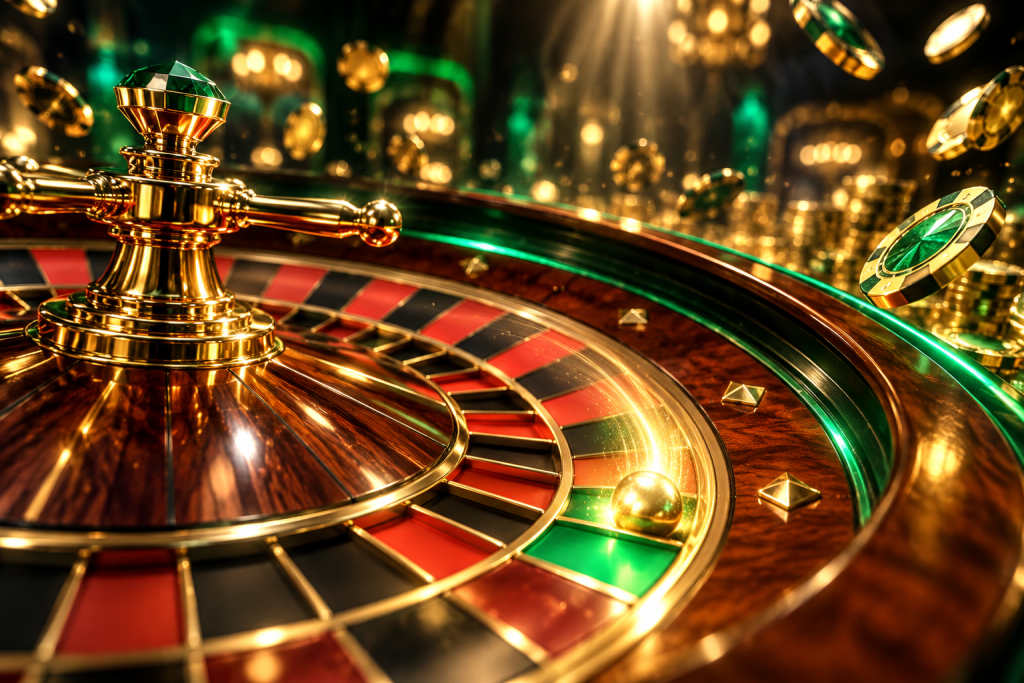
The green pocket is where the wheel's edge lives
When you bet on a single number in roulette, you are paid as if the wheel had 36 pockets, but the wheel you are playing has at least 37. That extra pocket is green. It is the reason a winning number pays less than the true odds against it, and it changes the arithmetic of every other bet on the layout.
The question of "either green" only makes sense on a wheel with two green pockets. On a European-style wheel there is one green pocket, the single zero. On an American-style wheel there are two: the single zero and the double zero. A bet on "either green" is therefore a two-number bet on an American layout, and a one-number bet on a European layout. The probability, the payout, and the house edge all shift with that difference.
Probability: what the wheel offers
A European wheel has 37 pockets total, and exactly one of them is green. If you name the green pocket as your number, the probability of it landing on any given spin is 1 in 37. An American wheel has 38 pockets, two of them green. If you want either green pocket to land, the probability is 2 in 38, which reduces to 1 in 19. If you name one specific green pocket on an American wheel, the probability is 1 in 38.
These probabilities are fixed by the physical layout of the wheel. They do not change because a number has appeared recently, because a colour has been absent for a while, or because a player has been losing. Each spin is an independent event under a functioning random number generator or a properly balanced physical wheel.
| Bet | Wheel | Winning pockets | Probability per spin | True odds against |
|---|---|---|---|---|
| Single zero | European (37 pockets) | 1 | 1 in 37 | 36 to 1 |
| Single zero | American (38 pockets) | 1 | 1 in 38 | 37 to 1 |
| Either green | American (38 pockets) | 2 | 1 in 19 | 18 to 1 |
The third row is the key one for this query. "Either green" on an American wheel is a two-number wager. The true odds against it are 18 to 1, because 36 non-green pockets exist for every 2 green ones. The house pays less than that, and the gap is the edge.
Payout versus true odds
A straight-up bet on a single number is conventionally paid at 35 to 1. On a European wheel the true odds against a single number are 36 to 1, so the payout is one unit short. On an American wheel the true odds against a single number are 37 to 1, so the payout is two units short. That shortfall is not a mistake in the player's favour; it is the mechanism by which the operator earns on the game over time.
A bet on two numbers, which is what "either green" amounts to on an American wheel, is usually paid as a split at 17 to 1. The true odds against two specific numbers on an American wheel are 18 to 1. The payout is again one unit short. The player is paid as if the wheel had 36 losing pockets, when in fact it has 36 losing pockets plus two zeroes that also lose for this bet.
House edge on the green bet
House edge and return to player are complements: for the same bet under the same rule set, they sum to 100%. The house edge is the share of each wager the operator expects to keep over a very large number of spins. It is not a per-session fee and it does not appear as a line item on a receipt, but it is built into the payout schedule.
As an example, suppose a player wagers 1 unit on a single zero on a European wheel, and the bet pays 35 to 1. Over 37 spins in which each number lands once, the player receives 35 units for the winning spin and loses 1 unit on each of the other 36 spins, for a net loss of 1 unit out of 37 wagered. That is an expected loss of roughly 2.7 units per 100 wagered. The same arithmetic on an American wheel, where the wheel has 38 pockets and the payout is still 35 to 1, produces a larger expected loss because there is one additional losing pocket.
For an "either green" bet on an American wheel, suppose the payout is 17 to 1. Over 38 spins in which each pocket lands once, the two green pockets each pay 17 units, for 34 units returned, while the other 36 spins lose 1 unit each. The player has wagered 38 units and received 34, a net loss of 4 units out of 38 wagered. That is an expected loss of roughly 10.5 units per 100 wagered, which is materially worse than a single-zero bet on the same wheel. The two green pockets do not rescue the bet; they are the losing pockets that create the edge.
Short sessions and long-run averages
The expected loss is a long-run statistical average, not a prediction of any single session. A player can hit a green pocket on the first spin, or miss it for fifty spins. The probability of a 1-in-19 event failing many times in a row is not zero, and short sessions are dominated by variance rather than by the house edge. The edge operates through a very large number of independent trials; in a few dozen spins, almost any outcome is possible.
What the edge does control is the rate at which money leaks away on average, and that rate is set by two things: the edge per bet and the number of bets placed. A bet with a larger edge loses faster on average than a bet with a smaller edge, and a player who places more bets per hour exposes more total wagered money to the edge. Slowing down does not remove the edge, but it reduces total exposure for a given bankroll.
Why no progression changes the green odds
Betting systems that increase the stake after a loss, or double it, or chase a colour, do not alter the probability of a green pocket landing. They redistribute outcomes: a progression produces many small wins and occasional large losses, or the reverse, depending on the system. The expected loss remains the edge multiplied by total wagered. If a player wagers 1,000 units over a session on a bet with a given edge, the expected loss is the same whether those units were wagered in a flat pattern, a rising pattern, or a falling pattern.
A common misreading is that a green pocket is "due" after a long absence. The wheel has no memory. The probability of either green pocket on an American wheel is 1 in 19 on every spin, regardless of the previous sequence. A long run without green does not increase the probability of green on the next spin, and a recent run of green does not decrease it.
What you can choose
The player's real choices are the wheel type, the bet type, and the pace of play. A European-style wheel with a single zero carries a smaller edge on most bets than an American-style wheel with two zeroes, because the extra pocket is a losing pocket for nearly every wager on the layout. Within a given wheel, different bets carry different edges, and the "either green" bet on an American wheel is among the worse choices because it combines a two-number payout with the double-zero structure.
The game information panel or the table layout itself will state the wheel type, the payout schedule, and any rule variations. Reading that panel before placing a bet is the only reliable way to know which wheel you are on and what the bet pays. The arithmetic above applies to the standard layouts; a specific table may advertise a different payout, and that changes the edge.
FAQ
Does betting on both green pockets at once improve my odds?
It increases the probability of winning on any given spin, because you now cover two pockets instead of one. But the payout is reduced accordingly, and the house edge on the combined bet is higher than on a single-zero bet. Covering more numbers does not turn a negative-expectation bet into a positive one.
What is the payout if I bet on green and it hits?
A straight-up bet on one green pocket is normally paid at 35 to 1. A two-number bet covering both green pockets on an American wheel is normally paid at 17 to 1. The exact payout is printed on the table layout or in the game rules, and it is the number to check before wagering.
Is the green pocket the only reason the house has an edge in roulette?
On a European wheel, the single green pocket is the main source of the edge on outside bets and straight-up bets. On an American wheel, the two green pockets increase the edge further. The payout schedule being short of true odds is the mechanism; the green pockets are the physical pockets that make the schedule short.
Gambling involves risk. Please only gamble with funds that you can comfortably afford to lose. While we do our best to provide good advice and information, we cannot be held responsible for any loss that may be incurred as a result of gambling. We do our best to make sure all the information that we provide on this site is correct. However, from time to time, mistakes or changes may occur. We cannot guarantee that all information is correct at all times. We do not offer any legal or financial advice. Please check the specific rules and regulations in your location before engaging in any gambling activity. If you or someone you know is struggling with gambling addiction, help is available. Consider reaching out to organisations like the National Council on Problem Gambling (NCPG) at the helpline printed in the footer below, or visit GamCare for support and resources.
Play responsibly
Gambling should be treated as paid entertainment, never as a way to earn income or recover losses. 1-800-MY-RESET (1-800-697-3738)
18+ or 21+ depending on where you are; follow the minimum age that applies to you.
This article is general information about how these mechanics work. It is not legal advice and not a recommendation to gamble or to use any particular operator. Availability and legality differ by jurisdiction — check the rules that apply where you are.