


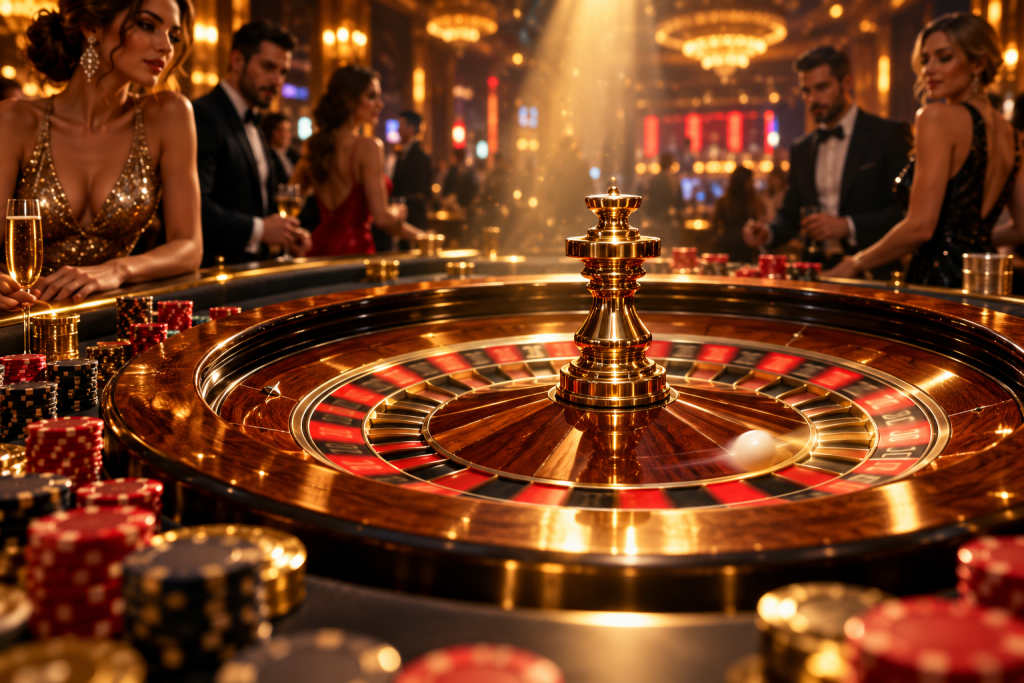
The board lights up after someone wins
A player walks past a roulette table and sees a screen glowing with numbers. Some are marked hot, others cold. The implication is that the wheel has been landing on certain numbers more often, and that this tells you something about where the ball will go next. The display is real, but what it records is narrower than it looks: a list of recent outcomes on that specific table, usually over a fixed number of spins the venue chooses. It is a history, not a forecast.
Roulette is a game of independent trials. Each spin starts from the same physical setup, and the result of one spin does not change the probability distribution of the next. A number that has appeared three times in the last twenty spins is not more likely to appear on spin twenty-one. The wheel has no memory, and the ball has no preference. What the hot-numbers display does is make variance visible: over a short stretch, some numbers will appear more often than others purely by chance, and the display simply highlights that.
How a hot number is determined
The method behind the display varies by table and by software. Some systems count the last fifty spins, others the last twenty or the last hundred. Some mark a number hot when it has appeared twice in that window, others when it leads the frequency count. The important point is that the window is arbitrary. Change the window and the hot numbers change, without any change in the wheel itself.
On a physical wheel, the display is generated by a sensor in the pocket and a small computer that logs outcomes. On an online game, the same display is generated from the random number generator's output history. In both cases, the display is a report of what has already happened. It does not influence the mechanism that produces the next result.
| What the display shows | What it does not show |
|---|---|
| Which numbers appeared most often in a recent window | Which numbers are more likely to appear next |
| A pattern created by short-run variance | A bias in the wheel or the software |
| History on one table or one game | Anything about a different table or a different session |
| An arbitrary window chosen by the operator | A statistically meaningful sample of spins |
A physical wheel can, in principle, develop a mechanical bias: a worn pocket, a slightly tilted rotor, a fret that catches the ball. Detecting such a bias would require thousands of recorded spins and careful statistical work, and casinos monitor their wheels for exactly this reason. The hot-numbers board is not that analysis. It is a marketing-grade summary of recent results, and it is not designed to reveal exploitable information.
The edge is built into the wheel, not the display
Every bet on roulette carries a house edge that exists independently of which numbers are hot or cold. The edge comes from the structure of the wheel: the payout for a winning bet is slightly less than the true odds against that bet. On a European wheel, there are 37 pockets and a single zero. A straight-up bet on one number pays 35 to 1, but the true odds against hitting that number are 36 to 1, because there are 36 ways to lose and one way to win. The gap between the payout and the true odds is the house edge.
The same arithmetic applies to every other bet on the layout. A split bet covers two numbers and pays 17 to 1, but the true odds are 35 to 2. A street bet covers three numbers and pays 11 to 1, but the true odds are 34 to 3. The payout is always short by the same proportion, and that proportion is the edge. The American wheel adds a double zero, which increases the number of losing pockets without changing the payouts, and that widens the gap further.
RTP and house edge are complements: for the same bet under the same rule set, they sum to 100%. If a game returns a certain percentage to players over a very large number of spins, the house edge is the remainder. The hot-numbers display does not change either figure. A number that has been hot has the same edge on the next spin as a number that has been cold, because the payout and the true odds are unchanged.
What a hot number strategy does
Players sometimes bet on hot numbers because they believe the streak will continue. Others bet on cold numbers because they believe a number is due. Both beliefs rest on the same misunderstanding: that past spins change the probability of future spins. They do not. The wheel does not compensate for a number that has been absent, and it does not continue a streak because a number has been present. Each spin is an independent event with the same probability distribution.
What changes when you follow a hot-number strategy is not your chance of winning, but the pattern of your results. Betting on a number that has appeared recently means you are betting on a number that has already produced wins for someone. That feels safer, but the feeling is not information. The edge on that bet is identical to the edge on any other number.
Progression systems built on hot numbers work the same way. Suppose a player doubles their bet after each loss, reasoning that a hot number must eventually hit. The system does not change the edge on any individual spin. What it does is redistribute outcomes: most sessions end with a small win, and a small number of sessions end with a large loss that wipes out the accumulated wins. The expected loss over time is the same as flat betting, because the total amount wagered is what the edge applies to, not the pattern of the bets.
Short sessions look nothing like the long-run average
RTP and house edge are long-run statistical averages. They describe what happens over a very large number of spins, not what happens in an evening. In a short session, variance dominates. A player can win on a number that has been cold all night, or lose on a number that has been hot. Neither outcome contradicts the house edge; both are exactly what variance produces.
The number of spins per hour also matters for total exposure. A player who bets one unit per spin and sees forty spins an hour has wagered forty units in that hour. The house edge applies to the total amount wagered, not to the amount the player sat down with. The more decisions per hour, the larger the total wagered, and the larger the expected loss in absolute terms, even though the edge per bet is unchanged.
As an example, suppose a game returns 97% of wagers over a very large number of spins. That means the house edge is 3% of each wager, on average, over the long run. If a player wagers 1,000 units in a session, the expected loss is 30 units. But that is an average across many sessions. Any single session can end far above or far below that figure, and the hot-numbers display is a record of exactly that kind of short-run variation.
Where the real information lives
If a player wants to know the edge on a specific roulette game, the information is in the game's rules and payout table, not on the hot-numbers board. The wheel type matters: a single-zero wheel has a smaller edge than a double-zero wheel on the same bets. The payout for each bet type is printed on the layout. The game's published RTP, where an online operator provides one, is the complement of the edge for that game under its specific rules.
The hot-numbers display is not dishonest. It shows real results. But it is a presentation choice, not a predictive tool. The operator chooses the window, the threshold for marking a number hot, and the visual emphasis. None of those choices change the mathematics of the next spin. A player who understands that can enjoy the display as a record of recent history, without treating it as a signal.
FAQ
Do hot numbers win more often on the next spin?
No. A hot number has the same probability of appearing on the next spin as any other number on the same wheel. The display records recent results, and recent results do not change the probability distribution of future spins.
Is there any roulette system that removes the house edge?
No betting pattern removes the built-in edge on a negative-expectation game. Progression systems that increase bets after losses redistribute outcomes, producing many small wins and occasional large losses, but the expected loss over time remains the same as flat betting.
Why do hot and cold numbers appear at all if the wheel is fair?
Short-run variance produces streaks and absences in any random process. Over a small number of spins, some numbers will appear more often than others purely by chance. Over a very large number of spins, the frequencies converge toward the wheel's true probabilities, but no single session is large enough to show that convergence.
Gambling can be addictive. Play responsibly and only with money you can afford to lose. If you or someone you know is struggling with gambling, help is available—contact the National Problem Gambling Helpline at the helpline printed in the footer below.
Play responsibly
Gambling should be treated as paid entertainment, never as a way to earn income or recover losses. 1-800-MY-RESET (1-800-697-3738)
18+ or 21+ depending on where you are; follow the minimum age that applies to you.
This article is general information about how these mechanics work. It is not legal advice and not a recommendation to gamble or to use any particular operator. Availability and legality differ by jurisdiction — check the rules that apply where you are.