


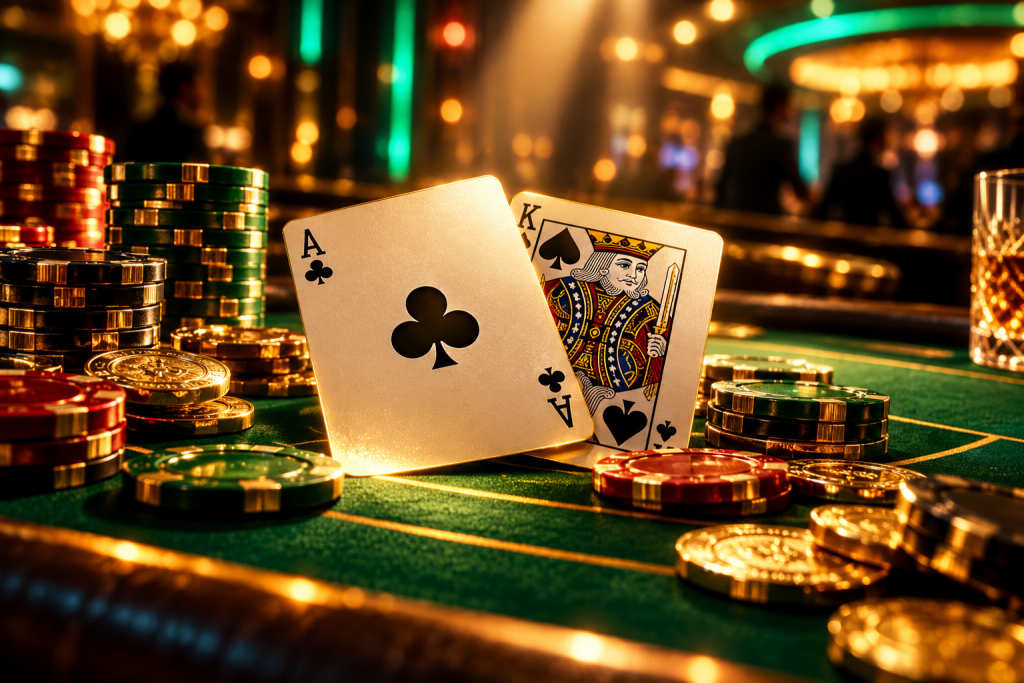
The Suit Changes Nothing About the Count
A player sitting down at a blackjack table for the first time often scans the cards and wonders whether a club counts differently from a heart, a diamond, or a spade. It does not. In blackjack, the suit printed on a card has no effect on the hand total, the payout, or any decision the player makes. A seven of clubs is worth seven, exactly like a seven of hearts. A king of clubs is worth ten, exactly like a king of spades. The suit is decoration for the purpose of scoring the game.
The only thing that matters when a card is dealt is its rank. Numbered cards from two through ten count at face value, face cards count as ten, and an ace counts as one or eleven, whichever helps the hand without pushing it over 21. That rule applies to every suit without exception. No table rule, side bet, or house variation in standard blackjack gives clubs a different value from any other suit.
Where the Confusion Comes From
The question usually comes from players who have spent time with other card games. In bridge, clubs are the lowest-ranking suit. In some poker variants, suits break ties in specific situations. In many trick-taking games, a club played at the right moment beats everything else on the table. Blackjack borrows none of that structure. It is a comparing game between the player and the dealer, and the comparison is built entirely on point totals.
A second source of confusion is the visual design of the cards themselves. Clubs look dense and dark, and a new player may unconsciously assign them more weight. The layout of a blackjack table does nothing to correct this because it never mentions suits at all. The felt shows betting circles, the dealer's rules, and sometimes the payout for a blackjack. Suit symbols appear nowhere in the decision-making information.
How a Round Works
The sequence of a hand is the same no matter what suits appear. A player buys in at the table, the dealer exchanges cash for chips, and the player places a wager in the betting circle before any cards are dealt. The dealer gives each player two cards face up and takes two cards, one face up and one face down. From that point, every decision is about the total in front of the player and the single card the dealer shows.
A player who is happy with the total can stand. A player who wants another card can hit, and may keep hitting until the total reaches 21 or goes over. A player whose first two cards match in rank may split them into two separate hands, placing an additional wager equal to the first. A player may double down, placing an additional wager equal to the original bet in exchange for receiving exactly one more card. Each of these choices changes the amount at risk or the number of cards in play, but none of them is affected by whether a card is a club.
Card Values Across Every Suit
The scoring system is compact enough to hold in a single table. Every card in a standard 52-card deck falls into one of three value groups, and the suit column is identical for all of them.
| Card rank | Point value in blackjack | Does the suit change it? |
|---|---|---|
| 2 through 10 | Face value | No |
| Jack, Queen, King | 10 | No |
| Ace | 1 or 11 | No |
The ace is the only card with a flexible value, and that flexibility exists to prevent an automatic bust. If a hand contains an ace and a six, the total can be read as 7 or 17. If the player then draws a ten, the ace drops to one so the hand stays at 17 instead of becoming 27. This adjustment has nothing to do with the ace being a club or any other suit.
What the Dealer's Upcard Tells You
Because suits are irrelevant, the only information a player extracts from the dealer's face-up card is its rank. A dealer showing a six is in a weak position regardless of whether that six is a club. A dealer showing a ten is in a strong position regardless of whether it is a ten of hearts. Strategy decisions flow from that rank and from the player's own total, never from the symbol in the corner of the card.
Published basic-strategy charts are built from the specific rule set in use at a given table. The number of decks, whether the dealer stands or hits on soft 17, whether doubling after splitting is allowed, and whether surrender is offered all shift the correct play in close situations. A chart written for one rule set may be slightly wrong for another. That is why a player who wants to use a chart should match it to the table's posted rules rather than treating any single chart as universal.
The House Edge Sits in the Rules, Not the Suits
Blackjack is a negative-expectation game, which means the operator holds a mathematical advantage on every wager over the long run. That advantage comes from the structure of the game: the player acts first and can bust before the dealer ever plays a hand. It does not come from any arrangement of suits, and no suit distribution changes it.
What does change the expected rate of loss is the rule set. A table where the dealer stands on all 17s gives back more to players over a very large number of hands than a table where the dealer hits soft 17, all else being equal. A table that allows doubling after splitting is more favourable than one that does not. These differences are real and measurable, but they are differences in table policy, not in the cards' suits. A player looking for the better game should read the felt and the posted rules, not hope for a run of clubs.
Side Bets Are the One Place Symbols Can Appear
Some blackjack tables offer optional side bets, and a few of those side bets do care about suits. A side bet that pays for a suited pair, for example, only pays when the two matching cards share a suit. A side bet built around a flush pays when the cards are all the same suit. In those narrow cases, a club matters because the side bet's paytable says it matters.
That does not change the main game. The side bet is a separate wager with its own house edge, usually higher than the main blackjack bet. A player who places a side bet is making two independent bets at once: one on the blackjack hand, where suits are irrelevant, and one on the side condition, where suits may be everything. The two should not be confused. The presence of a club on the table can win a side bet and simultaneously mean nothing for the hand itself.
Procedural Mistakes That Cost New Players
The first common mistake is touching the cards. In most shoe-dealt games, players never touch the cards at all; the dealer handles everything. In pitch games where cards are dealt face down, players are expected to hold them with one hand and keep them above the table. Reaching for a card in a shoe game, or handling a face-down card with two hands, will draw a correction from the dealer. The suit of the card is not the issue; the handling is.
The second mistake is signalling unclearly. A player who wants to hit should tap the felt behind the bet or use the hand signal the table expects. A player who wants to stand should wave a hand horizontally. Mumbling a decision or pointing at cards can be misread, and a misread signal can produce an unwanted card. The dealer is watching for a clear, consistent gesture, not for anything related to clubs or spades.
The third mistake is treating a soft hand as if it were hard. A hand containing an ace counted as 11 is soft, and it cannot bust from a single hit. A player holding an ace and a six has a soft 17 and may hit with no risk of busting on the next card. A player holding a ten and a seven has a hard 17 and should usually stand. The distinction is about the ace's flexibility, not about which suit the ace carries.
What Changes and What Stays Fixed
Across every blackjack table, the core scoring is fixed: suit is irrelevant, rank is everything, and the goal is a total closer to 21 than the dealer's without exceeding it. What varies from table to table is the rule set, the number of decks, the side bets on offer, and the minimum and maximum wagers. A player who understands which parts are fixed and which parts vary can sit down at any table and read it correctly.
| Element of the game | Fixed or variable | Where to find it |
|---|---|---|
| Card point values | Fixed | Standard blackjack rules |
| Suit has no scoring effect | Fixed | Standard blackjack rules |
| Dealer stands or hits on soft 17 | Variable | Printed on the table felt |
| Number of decks | Variable | Posted at the table or in the game information panel |
| Doubling and splitting rules | Variable | Printed on the table felt |
| Side bets and their paytables | Variable | Posted at the table or in the game information panel |
The table felt is the player's best reference. It carries the rules that govern the specific game in front of them, and those rules are what a strategy chart must match. A player who memorises a chart for one rule set and applies it to another is making decisions on slightly wrong information, even though the card values themselves never change.
FAQ
Does a club beat a spade in blackjack?
No. No suit beats any other suit in blackjack. The game compares only point totals, so a hand of 18 made from clubs ties or loses to a hand of 19 made from spades exactly as it would if the suits were reversed.
Are face cards of clubs worth more than numbered clubs?
A face card of any suit is worth ten. A numbered club is worth its printed number. The comparison is between ranks, not between suits, so a king of clubs and a king of hearts are identical in value.
Do any blackjack side bets make clubs worth more?
Some side bets pay for suited outcomes, such as a suited pair or a flush. In those side bets, a club can matter because the paytable rewards a specific suit combination. The main blackjack hand remains unaffected, and the side bet carries its own separate house edge.
Play responsibly
Gambling should be treated as paid entertainment, never as a way to earn income or recover losses. 1-800-MY-RESET (1-800-697-3738)
18+ or 21+ depending on where you are; follow the minimum age that applies to you.
This article is general information about how these mechanics work. It is not legal advice and not a recommendation to gamble or to use any particular operator. Availability and legality differ by jurisdiction — check the rules that apply where you are.