


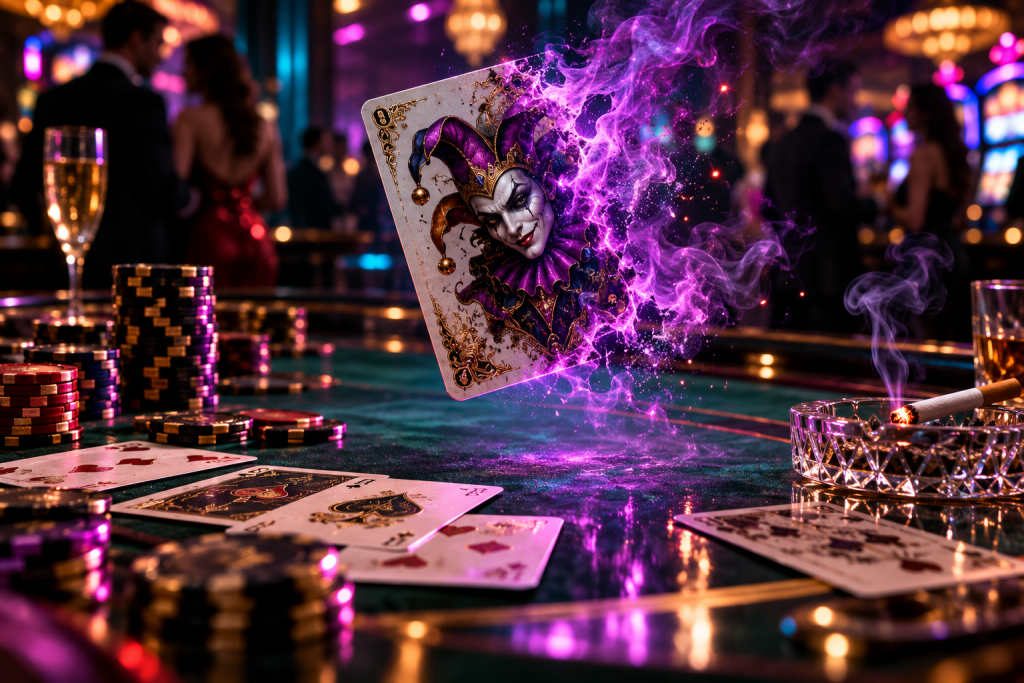
The Card That Is Not in the Shoe
You sit down at a blackjack table, buy in, and watch the dealer spread the cards. If you look closely, you will never see a joker. That absence is not an accident or a house preference; it is built into the arithmetic of the game. Blackjack is played with a standard 52-card deck, and the joker is a 53rd and 54th card that the game simply does not use. When a player asks what the joker means in blackjack, the honest answer is that it means nothing, because it is not dealt.
What makes the question worth asking is that the joker does exist in other card games, and some of those games are played on a casino floor. The confusion usually comes from seeing a joker in a video poker machine, a home poker game, or a novelty blackjack variant, and assuming the card carries over. It does not. Understanding why requires knowing what the joker is for, and what blackjack's deck is designed to do.
What the Joker Is, and Where It Lives
The joker is a wild card in many games, meaning it can stand in for whatever card the player needs to complete a hand. In some forms of poker, a joker can fill a straight or a flush. In certain video poker pay tables, a joker appears as a designated wild symbol that substitutes for any other card to form a paying combination. In children's card games and some home variants, the joker may carry a special action or a point value.
Blackjack has no use for a wild card because the game's entire payout structure depends on a fixed, known set of card values. A wild card would break the mathematics that the player and the dealer both rely on. The dealer's upcard, the player's decision to hit or stand, and the published strategy charts all assume that a ten-value card is one of sixteen specific cards in the deck, that an ace is one of four, and that no card can change its identity after it is dealt. A joker would introduce a card with no fixed value, and blackjack does not have a rule for that.
How the Blackjack Deck Is Built
A standard deck contains 52 cards: four suits of thirteen ranks each, from ace through king. In a single-deck blackjack game, that is the entire shoe. Many tables use multiple decks shuffled together, commonly two, six, or eight, but each of those decks is still a complete 52-card deck. The jokers that ship with a physical pack of cards are removed before the deck is put into play.
The values in blackjack are simple and fixed. Numbered cards from two through ten count as their face value. Face cards — jack, queen, and king — each count as ten. An ace counts as either one or eleven, whichever gives the hand the better total without exceeding 21. Because there are sixteen ten-value cards in every 52-card deck, the most common card value in the game is ten. That concentration is what makes the dealer's upcard so informative, and what makes a hand of 12 through 16 so dangerous to hit.
| Card | Value in blackjack | Count per 52-card deck |
|---|---|---|
| 2 through 10 | Face value | 4 of each rank |
| Jack, Queen, King | 10 | 12 total |
| Ace | 1 or 11 | 4 |
| Joker | Not used | 0 |
Because the joker has no value in this system, it cannot appear in any published strategy chart, any payout table, or any rule set for standard blackjack. If a table or a machine ever displays a joker, the reader is looking at a different game, or a variant with its own separate rules.
When a Joker Does Appear in a Casino Game
The joker is not a casino-wide outlaw. It appears in specific games where the rules are written around it. The most common sighting is in video poker, where certain pay tables, often labelled as Joker Poker or Joker Wild, include a single joker in the deck as a wild card. The pay table is adjusted to account for the joker's presence, which changes the frequency of paying hands and therefore the game's return profile.
Some table-game side bets or novelty blackjack variants may use a joker as a promotional symbol or as part of a separate bonus wager. In those cases, the joker is not part of the main blackjack hand. The base game still runs on the standard 52-card deck, and the joker, if it appears at all, lives only inside the side bet's own rules. A player who sees a joker printed on a blackjack layout should read the side-bet terms carefully, because the card's meaning there is defined by that specific wager, not by blackjack itself.
Outside the casino, the joker is a standard part of a 54-card pack, and many home card games assign it a role. Euchre uses a joker as the highest trump in some versions. Canasta uses jokers as wild cards. Rummy variants sometimes include them. None of those roles transfers to a blackjack table.
The Sequence of a Blackjack Round, Without the Joker
Because the deck is fixed, the round follows a predictable sequence from buy-in to settlement. The player buys chips at the cage or from the dealer, then places a wager in the betting circle. The dealer deals two cards to each player and two to the house, typically one dealer card face up and one face down, though the exact procedure varies by table rule. The player then acts on the hand.
The decision points are where the game's strategy lives. The player may stand, keeping the current total. The player may hit, taking another card, and may keep hitting until the hand busts by exceeding 21. The player may double down on certain totals, placing an additional wager equal to the original in exchange for exactly one more card. If the first two cards are a pair, the player may split them into two separate hands, each with its own additional wager. Some tables also offer surrender, letting the player forfeit half the wager and end the hand before the dealer plays.
After all players have acted, the dealer reveals the hole card and plays according to a fixed rule, usually standing on all totals of 17 or higher and hitting on 16 or lower, with a specific rule for whether a soft 17, a hand containing an ace counted as 11, is hit or stood. The dealer has no discretion. The hand closest to 21 without exceeding it wins. A player total that beats the dealer's total pays even money. A blackjack, an ace plus a ten-value card on the first two cards, typically pays 3 to 2, though some tables pay 6 to 5, which is a materially worse return for the player.
What Changes the House Edge, and What Does Not
Blackjack's house edge is not a single number printed on the table. It is the product of the exact rule set in force, and different tables in the same building can carry different edges. The number of decks, whether the dealer hits or stands on soft 17, whether doubling after splitting is allowed, whether surrender is offered, and the payout on a natural blackjack all move the edge. A table that pays 6 to 5 on blackjack gives the house a larger share of each wager than a table that pays 3 to 2, all else equal.
Published basic-strategy charts are derived from a specific rule set. A chart built for a six-deck game where the dealer stands on soft 17 and doubling after splitting is allowed will not be exactly correct for a single-deck game with different rules. The player who wants to use a chart should match it to the table's posted rules, not to a generic memory of how blackjack is played.
| Rule variant | Direction of house edge | What it changes for the player |
|---|---|---|
| Fewer decks | Lower edge, all else equal | Changes the value of hitting and standing decisions |
| Dealer hits soft 17 | Higher edge | Dealer improves more weak hands |
| Doubling after split allowed | Lower edge | More aggressive play on split pairs |
| Surrender offered | Lower edge | Player can cut losses on weak totals |
| Blackjack pays 6 to 5 instead of 3 to 2 | Higher edge | Natural blackjack pays less |
The joker plays no part in any of this. The edge comes from the fixed composition of the deck and the rules that govern how the dealer must play. Removing the joker is not a house decision designed to tilt the game; it is the baseline condition under which the game's mathematics are defined.
Procedural Mistakes That Cost New Players
The mistakes that hurt new blackjack players are rarely about the joker. They are procedural, and they are visible at the table every night. The first is touching the cards. In most shoe-dealt games, the player never touches the cards at all; the dealer handles everything. In hand-held games where the cards are dealt face down, the player may touch them, but only with one hand and only above the table. Reaching for the cards in a shoe game, or handling them with two hands, will draw an immediate correction from the dealer and can void the hand.
The second is signalling unclearly. The dealer reads hand signals, not spoken words, because the table is recorded and the signals are the auditable record of the player's decision. A tap on the felt means hit. A wave of the hand means stand. Placing an additional wager next to the original, not on top of it, signals a double down. A player who says one thing and signals another creates a dispute that the floor supervisor must resolve, and the resolution will follow the signal, not the words.
The third is misunderstanding the payout. A player who sits at a 6-to-5 blackjack table without noticing the printed payout has accepted a worse game than the one they may have intended to play. The payout is printed on the layout, and the player should read it before the first bet goes down. The same applies to the rule card that states whether the dealer hits soft 17 and whether surrender is available. Those two printed items, the payout and the rule card, carry more information about the table's edge than any conversation with the dealer.
How to Confirm What a Table Is Using
The deck composition is not a secret. The shoe, the discard tray, and the dealer's procedure are all visible. A player who wants to confirm that no joker is in play can simply watch the cards as they are dealt, or ask the dealer how many decks are in the shoe. The answer will be a number of standard 52-card decks, and the jokers will have been removed before the cards were ever shuffled.
The rules that matter are posted. The table layout prints the blackjack payout. A placard or a screen at the table states the deck count, the dealer's soft-17 rule, and the available options such as surrender and doubling after split. The player who reads those two sources before betting knows more about the game they are playing than most of the table. The joker, for its part, will not be mentioned anywhere, because it is not part of the game.
FAQ
Can a joker ever be used as a wild card in blackjack?
Not in standard blackjack. The game uses only the 52-card deck, and no wild card exists in the base rules. If a joker appears in a blackjack-themed game, it belongs to a side bet or a separate variant with its own pay table, and the main hand is still played without it.
Why do card decks come with jokers if casinos do not use them in blackjack?
The joker is included in a standard 54-card pack because many other games use it, including euchre, canasta, and some forms of poker and video poker. Casinos that spread blackjack remove the jokers before the decks enter the shoe, just as they would remove any card that is not part of the game's defined deck.
Does the number of decks change whether a joker is used?
No. A single-deck game uses one 52-card deck, a six-deck game uses six 52-card decks shuffled together, and an eight-deck game uses eight. In every case, each deck is a complete 52-card deck with the jokers removed, so the joker is absent regardless of how many decks are in the shoe.
Play responsibly
Gambling should be treated as paid entertainment, never as a way to earn income or recover losses. 1-800-MY-RESET (1-800-697-3738)
18+ or 21+ depending on where you are; follow the minimum age that applies to you.
This article is general information about how these mechanics work. It is not legal advice and not a recommendation to gamble or to use any particular operator. Availability and legality differ by jurisdiction — check the rules that apply where you are.