


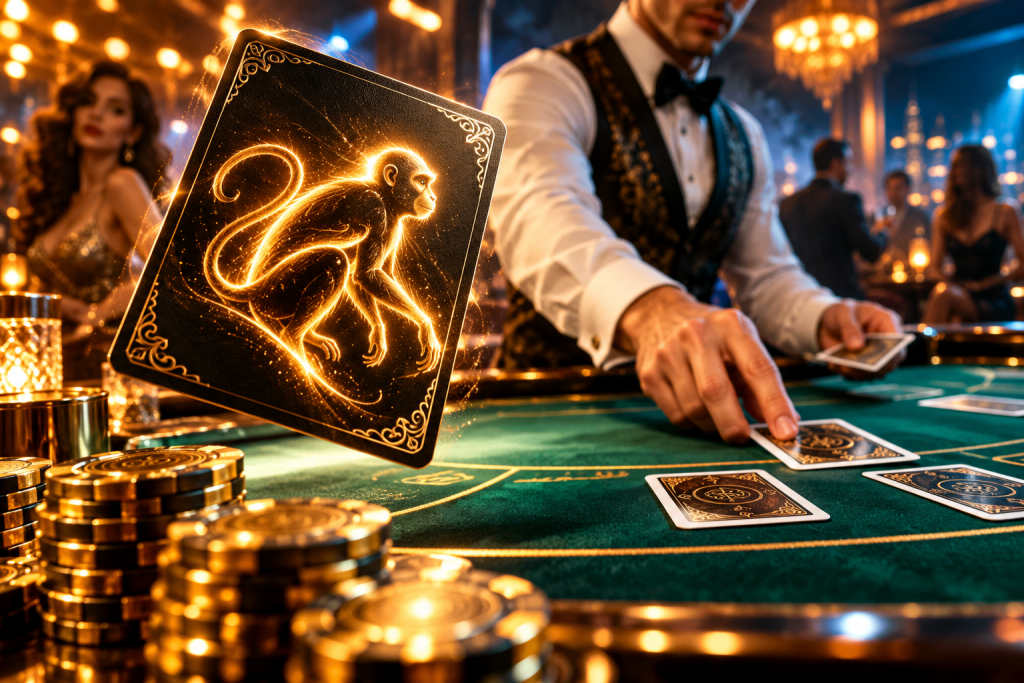
The call you hear when a player needs a ten
A player on a hard twelve against a dealer's six taps the felt behind their cards and says "monkey, monkey." They are not asking for an animal. They are asking the shoe for any card worth ten: a ten, a jack, a queen, or a king. The word is blackjack table slang, and once you know it, you will hear it in every session you ever play.
The request makes sense because of how blackjack hands are built. A hard twelve is a weak total, but it becomes a strong 21 if the next card carries a value of ten. The player is not changing the odds by asking. They are voicing the one outcome that would fix the hand. The dealer will deal whatever the shoe holds, and no amount of tapping or naming changes that.
Where the term comes from
The origin is not documented in any rulebook, and no casino prints the word on its layout. The most common account traces it to the face cards. A jack, queen, or king wears a crown, and a crowned figure reads as royalty. Another account points to the old mechanical shuffling machines and the way a ten-value card could swing a hand the way a monkey swings from a branch. Neither story is verifiable, and both survive because table slang travels by word of mouth.
What matters is the function. "Monkey" is a request for a ten-value card, and it is used as a noun, a verb, and a chant. A player can say "give me a monkey," "monkey it," or simply "monkey" as the card is about to leave the shoe. The dealer understands all three. Nobody at the table is confused about what is being asked.
Why ten-valued cards matter so much
A standard deck holds 52 cards. Four of them are tens, and twelve of them are ten-valued once you count the jacks, queens, and kings. That means 16 of every 52 cards, or a little under a third of the deck, carry the value a monkey-caller wants. No other value appears that often. Aces appear four times in 52 cards. Sevens appear four times. Tens, in the broad sense, appear sixteen times.
That concentration is the quiet engine of the whole game. It is why a dealer's upcard of six is considered weak: the dealer is likely to draw a ten-value card and bust. It is why doubling on eleven is attractive: a ten-value card makes 21. And it is why the monkey call exists at all. When a player needs one specific value to turn a hand around, the ten is the most likely single value to appear.
But "most likely single value" is not a promise. The next card is still more likely to be something other than a ten than it is to be a ten. The player who calls for a monkey and receives a five has not been cheated. They have simply seen the more probable outcome.
The sequence of a hand where the call appears
The monkey call usually lands at one of three moments. The first is after the initial deal, when a player holds a hard total between twelve and sixteen and wants a ten to complete a strong hand. The second is on a double down, when the player has put out an additional wager and will receive exactly one more card. The third is when the dealer has a low upcard and the table is hoping the dealer's hole card and draw card are both ten-valued, which would bust the dealer's hand.
None of these moments changes the procedure of the round. The player has already committed to the hand. The call is a wish, not an instruction to the dealer, and the dealer's only job is to deal the next card from the shoe according to the table rules. A player who taps the felt, names a card, or chants does not receive a different card than a silent player in the same seat would have received.
What the monkey call does not do
It does not alter the order of the cards. It does not make a ten more likely. It does not affect the house edge on the hand, and it does not function as a strategy. A player who believes the call works will sometimes press a hand they would otherwise have played more cautiously, and that is the only measurable effect: a decision made under the influence of a superstition.
Blackjack strategy comes from the specific rule set in use. The number of decks, whether the dealer stands or hits on soft seventeen, and the doubling and splitting rules all feed into published basic-strategy charts. A chart for a six-deck shoe where the dealer stands on soft seventeen is not identical to a chart for a single-deck game where the dealer hits. The monkey call belongs to the social layer of the table, not to the strategic one.
How the ten-value cards compare
| Card | Value in blackjack | Count in a 52-card deck | Role in the monkey call |
|---|---|---|---|
| Ten | 10 | 4 | Directly named |
| Jack | 10 | 4 | Counts as a monkey |
| Queen | 10 | 4 | Counts as a monkey |
| King | 10 | 4 | Counts as a monkey |
| Ace | 1 or 11 | 4 | Not a monkey |
The table shows why the call is so common. Sixteen cards in the deck satisfy it. No other request a player can make at the table has that many cards behind it. Asking for a five means hoping for one of four cards. Asking for a monkey means hoping for one of sixteen.
Other table slang you will hear alongside it
Slang clusters. A player who calls for a monkey may also refer to a hard hand as a "stiff," meaning a total between twelve and sixteen that can be broken by a single ten-value card. A soft hand is one that contains an ace counted as eleven. "Paint" is another word for a face card, and "pat hand" means a two-card total of seventeen or higher that the player will not hit. These terms are not official, but they are stable enough that a new player can learn them in one session.
The important distinction is between slang and rules. Slang describes what players feel about the cards. Rules describe what the dealer must do with them. A dealer who must hit sixteen and stand on seventeen is following the table rules, not responding to the mood of the table. The monkey call lives entirely on the players' side of that line.
The odds behind the request
Suppose a single deck has been shuffled and no cards have been dealt. The chance that the first card off the top is a ten-valued card is 16 in 52. If a player has already seen their own two cards and the dealer's upcard, and none of those three cards is a ten, the remaining deck contains 16 ten-valued cards among 49 unseen cards. The chance shifts slightly, but it never becomes a certainty.
That is the honest shape of the monkey call. It asks for the most common single value in the deck, and even so, the request fails more often than it succeeds. A player who understands that can still enjoy the call. It is a piece of table theatre, a way to share a moment with the other players, and a reminder that everyone at the table is hoping for the same sixteen cards.
Procedural mistakes that cluster around the call
The first mistake is treating the call as a strategy. A player who hits a sixteen against a dealer's ten because they "feel a monkey coming" has abandoned the basic-strategy chart for a superstition. The chart says to hit or stand based on the rule set in use, and the call does not enter the calculation.
The second mistake is touching the cards. In most shoe-dealt games, players never touch the cards at all. The dealer handles everything. A player who taps the felt near the cards is fine; a player who reaches for the cards will be corrected immediately. The monkey call is spoken, not handled.
The third mistake is directing the dealer. A player who says "monkey" is not giving an instruction, and a dealer who draws a four has not disobeyed. The dealer deals according to the table procedure. A player who treats the call as an order creates friction at the table for no reason.
What the call reveals about the game
Blackjack is a comparing card game. The objective is a hand total closer to 21 than the dealer's without exceeding it. Everything else at the table, from the monkey call to the tap on the felt, is the social membrane around that objective. The call is not in any rulebook, it is not taught in any strategy guide, and it does not appear on any chart. It survives because it names the one card that can turn a bad hand into a good one, and because sixteen cards in every deck answer to it.
A new player who learns the term before sitting down has one less thing to decode at the table. The dealer's announcements, the other players' chatter, and the rhythm of the shoe all become easier to read once you know that a monkey is just a ten with a better name.
FAQ
Is calling for a monkey considered rude at a blackjack table?
No. It is common table chatter and dealers hear it constantly. It only becomes a problem when a player treats it as an instruction or complains when the requested card does not arrive. Spoken lightly, it is part of the social texture of the game.
Does the monkey call work better on a single deck than on a shoe?
The proportion of ten-valued cards is the same in any standard deck, but the composition of the remaining cards changes as cards are dealt. On a single deck, each visible card shifts the odds more than it does in a six-deck shoe. The call itself has no effect in either format.
What is the difference between a monkey and paint?
Paint refers specifically to face cards: jacks, queens, and kings. A monkey includes those three plus the ten card, since all four carry a value of ten. A player asking for paint is asking for twelve cards in the deck; a player asking for a monkey is asking for sixteen.
If you or someone you know needs support with gambling, contact the helpline printed in the footer below. Play within your limits, and remember that outcomes are never guaranteed.
Play responsibly
Gambling should be treated as paid entertainment, never as a way to earn income or recover losses. 1-800-MY-RESET (1-800-697-3738)
18+ or 21+ depending on where you are; follow the minimum age that applies to you.
This article is general information about how these mechanics work. It is not legal advice and not a recommendation to gamble or to use any particular operator. Availability and legality differ by jurisdiction — check the rules that apply where you are.