


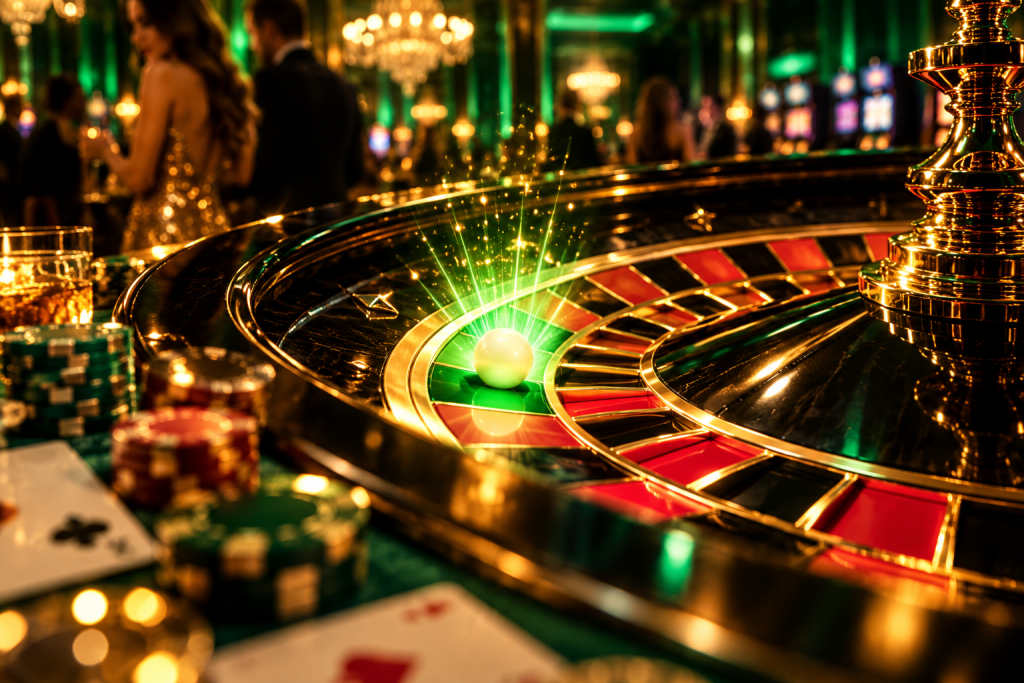
The green pocket is the one outcome that breaks every pattern
Walk up to a roulette table and you will see the same colour split on every wheel: red numbers, black numbers, and one or two green pockets marked 0 and 00. A player who has been betting red or black, odd or even, or high or low has been playing a near-even proposition. The green pocket is the reason it is not even. When the ball settles there, every one of those outside bets loses at once, and the table keeps the wagers. That single outcome is the mathematical engine of the whole game.
Roulette is built so that the payout on a winning outside bet is slightly smaller than the true odds of winning it. The green pocket is where that gap lives. A European wheel has 37 pockets: 18 red, 18 black, and one green zero. A bet on red pays 1:1, but the chance of red is 18 in 37, not 18 in 36. The missing fraction is the zero. An American wheel has 38 pockets because it adds a second green pocket, the double zero, which widens the gap further.
What happens to each bet when green hits
The settlement depends entirely on where your chips are sitting. Roulette bets fall into two broad families, and green treats them very differently.
| Bet type | What green does to it | Why |
|---|---|---|
| Straight-up on 0 or 00 | Wins at fixed odds, usually 35:1 | The green pocket is a number like any other for an inside bet placed directly on it |
| Other inside bets (split, street, corner, six-line) | Loses | Green is not part of the covered numbers, so the wager is collected |
| Red, black, odd, even, high, low | Loses | Green is neither red nor black, neither odd nor even, and sits outside the high/low split on most layouts |
| Dozens and columns | Loses | Zero and double zero are not included in any dozen or column grouping |
There is one partial exception worth knowing: some tables, mostly on European single-zero wheels, offer a rule called la partage or en prison. Under those rules, an even-money outside bet that loses to zero is not collected in full. La partage returns half the stake immediately; en prison holds the bet in place for the next spin, where it either wins and is released or loses and is collected. These rules soften the blow of the green pocket on even-money bets, but they apply only where the table advertises them, and only to the outside bets named in the table rules.
Why the green pocket changes the arithmetic of every other bet
The green pocket does not just punish outside bets when it lands. Its existence changes the odds on every spin, including the spins where it does not appear. House edge and RTP are complements: for the same bet under the same rule set, they sum to 100%. The edge exists because the payouts are calibrated against a wheel that contains one or two extra pockets.
On a European wheel, a straight-up bet on any single number pays 35:1. The true odds against hitting that number are 36:1, because there are 37 pockets and only one wins. The difference between 36:1 true odds and 35:1 paid odds is the house edge on that bet. The green pocket is simply the most visible member of that 37-pocket set. The same logic applies to every bet on the layout: the payout is fixed, the wheel has 37 or 38 pockets, and the gap between the two is the operator's mathematical advantage.
An American wheel adds a second green pocket and changes the arithmetic again. The extra pocket increases the house edge on the American layout compared with the European layout, because every payout stays the same while the number of losing pockets grows by one. This is the single most important structural difference between the two wheel types, and it is why the first question a new player should ask at any table is how many green pockets the wheel carries.
The sequence of a round, from buy-in to settlement
Understanding what green does is easier when you see where it sits in the flow of a spin. A round at a roulette table moves through a fixed sequence, and the green pocket only matters at the final step.
You buy in at the table by placing cash on the layout; the dealer exchanges it for roulette chips, which are colour-coded to you and carry no cash value away from that table. You place bets on the layout until the dealer announces that no more bets are accepted. The dealer spins the wheel in one direction and sends the ball travelling the other way around the outer track. When the ball drops into a pocket, the dealer places a marker on the winning number on the layout, collects all losing bets, and then pays winning bets. Only after the losing bets are cleared and the winning bets are paid does the next round of betting open.
The green pocket matters at the collection step. If the ball is in 0 or 00, the dealer's marker goes on that green number, and every bet that does not include it is swept. A player who has bet on the green number itself is paid at the table's posted straight-up odds before the next round begins.
What the player controls, and what the wheel controls
Nothing a player does changes the fact that the green pocket is on the wheel, or how often it is expected to appear over a very large number of spins. What the player does control is which bets they place, and therefore how the green pocket affects them when it arrives.
A straight-up bet on zero means the green pocket is your winning number rather than the table's. That does not make it a better bet; it pays 35:1 against 36:1 true odds on a European wheel, so the edge still sits with the house. It simply changes the shape of the outcome: rare wins instead of frequent small losses. A player who covers red, black, and zero on the same spin has not removed the edge either; they have redistributed it across more of the layout while still leaving uncovered pockets that lose.
The decision points at a roulette table are narrower than at a card table. There is no strategy chart that changes the odds, because no decision after the spin begins affects the outcome. The only choices are which bets to place, how much to stake, and when to stop. Roulette is a game of fixed probabilities and fixed payouts, and the green pocket is the clearest expression of both.
Procedural mistakes new players make around the green
The first mistake is assuming that red or black is a coin flip. It is close, but the green pocket makes it worse than even, and a player who sizes their bets as if it were a true 50/50 proposition is misreading the table. The second is betting on both zero and double zero on an American wheel without realising that each is a separate straight-up bet with its own 35:1 payout and its own house edge. Covering both does not combine them into a single stronger bet; it places two independent wagers. The third is placing a late bet after the dealer has called no more bets, which is void or returned depending on the table's procedure, and which often happens when a player sees the ball slowing near the green and tries to react. The ball's final pocket is already determined by physics by the time it is visibly slowing; the no-more-bets call exists to close the window before that information becomes readable.
Strategy charts exist for games where decisions change the outcome after the cards are dealt. Roulette has no such chart, because no decision after the spin changes where the ball lands. What a player can read instead is the table's own posted information: the wheel type, the payout schedule, and any special rules such as la partage or en prison that apply to even-money bets when green appears.
FAQ
Does the green pocket pay more than other numbers?
No. On a standard layout, a straight-up bet on 0 or 00 pays the same fixed odds as a straight-up bet on any other single number, usually 35:1. The green pocket is not a jackpot number; it is simply another pocket with the same payout and the same house edge as every other straight-up bet.
What is the difference between 0 and 00?
They are two separate pockets and two separate straight-up bets. A European wheel has only the single zero; an American wheel has both. The double zero is the extra pocket that increases the house edge on the American layout, because every payout remains the same while the wheel gains one more losing pocket.
Can I bet on green as a colour?
No. The colour bets on a roulette layout are red and black only. Green is not offered as a colour wager. The only way to bet on the green pocket is to place a straight-up bet on the zero or double zero number itself, or to include it in a combination bet that covers it as one of the numbers.
Play responsibly
Gambling should be treated as paid entertainment, never as a way to earn income or recover losses. 1-800-MY-RESET (1-800-697-3738)
18+ or 21+ depending on where you are; follow the minimum age that applies to you.
This article is general information about how these mechanics work. It is not legal advice and not a recommendation to gamble or to use any particular operator. Availability and legality differ by jurisdiction — check the rules that apply where you are.