


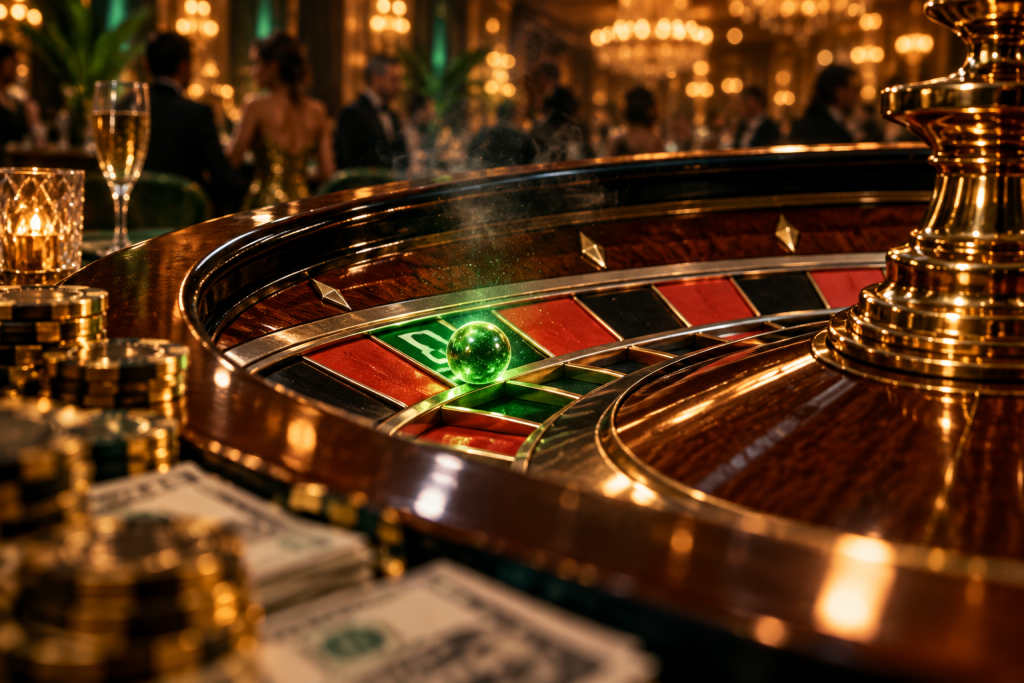
The green pocket is the number that resets the table
Most roulette bets are built around red or black, odd or even, and the ranges of numbers printed on the felt. The green pocket sits outside all of those categories. When the ball stops there, every wager that was not placed directly on that pocket is settled as a loss unless the table rules say otherwise. That single outcome is the reason the game has a built-in edge for the house, and it is also the reason a direct bet on green pays more than a bet on any individual red or black number.
A European wheel has 37 pockets: the numbers 0 through 36, with one green zero. An American wheel has 38 pockets because it adds a second green pocket, the double zero. The extra pocket does not change what green means; it changes how often a green result appears. On the American layout, the ball finds a green pocket more often, which is why the house edge on that layout is higher for the same bets.
What green does to each type of bet
The effect of a green result depends entirely on where the chips were placed. Bets fall into two broad groups: outside bets, which cover categories of numbers, and inside bets, which cover specific numbers or small groups of them. A green result treats those two groups very differently.
| Bet type | What it covers | What a green result does |
|---|---|---|
| Red / black | All numbers of one colour | Loses; green is neither red nor black |
| Odd / even | All odd or all even numbers | Loses; zero is not counted as odd or even |
| High / low | 1-18 or 19-36 | Loses; zero falls outside both ranges |
| Dozens and columns | Twelve numbers in a block or line | Loses; zero is not part of any dozen or column |
| Straight-up on zero | The green pocket itself | Wins at the table's posted straight-up odds |
| Split, street, corner or line that includes zero | A small group containing zero | Wins if zero is one of the covered numbers |
The table above is the core answer to the question. Green is not a colour that loses for everyone; it is a number that sits outside the even-money and range bets. A chip placed on the zero itself, or on a group that includes it, is settled as a winning bet just like any other number.
Why the payout on green is larger
A straight-up bet on any single number, including zero, pays at the odds printed on the table layout. That payout is the same for zero as for any other number. What makes green feel different is that it is the only number that also voids the most common bets on the table. A player who has chips on red and chips on 17 loses the red bet when zero appears, while a player who has chips on zero collects the straight-up payout.
The size of that payout is set by the table, not by the colour of the pocket. Every straight-up number on the same wheel pays the same amount. The difference between wheels is how many green pockets exist, because that changes the probability of the result but not the posted payout for hitting it.
The sequence of a round when green appears
A round of roulette follows the same sequence whether the result is green, red or black. The dealer closes betting, spins the wheel, sends the ball in the opposite direction, and calls the result when the ball settles. If the result is green, the dealer places a marker on the winning number and clears losing bets first. Winning bets are then paid, including any chips placed directly on the green pocket or on a group that contains it.
Buy-in works the same way as at any table game. The player exchanges cash for roulette chips at the table, and those chips are normally a distinct colour so the dealer can tell one player's bets from another's. Roulette chips do not carry a printed value the way regular casino chips do; the dealer assigns the value at buy-in. When the session ends, roulette chips are exchanged back at the table because they are not valid at other games.
Decision points before the spin
The player's only decisions happen before the ball is released. The first is where to place chips. The second is how much to stake on each position. The third is when to stop betting for that spin. Once the dealer calls no more bets, nothing on the layout can be changed, and the outcome is determined by the wheel.
New players sometimes treat the green pocket as a side bet that should be covered on every spin. There is no rule that requires it, and covering it does not change the mathematics of the other bets. A chip on zero and a chip on red are two separate wagers, each with its own odds and its own expected loss. Placing both does not protect the red bet; it simply adds a second bet that loses on most spins.
Where the house edge comes from
The green pocket is the mechanism that creates the gap between the payout odds and the true odds of a result. On a European wheel, a straight-up bet on any number pays as if there were 36 numbers on the wheel, but there are 37. The missing unit is the green zero. On an American wheel there are 38 pockets, so the same payout is short by two units. That gap is the house edge, and it applies to every bet on the layout, including a bet on green itself.
House edge and Return to Player are complements: they sum to 100% for the same bet under the same rule set. A lower house edge does not mean a player should expect to win; it means the expected rate of loss is smaller for the same amount wagered. The European layout has a smaller edge than the American layout because it has one green pocket instead of two. That is a structural difference between wheel types, not a guarantee about any session.
What varies under the player's control
The player controls bet selection, stake size, and how long the session lasts. Bet selection matters because different bets on the same table carry materially different edges. A straight-up bet has a different expected loss per unit wagered than an even-money bet, even though both are resolved on the same spin. Stake size controls how much is exposed to that edge on each spin. Session length controls how many times the edge is applied.
What the player does not control is the wheel. No pattern of previous results changes the probability of the next one. A green result does not make another green result more or less likely, and a long run of red numbers does not make black due. Each spin is an independent event governed by the same probabilities as the one before it.
Procedural mistakes new players make
The first mistake is placing chips after the dealer has called no more bets. The call is the cutoff, and a late hand over the layout will be sent back. The second is treating roulette chips as cash chips and walking away from the table with them. Roulette chips must be exchanged at the table before leaving, because their value exists only in the dealer's record for that session. The third is assuming that a bet on zero and a bet on red somehow cancel each other's risk. They are separate wagers, and on most spins both lose.
A fourth mistake is reading the posted payout for a straight-up number and assuming it applies to every bet on the layout. Each bet type has its own payout and its own probability. The table layout prints the payout for each position, and the player should read it before placing chips rather than after the result is called.
FAQ
Does green count as odd or even in roulette?
No. The zero and double zero are not classified as odd or even, so a bet on either category loses when the ball lands on green. The same applies to red and black: green is not a colour covered by either outside bet.
What is the difference between a European and an American wheel when green appears?
The result is settled the same way, but the American wheel has two green pockets, the zero and the double zero, while the European wheel has one. That means a green result is more frequent on the American layout, which increases the house edge on every bet compared with the European layout.
Can you bet on green and another colour at the same time?
Yes, because they are separate positions on the layout. A chip on zero and a chip on red are two independent wagers. If the ball lands on green, the zero bet wins and the red bet loses. If it lands on red, the reverse happens. On most spins, both lose.
Play responsibly
Gambling should be treated as paid entertainment, never as a way to earn income or recover losses. 1-800-MY-RESET (1-800-697-3738)
18+ or 21+ depending on where you are; follow the minimum age that applies to you.
This article is general information about how these mechanics work. It is not legal advice and not a recommendation to gamble or to use any particular operator. Availability and legality differ by jurisdiction — check the rules that apply where you are.