


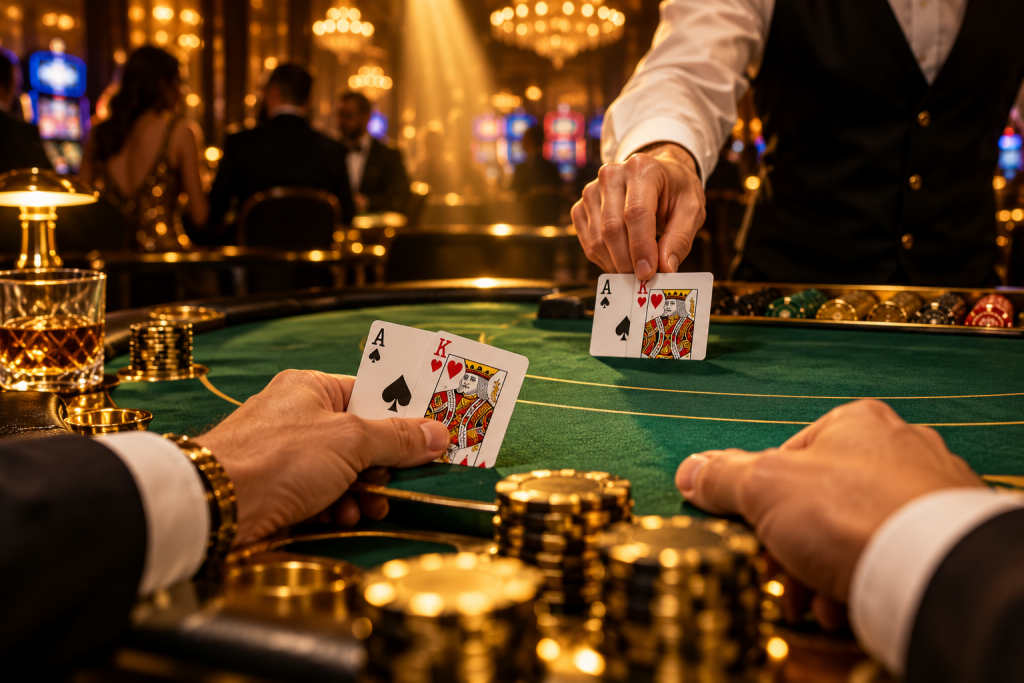
The moment the second blackjack appears
You turn over an ace and a ten-value card. The player next to you does the same. For a second it looks like you have both won, but the round is not settled until the dealer's hand is exposed. In blackjack, a natural 21 on the player's side is not a prize that two people split. Each hand is settled separately against the dealer, and the dealer's own cards decide whether either of you is paid.
What most new players miss is that the word "blackjack" describes two different situations. A player blackjack is an ace plus any ten-value card as the first two cards. A dealer blackjack is the same combination on the dealer's side. When both appear in the same round, the outcome is usually a push: the player's stake is returned and no winnings are paid. The important detail is that a player blackjack normally pays at a better rate than a standard win, but a push pays nothing at all.
How a round is settled
Blackjack is a comparing card game. The objective is a hand total closer to 21 than the dealer's without exceeding it. The dealer does not play against each player individually in the sense of trying to beat one person; the dealer follows a fixed procedure, and every player's hand is compared with the dealer's final total at the end of the round.
The sequence from buy-in to settlement looks like this. You exchange cash or chips at the table, the dealer places your wager in the betting circle, and cards are dealt. If your first two cards total 21, you have a natural. The dealer checks for a possible blackjack at the appropriate point, which depends on whether the dealer's upcard is an ace or a ten-value card. Once the dealer's hand is complete, each player's hand is settled in turn.
If you hold a natural and the dealer does not, you are paid at the blackjack rate printed on the table, commonly higher than an ordinary win. If the dealer also holds a natural, your hand pushes. The two outcomes are not symmetrical: a player blackjack pays extra, while a dealer blackjack simply takes all non-pushing wagers.
What changes when both players have it
Two players holding a natural at the same table does not change the arithmetic of either hand. Each hand is independent. One player may be paid at the blackjack rate while the other pushes, if the dealer's hand interacts with them differently, though in practice a dealer blackjack pushes every player natural at the table.
The comparison that matters is between the player's hand and the dealer's hand, not between two players. Here is how the common settlement outcomes differ:
| Situation | Outcome for the player | What the player receives |
|---|---|---|
| Player natural, dealer no natural | Win at blackjack rate | Stake plus the blackjack payout shown on the table |
| Player natural, dealer also natural | Push | Original stake returned, no winnings |
| Player total higher than dealer without busting | Standard win | Stake plus an equal amount |
| Player total lower than dealer, dealer does not bust | Loss | Stake is collected |
| Player and dealer same total | Push | Stake returned |
Why the dealer's hand changes everything
The dealer's procedure is not a strategy. The dealer draws to a fixed total and stands at a fixed total, both printed in the table rules. A dealer natural is checked before players take further action, which is why the round can end quickly when the dealer shows an ace or a ten-value card. If the dealer has a natural, the round is over for players who have not already acted; no amount of hitting, standing, doubling or splitting matters.
This is the core of the two-blackjack question. The player's natural is a strong hand, but it is not a guaranteed win. The dealer's natural cancels it. The house edge in blackjack comes partly from the fact that the dealer acts last and the player can bust before the dealer even plays. A natural reduces that exposure on that particular hand, but it does not remove the built-in edge across many hands.
Decision points that new players misread
Most procedural mistakes around a natural come from not understanding that the hand is already settled. A player who has a natural does not hit, stand, double or split. The hand is complete the moment the first two cards total 21. The dealer will move to the next hand.
The first common mistake is asking to split a natural. A natural is an ace plus a ten-value card. Some tables allow splitting paired ten-value cards, but splitting a natural is almost never permitted, and even where paired ten-value cards can be split, the resulting hands are ordinary hands, not naturals. The blackjack payout is lost the moment the cards are separated.
The second mistake is assuming that a push is a loss. A push returns the stake. It feels like a missed win, and over a session it can be frustrating, but the wager is not collected. The third mistake is misreading the payout. The blackjack rate is printed on the table layout, and it differs from the even-money rate on an ordinary win. A player who does not check the printed rate cannot verify that the payout is correct.
Where strategy charts fit into this
Published basic-strategy charts tell a player what to do with any two-card total against any dealer upcard. They derive from the exact rule set in use: the number of decks, whether the dealer stands or hits on a soft 17, which doubling and splitting rules are allowed, and whether surrender is offered. A chart built for one rule set can be wrong for another, so a player should use the chart that matches the table's posted rules.
A natural is not part of basic strategy because there is no decision to make. The chart matters for every other hand. What a player controls at the table is limited: which hands to hit, stand, double or split, how much to wager, and how long to stay. None of that changes the fact that the dealer's natural pushes a player's natural, and none of it changes the house edge built into the game's rules.
FAQ
Do two players with blackjack split the payout?
No. Each hand is settled separately against the dealer. Two players with a natural do not share anything; each receives whatever the dealer's hand dictates.
What if the dealer has blackjack and one player does too?
The player's hand pushes. The stake is returned and no blackjack payout is made. The dealer's natural cancels the player's natural.
Can a player blackjack ever lose?
A natural cannot lose to a higher total, because 21 is the highest total in the game. It can push when the dealer also has a natural, which means the stake is returned without winnings.
Play responsibly
Gambling should be treated as paid entertainment, never as a way to earn income or recover losses. 1-800-MY-RESET (1-800-697-3738)
18+ or 21+ depending on where you are; follow the minimum age that applies to you.
This article is general information about how these mechanics work. It is not legal advice and not a recommendation to gamble or to use any particular operator. Availability and legality differ by jurisdiction — check the rules that apply where you are.