


The Shoe Is a Dealing Tool, Not a Rulebook
You can buy a blackjack shoe from a handful of places, but before you spend money it helps to know what you are buying. A shoe is a dealing device that holds multiple decks of cards and lets the dealer pull them one at a time without handling the stack. It does not change the value of any card or the odds of the game. It changes the pace, the number of decks in play, and how much of the deck has been seen before a reshuffle.
The purchase decision usually comes down to three questions: how many decks you want to run, whether you need a discard tray and a cut card to go with it, and what material you want the shoe made from. Answer those first and the shopping becomes straightforward.
What a Shoe Does at the Table
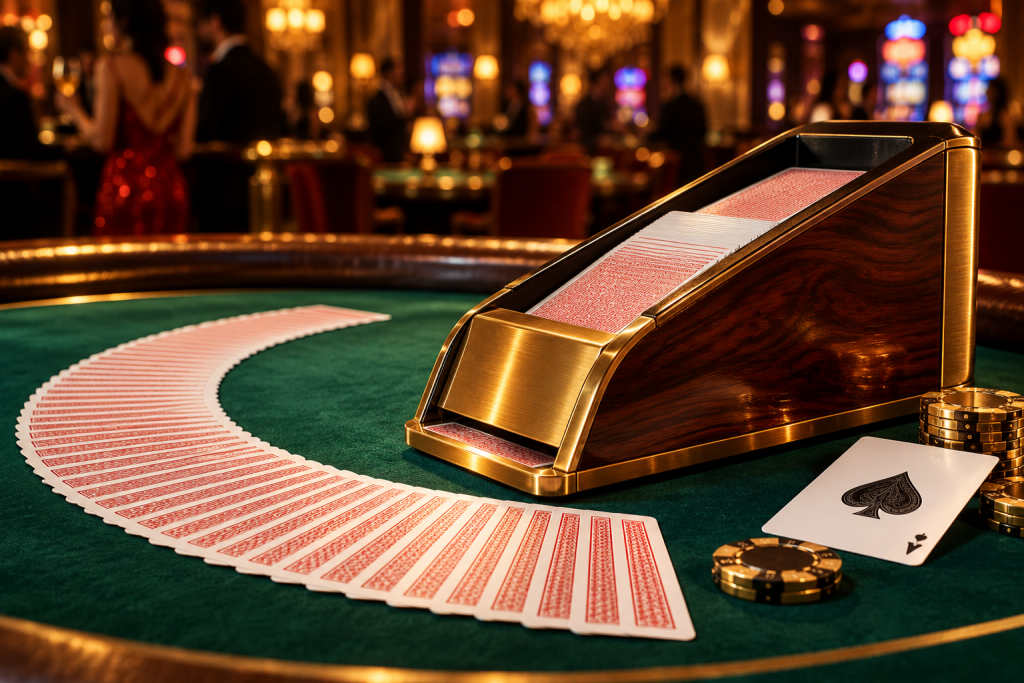
In a hand-dealt game, the dealer holds one or two decks and deals from the hand. In a shoe game, the cards sit in a plastic or metal cradle with a sloped front. The dealer presses a weighted wedge against the back of the stack, which pushes the cards forward so the next card is always presented at the mouth of the shoe. A cut card is inserted toward the back of the stack. When that card appears, the dealer finishes the round and reshuffles.
This matters for one reason above all: penetration. Penetration is how deeply into the stack the game goes before the cut card triggers a shuffle. A deeper cut means more cards are dealt from the shoe before the shuffle. That is a table rule decision, not a property of the shoe itself. The shoe only makes multi-deck dealing practical. A single-deck game does not need one; a six- or eight-deck game is difficult to run without one.
Where People Buy Them
Blackjack shoes are sold through a few distinct channels, and the right one depends on whether you are running a home game, stocking a private club, or just want a piece of equipment for practice.
- Casino supply retailers. These are the most direct source. They stock shoes in the standard sizes, along with cut cards, discard trays, and layout felt. Some sell to the public; others require a business account.
- Online marketplaces. General e-commerce sites list new and used shoes, often from third-party sellers. Quality varies, and sizing is usually listed in deck capacity rather than physical dimensions.
- Game and hobby stores. Some board game and card specialty shops carry dealing shoes, usually in the smaller two- to four-deck sizes that suit home tables.
- Used equipment auctions. When a casino replaces its table equipment, surplus shoes sometimes appear through liquidation channels. Condition is the main variable there.
None of these channels requires a licence to buy from in most places, because a shoe is inert equipment. It is a card holder. The cards, the table, and the people running the game are what bring regulation into the picture.
Deck Capacity and What It Means for Play
Shoes are sized by how many standard decks they hold. The number is usually printed on the product listing or the box. The size you buy sets the ceiling on the game you can run, but it does not set the rules.
| Shoe size | Typical use | What changes for the player |
|---|---|---|
| 1-2 decks | Home games, practice setups | Frequent shuffles; fewer cards between reshuffles |
| 4 decks | Small private tables | Longer dealing runs; cut card placement matters more |
| 6 decks | Common casino configuration | Deep shoe; reshuffle interval set by the house cut |
| 8 decks | High-volume casino tables | Longest runs between shuffles; same rules otherwise |
Deck count interacts with the published basic-strategy charts. A chart derived for a six-deck shoe with the dealer standing on soft 17 is not automatically correct for a two-deck game where the dealer hits soft 17. The shoe size is one input into the rule set; the dealer's standing rules, doubling restrictions, and whether surrender is offered are the others.
What to Check Before You Pay
A shoe is a simple device, but a bad one is annoying in ways that show up immediately at the table. Look for these things when comparing listings.
- Mouth width and card clearance. The front opening should let a single card slide out cleanly without the dealer having to dig. A mouth that is too tight jams; one that is too loose lets cards fan.
- Weighted wedge. The internal block that pushes the cards forward should move smoothly and hold its position. If it sticks, dealing becomes a two-handed job.
- Material. Most casino shoes are acrylic or ABS plastic. Acrylic shows scratches but is easy to clean. Metal shoes exist but are heavier and less common for home use.
- Base stability. The shoe should sit flat on the felt without rocking. Some have a felt or rubber strip on the bottom.
- Included accessories. A cut card and a discard tray are usually sold separately. If you are buying the shoe for a full table setup, check whether the listing bundles them.
What the Shoe Does Not Do
There is a persistent idea that a shoe makes a game fairer, or less fair, or somehow changes the odds. It does none of those things. The shoe is a container. The game's return is set by the rules of the specific table: deck count, dealer stand rules, doubling and splitting options, and whether surrender or side bets are offered. The shoe only determines how the cards are physically delivered.
One practical effect is worth naming. A shoe game deals faster than a hand-held game because the dealer never pauses to square the deck. More hands per hour means more decisions per hour, and more decisions per hour means the long-run arithmetic of the game arrives sooner. That is a pacing fact, not a change in the house edge on any single bet.
If you are buying a shoe to run a home game, the same principle applies. Decide the rule set first. Then buy the shoe that holds the number of decks that rule set calls for. Buying an eight-deck shoe and then running a two-deck game inside it works fine mechanically, but it is easier to just match the equipment to the game.
FAQ
Can I use a blackjack shoe for a single-deck game?
You can, but it is unusual. A single-deck game is normally dealt from the hand precisely because the deck is small enough to hold. If you want the dealing rhythm of a shoe without multiple decks, a one- or two-deck shoe will do the job, but the cut card placement becomes the main thing controlling how often you shuffle.
Does the shoe size change the house edge?
Not by itself. The house edge comes from the full rule set: how many decks are in play, whether the dealer stands or hits on soft 17, which doubling and splitting options exist, and whether surrender is offered. Two tables can use the same six-deck shoe and have different edges because their rules differ. The shoe is just the delivery mechanism.
What else do I need to buy with a shoe?
At minimum, a cut card. Without one, you have no defined point to stop dealing and reshuffle. A discard tray is also standard, because dealt cards need somewhere to go that keeps them separate from the undealt stack. If you are setting up a full table, you will also want the right number of decks for the shoe size and a felt layout that matches the game you intend to run.
Play responsibly
Gambling should be treated as paid entertainment, never as a way to earn income or recover losses. 1-800-MY-RESET (1-800-697-3738)
18+ or 21+ depending on where you are; follow the minimum age that applies to you.
This article is general information about how these mechanics work. It is not legal advice and not a recommendation to gamble or to use any particular operator. Availability and legality differ by jurisdiction — check the rules that apply where you are.