


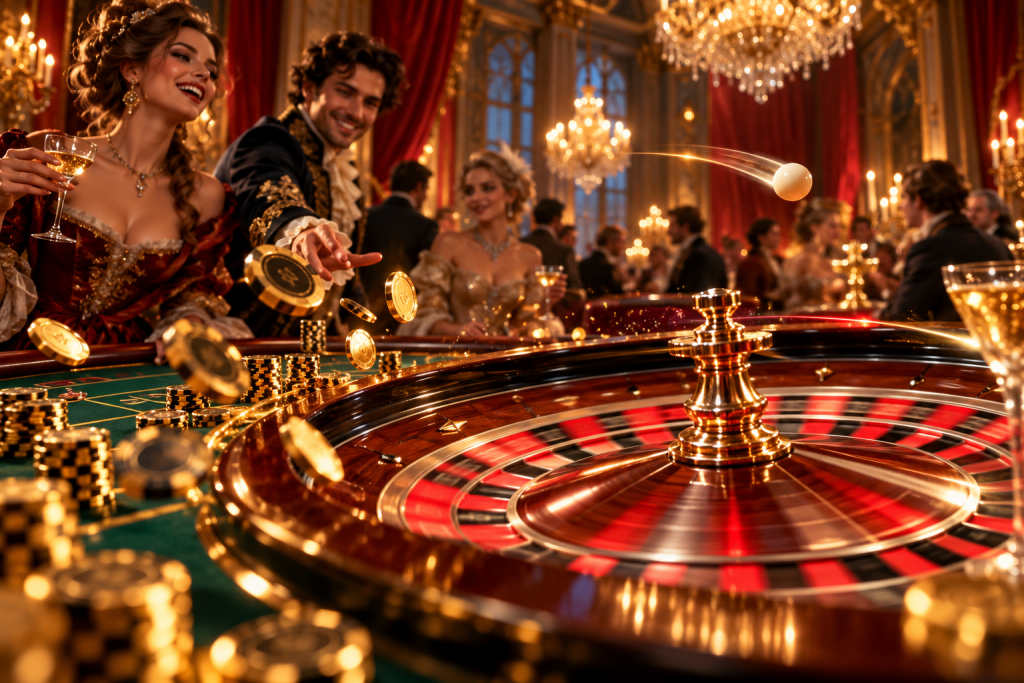
The search for a machine that never stopped
The question of who invented French roulette has no single name attached to it, and that is not a gap in the record. The game emerged from a scientific failure. In the middle of the 17th century, the French mathematician and philosopher Blaise Pascal was working on a perpetual motion machine, a device that would keep moving without an external energy source. He did not succeed, because such a machine cannot exist, but the mechanism he was tinkering with, a wheel set in motion and left to spin, became one of the ancestors of the roulette wheel. Nobody sat down in a Paris salon and declared roulette invented; the wheel and the betting layout accumulated over decades.
What can be said with confidence is that the game recognisable as roulette took its modern form in Paris in the late 18th century. The word itself is French for "little wheel," and the early French game already contained the elements a player would recognise today: a numbered wheel, a cloth layout for bets, and a house advantage built into the wheel's structure rather than into the dealing of cards. The single zero, the defining feature of the French layout, was present in those Parisian houses. The double zero arrived later, mostly as a variation that spread through other parts of Europe and across the Atlantic, where it became standard on American wheels.
So the honest answer to the query is layered. Pascal is often credited as the conceptual starting point because of the wheel mechanism. The Parisian gaming houses of the 1790s are where the game became roulette as a casino game. And the specific French layout, with its single zero and its named bets, is the product of that Parisian tradition rather than the work of one inventor on one date.
What makes the French layout French
French roulette is not simply roulette played in France. It is a specific wheel and table configuration. The wheel carries the numbers 0 through 36, arranged in a sequence designed to alternate red and black, high and low, odd and even as evenly as the wheel allows. The single zero is green and sits apart from the red and black sequence. A European wheel has 37 pockets and a single zero; an American wheel has 38 pockets and a double zero. That extra pocket increases the house edge on the American layout, because the zero and double zero are neither red nor black, neither odd nor even, and they defeat the even-money outside bets when they land.
The table layout is where the French identity is strongest. The betting area is printed in French, and the outside bets carry names that do not appear on an American table. Passe and manque cover the high and low halves of the numbers. Pair and impair cover even and odd. Rouge and noir cover red and black. The dozens are written as douzaine, and the column bets as colonnes. None of this changes the mathematics of the bets; it changes the vocabulary a player must read before putting chips down.
The distinctive French rules are the la partage and en prison conventions, which apply to even-money bets when the zero lands. Under la partage, the player receives half the even-money wager back immediately. Under en prison, the full wager is held in place, imprisoned, for the next spin; if the next spin wins, the wager is returned without profit, and if it loses, the wager is collected. Both rules soften the cost of the zero on even-money bets, and both are optional table rules that vary from venue to venue. A player should read the table's printed rules before assuming either applies.
| Feature | French wheel | European wheel | American wheel |
|---|---|---|---|
| Pockets | 37 (0-36) | 37 (0-36) | 38 (0, 00-36) |
| Zero count | Single | Single | Single and double |
| Layout language | French terms | Usually English or local | English |
| Even-money zero rule | La partage or en prison, where offered | Sometimes en prison or la partage | Rarely offered |
| House edge on even-money bets | Lower when la partage or en prison applies | Higher than French with zero rule, lower than American | Highest of the three |
The distinction between French and European is often collapsed in casual conversation, and many venues use the terms loosely. A player who cares about the zero rule should look at the table itself: the printed rule for what happens when zero lands on an even-money bet is the only reliable indicator, not the name of the game on the marquee.
How a round plays, from buy-in to settlement
A roulette round is a sequence of exchanges between the player and the table staff. The player buys chips at the table, and in many European and French-style rooms the chips are colour-coded to the individual player rather than carrying a printed value. That is why two players at the same table may hold chips of different colours with the same value. The player places chips on the layout, the croupier announces that no more bets are accepted, the ball is released against the direction of the spinning wheel, and the ball loses momentum and settles in a pocket. The croupier marks the winning number on the layout, removes losing bets, and pays winners according to the odds printed or posted for each bet type.
The decision points for the player are fewer than in a card game. There is no strategy that changes the odds of any individual spin, because the wheel has no memory and the ball has no target. The decisions are about which bets to place, how much to stake on each, and when to stop. A player who spreads chips across many numbers changes the distribution of outcomes, not the expected return of the game. A player who bets the same amount on red every spin faces the same house edge on every spin, no matter what the previous ten spins produced.
The bet types split into inside and outside bets. Inside bets are placed on the numbered grid and cover individual numbers or small groups. Outside bets sit around the grid and cover large groups: red or black, odd or even, high or low, dozens, and columns. The payout for a winning bet is inversely related to the probability of that bet winning. A straight-up bet on a single number pays 35 to 1, which is less than the 36 to 1 a fair game would pay on a 37-pocket wheel. That shortfall is the house edge, and it is built into the payout schedule rather than added as a fee.
| Bet type | Coverage | Payout | House edge on French wheel |
|---|---|---|---|
| Straight-up | One number | 35 to 1 | Present on every spin |
| Split | Two adjacent numbers | 17 to 1 | Present on every spin |
| Street | Three numbers in a row | 11 to 1 | Present on every spin |
| Corner | Four numbers meeting at a corner | 8 to 1 | Present on every spin |
| Six line | Six numbers in two rows | 5 to 1 | Present on every spin |
| Red or black, odd or even, high or low | 18 numbers | 1 to 1 | Reduced by la partage or en prison, where offered |
| Dozen or column | 12 numbers | 2 to 1 | Present on every spin |
Every bet on the table carries the house edge, but the even-money bets are the only ones affected by the French zero rules. The inside bets and the dozen and column bets pay as printed, and the zero simply counts as a losing number for them. A player choosing among bets is choosing among different payout distributions and different rates of loss, not choosing a way to overcome the wheel's built-in advantage.
What the inventor question obscures
Asking who invented French roulette is a way of asking where the game came from, and the answer is less a name than a process. The wheel came from a failed physics experiment. The betting layout came from the Parisian gambling houses that standardised the game so that players and bankers could settle bets quickly and without dispute. The single zero came from a design decision about how the house would be paid, and the double zero came later as a variant that gave the house a larger share. The French names on the layout are the residue of that Parisian origin, preserved even on tables thousands of miles from France.
For a player sitting down today, the history matters less than the table rules. The same game can be offered with different zero rules, different minimums, and different payout schedules for the same named bets. The printed table rules are the controlling document, and the croupier's announcements are the live interpretation of those rules. A player who learns the French layout from one table and then sits at another should not assume the zero rule carried over. The wheel is the same shape; the terms are not.
The procedural mistakes new players make are mostly about the physical flow of the game. One is placing chips after the croupier has called no more bets, which is refused and can disrupt the round. Another is placing a chip on a line between bets and assuming the croupier will interpret it the way the player intended; ambiguous placement is resolved by the croupier according to house convention, and the player should ask before the ball is released if the placement is unclear. A third is leaving the table with colour chips and assuming they can be cashed at the main cage; colour chips are generally converted back to cash-value chips at the roulette table before the player leaves. None of these mistakes changes the odds, but each can cost a player time, money, or a disputed bet.
FAQ
Did Blaise Pascal really invent roulette?
Pascal did not design a gambling game. He was working on perpetual motion, and the spinning wheel mechanism he explored is often cited as a precursor to the roulette wheel. The game itself took shape in Parisian gaming houses long after Pascal's death, and no single person is credited with assembling the wheel, the layout, and the betting rules into the game now called roulette.
Why does French roulette have only one zero?
The single zero was the original Parisian design, and it gives the house a smaller share of each even-money wager than a double-zero wheel does. The double zero was introduced later in other markets, and it persists on American wheels because the extra pocket increases the house edge on every bet.
Is French roulette better for the player than American roulette?
The French layout with la partage or en prison reduces the cost of the zero on even-money bets compared with an American wheel, where the zero and double zero both defeat those bets outright. The inside bets still carry the house edge on either wheel. A player should read the posted table rules to see whether the French zero rule is in force before comparing one table to another.
Gambling involves risk. Please only gamble with funds that you can comfortably afford to lose. While we do our best to provide good quality information, we cannot guarantee the accuracy or completeness of any information presented. This site is not a gambling operator and does not provide gambling advice. If you or someone you know has a gambling problem, contact the helpline printed in the footer below.
Play responsibly
Gambling should be treated as paid entertainment, never as a way to earn income or recover losses. 1-800-MY-RESET (1-800-697-3738)
18+ or 21+ depending on where you are; follow the minimum age that applies to you.
This article is general information about how these mechanics work. It is not legal advice and not a recommendation to gamble or to use any particular operator. Availability and legality differ by jurisdiction — check the rules that apply where you are.