


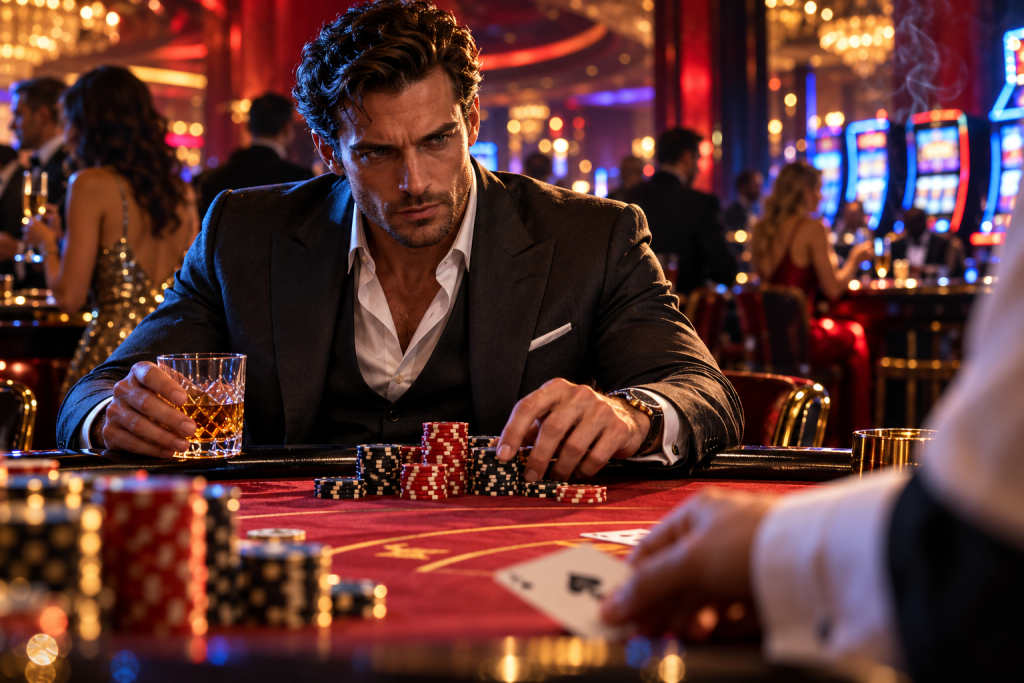
The table is a pressure cooker for a specific kind of frustration
Blackjack looks calm from a distance. Players sit in a semicircle, cards slide across felt, chips click. Up close, it is one of the most socially charged games in a casino. The anger you see at a blackjack table is rarely about a single lost hand. It is usually the collision of three forces: a game that produces brutal short-run swings, a table where one stranger's choices change another stranger's results, and a set of unwritten etiquette rules that players enforce on each other with real hostility.
None of this is mysterious once you see the mechanism. A player who seems furious about a dealer drawing a five-card 21 is often angry about something else: a losing session, a perceived betrayal by the player in the third seat, or the slow realisation that the game does not owe them anything. This article explains the actual triggers, what is happening mathematically, and what a player can do when the frustration stops being part of the game and starts becoming a problem.
The math produces streaks that feel personal
Blackjack is a negative-expectation game. The house edge is the mathematical advantage the operator holds on a given game, expressed as a percentage of each wager. It does not mean every session loses, and it does not mean losses arrive in a smooth, predictable trickle. It means the edge operates over a very large number of hands, while any single evening is dominated by variance.
Variance is how payouts are distributed over time. High volatility means rarer but larger payouts; low volatility means more frequent but smaller ones. Blackjack sits somewhere in the middle, but it still produces runs that feel absurd while they are happening. A player can make the correct decision on every hand and lose eight in a row. Another player can stand on 16 against a dealer's 10, catch a bust card, win the hand, and be treated like a genius. The second player made a worse decision and got a better result. That gap between decision quality and outcome is the single biggest anger engine in the game.
When a player has internalised basic strategy, the anger gets sharper. Basic strategy is a comparing card game where the objective is a hand total closer to 21 than the dealer's without exceeding it, and published basic-strategy charts derive from the specific rule set in use. A player who follows the chart and still loses feels cheated, because they did everything right and the game did not care. The honest framing is that basic strategy minimises the expected loss rate. It does not convert a negative-expectation game into a positive one, and it does not flatten the variance. A correct play can lose. That is not a malfunction; it is the design.
Another player's hand changes your hand
Blackjack is not a team game, but it is played on a shared shoe. Every card another player takes or leaves changes which card the dealer receives, which changes every other hand at the table. This is the structural reason blackjack produces so much interpersonal anger, and it separates blackjack from nearly every other casino game. In roulette, nobody else's bet changes where the ball lands. In blackjack, the player in the third seat hitting a 12 against a dealer's 6 genuinely does alter the sequence of cards that reach the dealer and everyone else.
The anger this produces is real, but the logic underneath it is usually backwards. A player who hits when basic strategy says to stand is not stealing your card. They are changing the order of cards, and the change is as likely to help you as hurt you. The player who gets mad at the third seat is usually remembering the times the deviation hurt and forgetting the times it helped. Confirmation bias does the rest. The anger feels justified because the causal chain is visible: the player hit, the dealer drew a 10, the table lost. What is invisible is the counterfactual, the version where the player hits and the dealer busts.
| Trigger | What happened | What the angry player believes happened |
|---|---|---|
| Third seat hits 12 vs dealer 6 | Card order changed; outcome for the table is random either way | That player stole the dealer's bust card |
| Player doubles on a soft hand and loses | A correct play with a negative short-run result | The player was reckless and cost the table |
| Dealer draws to 21 three times in a row | Variance clustering; no memory in the shoe | The dealer or the shoe is rigged |
| New player joins mid-shoe | Card sequence changes; no mathematical effect on anyone's edge | The flow of the cards is now ruined |
Etiquette rules are enforced harder than the game rules
Blackjack has a dense unwritten code, and players police it more aggressively than any posted rule. The anger you see at a table is often not about money at all. It is about a perceived violation of that code. A player who splits tens when the table expects them to stand, or who touches their cards when the table rules say not to, or who buys in mid-shoe, can trigger a level of hostility that seems disproportionate to the act.
Part of this is superstition dressed as strategy. Many players genuinely believe that a deviation from conventional play disrupts the flow of the cards, as if the shoe had a memory or a rhythm that a stranger can break. That belief is false. The cards have no memory, and the shoe has no flow. The sequence is determined by the shuffle and the deals, and every new decision simply creates a new branch of possible sequences. But the belief is powerful, and it converts a stranger's ordinary decision into a personal insult.
Another part is loss displacement. A player who is losing feels a need to locate the loss somewhere outside themselves. The dealer is one target. The player who hit when they should have stood is a better one, because that player is present, visible, and cannot escape the table. The anger is real, but its target is usually incidental. The losing player was already frustrated before the third seat touched a card.
Losses arrive faster than the mind can process them
Blackjack is fast. A full table can play dozens of hands an hour, and a player betting multiple spots accelerates the exposure further. The speed matters because it compresses the emotional experience of loss. A slot player loses slowly, spin by spin, with pauses built in. A blackjack player can lose a meaningful portion of a session bankroll in ten minutes, across fifteen hands, with no pause at all. The brain does not have time to reset between losses, so the losses stack into a single continuous feeling of being punished.
That feeling is what players call tilt. Tilt is the state where emotion overrides decision-making, and it is the point where blackjack stops being a game with a known edge and becomes a spiral. A player on tilt raises their bet to win back losses, abandons basic strategy, and starts blaming the table. The anger is not the cause of the tilt; it is the symptom. The cause is the collision of speed, variance, and the natural human refusal to accept a negative short-run result.
No betting pattern changes the built-in edge of a negative-expectation game. Progression systems, including doubling after losses, redistribute outcomes rather than remove the edge. A player who doubles their bet after every loss is not recovering; they are increasing the size of each subsequent loss while the edge stays fixed. The anger that follows a failed progression is often the angriest kind, because the player believed the system would work and experienced its failure as a personal betrayal.
What a player can control
The list of controllable variables at a blackjack table is short, and none of them eliminate the house edge. What they do is change the rate of expected loss, the speed of exposure, and the emotional temperature of the session.
Bet selection matters. Basic strategy, correctly applied to the specific rule set in use, reduces the expected loss rate compared with improvised play. It does not make the game profitable, and it does not stop losing sessions. It changes the slope of the long-run line, not the direction.
Game speed matters. A player who plays fewer hands per hour loses more slowly, all else equal. Slowing down is not a strategy to win; it is a method for keeping a session within the emotional range the player can handle. The same applies to session length. A short session with a clear stopping rule produces a different emotional experience than an open-ended session with no exit.
Bankroll sizing as a method matters. A player who brings an amount they can lose without distress is playing a different game, emotionally, than a player who brings rent money. The math is identical. The experience is not. The player with rent money on the felt is primed for anger before the first card is dealt, because every loss is a threat rather than a cost.
| Controllable variable | What it changes | What it does not change |
|---|---|---|
| Bet selection and basic strategy | Expected loss rate per hand | The house edge itself |
| Hands per hour | Speed of bankroll exposure | The edge on any single hand |
| Session length and stopping rules | Total exposure per visit | The variance within the session |
| Bankroll size relative to stakes | Emotional tolerance for swings | The probability of any given hand |
| Choice of table and rules | Edge on specific bets | The fact that the edge stays with the house |
When the anger stops being part of the game
Frustration at a blackjack table is normal. Losing streaks feel bad, and the social dynamics of the table can make them feel worse. But there is a line between ordinary frustration and a pattern that needs attention. A player who regularly leaves the table furious, who chases losses across sessions, who borrows to keep playing, or whose anger spills into their life outside the casino is no longer experiencing the ordinary friction of a negative-expectation game. They are experiencing a gambling problem, and the anger is one of its signals.
The tools that exist for this situation are structural, not emotional. Self-exclusion is a programme held by the operator or a state-level scheme, and it blocks the player from gambling with that operator or in that jurisdiction for a set period. Site and device blocking tools prevent access to gambling platforms from a specific device or network. Deposit limits cap how much can be transferred into an account over a defined window. Time limits cap session length. Cooling-off periods are shorter temporary blocks, typically measured in days or weeks, designed to interrupt a spiral before it deepens.
Enrolment usually involves contacting the operator's responsible gambling team or the relevant programme directly, confirming identity, and selecting the period and scope of the exclusion. The exclusion is held by the operator or programme, not by the player, and it is not something an article, a forum post, or a customer service script can undo. Any reinstatement is handled solely by the operator or programme that holds the exclusion on its own terms, and cooling-off periods exist precisely because the impulse to reverse them is strongest when the player is least able to make a clear decision.
Free, confidential help is available through the helpline printed in the footer below. It is staffed by people who understand the specific anger blackjack produces, and it is the right first call when the frustration has stopped being occasional and started being the point of the game.
FAQ
Does another player's bad decision cost me money?
It changes the order of the cards, and the change is as likely to help you as hurt you. The anger feels justified because you can see the causal chain, but the counterfactual is invisible. Over many hands, other players' deviations have no systematic effect on your expected loss rate.
Why do I get angrier at blackjack than at slots or roulette?
Blackjack combines fast losses, visible decision points, and a shared shoe where strangers affect your outcome. Slots and roulette isolate the loss inside your own bet. Blackjack spreads it across the table, which gives the anger a target and a story.
Is getting mad a sign I should stop playing entirely?
Not necessarily. Occasional frustration is a normal response to variance. But if the anger is frequent, if it drives you to raise bets or chase losses, or if it follows you away from the table, that is a sign to use the limit tools described above or to call the helpline in the footer below. The anger is information; what you do with it is the decision.
If you or someone you know is struggling with gambling, help is available. Call or text the National Problem Gambling Helpline at the helpline printed in the footer below for free, confidential support, 24/7. You can also visit www.ncpgambling.org for resources and information.
Play responsibly
Gambling should be treated as paid entertainment, never as a way to earn income or recover losses. 1-800-MY-RESET (1-800-697-3738)
18+ or 21+ depending on where you are; follow the minimum age that applies to you.
This article is general information about how these mechanics work. It is not legal advice and not a recommendation to gamble or to use any particular operator. Availability and legality differ by jurisdiction — check the rules that apply where you are.