


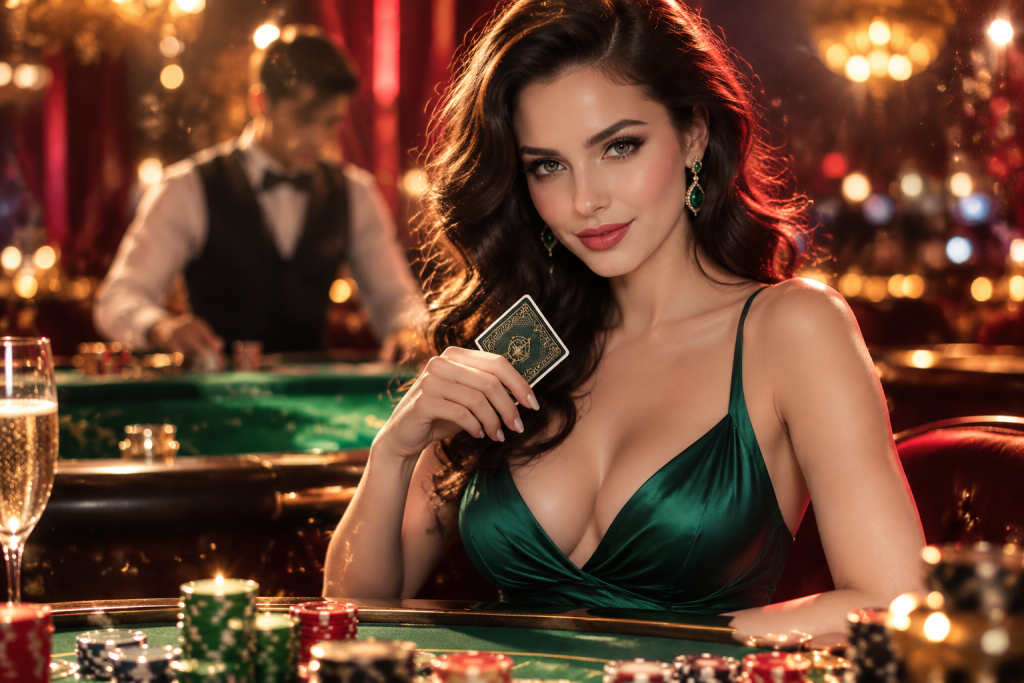
The game that asks you to make a decision every hand
Walk past a blackjack table in any busy casino and one thing stands out: the players are not just watching. They are touching the cards, signalling for hits, tapping the felt to stand, sliding chips forward. Few other games put a decision in front of the player this often, and that is where much of the enjoyment comes from. A slot spin resolves itself. A roulette ball lands where it lands. Blackjack deals two cards and then waits for you to say what happens next.
That decision loop is short. A hand lasts seconds, not minutes. The outcome is immediate, the next hand starts right away, and the player gets to act again. For people who enjoy being engaged rather than passive, that rhythm is a large part of the draw. The game does not ask for deep study before the first hand; the basic goal is easy to state: finish with a hand total closer to 21 than the dealer's without going over. But inside that simple frame there is room to think, and thinking is the fun.
Simple rules, visible choices, real consequences
The rules of blackjack can be learned in a few minutes. Cards have point values, the dealer follows a fixed procedure, and the player decides whether to take another card, stand, split a pair or double the wager. What makes the game feel different from pure chance is that the player's choices change the shape of the hand. A player who stands on 16 against a dealer's 6 is making a judgement about what is likely to happen next. A player who doubles on 11 is committing more money to a strong position. The choice is visible to everyone at the table, and so is the result.
That visibility matters. In a slot game the result is hidden inside a spin animation. In blackjack the sequence is open: you saw the cards, you made the call, the dealer turned over the next card. When the decision works, it feels earned. When it fails, it still feels like a decision was made, not just a button pressed. Both outcomes feed the same loop: the next hand is a chance to make a better call.
There is a mathematical layer underneath this. Published basic-strategy charts derive from the specific rule set in use, including the number of decks, whether the dealer stands or hits on soft 17, and which doubling and splitting options are allowed. Players who enjoy the game often enjoy that layer too: the idea that a hand can be played correctly or incorrectly against a known rule set. It gives the game a sense of mastery that pure chance games do not offer.
Skill changes the expected loss, not the direction of the edge
This is the point where enjoyment and honesty have to share a sentence. Blackjack is a negative-expectation game. The house edge is the mathematical advantage the operator holds on a given game, expressed as a percentage of each wager, and no betting pattern removes it. What a player's skill does is change how quickly the edge applies. A player who follows a solid basic strategy for the table's rule set will lose less slowly, on average, than one who plays hunches. That is a real difference, and it is part of why the game rewards attention. But it is a difference in the rate of expected loss, not a route to a guaranteed win.
The short run and the long run diverge sharply in blackjack, and that divergence is part of the emotional texture of the game. A single session can swing far from the average. A player can make every correct decision and lose, or make a questionable call and win. The game's appeal is partly that tension: the feeling that skill is being applied to an uncertain outcome. Variance is what makes the session exciting; the house edge is what makes the long run predictable. Enjoying the game does not require confusing the two.
The table is a social space
Blackjack is played facing other people. Players sit side by side, share a dealer, and react to the same cards. In a live casino the table has a rhythm of its own: chips clicking, cards sliding, players groaning at a dealer's 21 or nodding at a well-timed stand. Online live-dealer games reproduce some of that atmosphere with a real dealer on camera and a chat window. Even a purely digital blackjack table can feel more social than a slot bank, because the game's pace creates moments where players are all watching the same thing at the same time.
There is also a shared culture around the game. Basic strategy charts, table etiquette, the little rituals of tapping the felt or waving a hand flat to stand — these give blackjack a language that regular players recognise. For some people the enjoyment is partly about belonging to that culture, even casually. It is a game you can play alone in an app, but it is designed around a table, and the table is where its personality lives.
Fast pace without constant re-buying
Blackjack hands resolve quickly, but the game does not demand a new wager every few seconds in the way some rapid-play products do. The player controls the tempo to a degree: how long to think, whether to chat between hands, when to sit out a round. That pacing appeals to people who want engagement without feeling rushed. The bet size is also chosen by the player within the table's posted limits, which means the same game can be played as a low-stakes social activity or a high-stakes contest. The structure stays the same; only the stakes change.
The game's decision points also create natural pauses. A player considering a double or a split is not just waiting for an outcome; they are calculating. That mental activity is a feature, not a bug. For many players, the enjoyment is the calculation itself: reading the dealer's upcard, recalling the strategy for that situation, committing to the play. The result matters, but the decision is where the game lives.
What varies and what stays fixed
| Element | What the player can influence | What stays fixed |
|---|---|---|
| Bet selection | Which hands to hit, stand, split or double, based on the rule set | The house edge on the game under that rule set |
| Game speed | How many hands per hour, how long to think, when to sit out | The dealer's fixed procedure |
| Session length | When to start and stop | The long-run expectation of the game |
| Bankroll sizing | How much to wager per hand within table limits | The variance built into the game's card distribution |
| Rule variant | Which table to choose, if multiple rule sets are offered | The edge attached to the chosen variant |
The table above is the honest map of blackjack's appeal. The player controls the decisions, the pace, the stakes and the stopping point. What the player never controls is the direction of the edge. Enjoyment comes from the controllable parts; expectation comes from the fixed one. Players who keep those two in separate mental boxes tend to enjoy the game more, because they are not asking it to be something it is not.
Why the game endures across formats
Blackjack has survived every shift in how people gamble because its core loop translates well. A physical table, a live-dealer stream and a mobile app all preserve the same sequence: two cards, a dealer upcard, a decision, a result. The rule variants change around the edges — deck counts, surrender options, side bets — but the central experience stays recognisable. That consistency is part of the appeal. A player who learns the game once can sit down at almost any blackjack table anywhere and understand what is happening.
The game also scales with the player's interest. A casual player can enjoy the simple hit-or-stand rhythm. A more engaged player can learn basic strategy, compare rule sets, and think about how deck count and dealer rules change the correct plays. A player who enjoys numbers can study the expected loss on different decisions without ever being promised a win. The game does not punish a shallow understanding, but it rewards a deeper one. That range is rare in casino games, and it is a large part of why people keep coming back to it.
FAQ
Is blackjack a game of skill or luck?
It is both, in different timeframes. In a single hand, luck dominates: the cards are random and a correct decision can lose. Over many hands, skill in the form of basic strategy changes the expected rate of loss, because some decisions carry a lower expected loss than others under the same rule set. Skill does not reverse the house edge; it reduces how quickly it applies on average.
Why do people prefer blackjack to slots?
The two products offer different kinds of engagement. Slots are passive: the player chooses a stake and the machine resolves the outcome. Blackjack requires a decision on most hands, and the player can see how that decision interacts with the cards. People who enjoy agency, visible cause and effect, or a social table tend to find blackjack more satisfying, while people who want pure pace and spectacle often prefer slots. Neither preference is more correct.
Does playing blackjack with a strategy make it profitable?
No. A published basic-strategy chart reduces the expected loss per wager compared with playing hunches, but the game remains negative-expectation. The house edge is built into the rule set and the payout structure, and no decision pattern removes it. What strategy changes is the rate of expected loss and the variance a player experiences, not the long-run direction of the result.
If you or someone you know is struggling with gambling, help is available. Contact the National Problem Gambling Helpline at the helpline printed in the footer below for confidential support, or visit NCPGambling.org for resources. Please gamble responsibly and only wager what you can afford to lose.
Play responsibly
Gambling should be treated as paid entertainment, never as a way to earn income or recover losses. 1-800-MY-RESET (1-800-697-3738)
18+ or 21+ depending on where you are; follow the minimum age that applies to you.
This article is general information about how these mechanics work. It is not legal advice and not a recommendation to gamble or to use any particular operator. Availability and legality differ by jurisdiction — check the rules that apply where you are.