
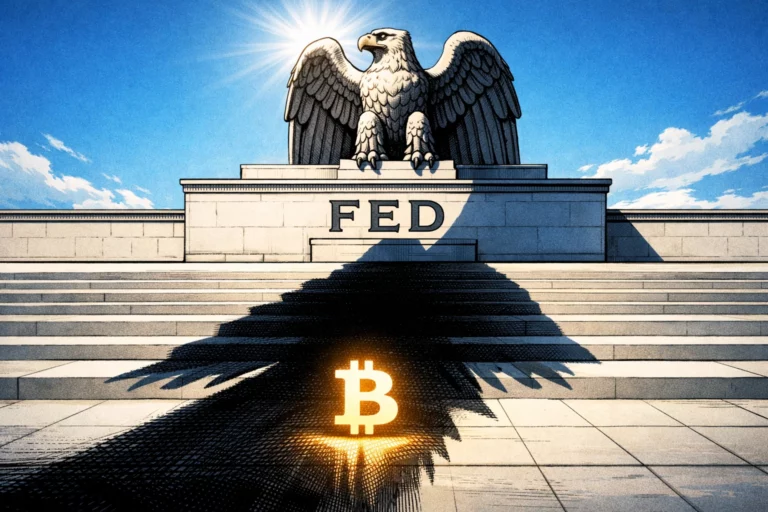
Donald Trump has formally nominated Kevin Warsh to become the next Federal Reserve chair, replacing Jerome Powell, who is set to leave the post in May. The nomination was announced on January 30, 2026, though Warsh still needs Senate confirmation before taking office. For crypto markets, the immediate focus is less about the personnel change itself and more about what it could mean for monetary policy.
Before the nomination became official, 10x Research founder Markus Thielen had already warned that a Warsh-led Fed could be negative for Bitcoin and other digital assets. His concern rests on Warsh’s long-standing hawkish stance: an emphasis on monetary discipline, higher real interest rates, and less abundant market liquidity. That mix has typically been difficult for speculative assets.
Why higher real rates matter for crypto
Thielen’s argument centers on real rates, the borrowing cost left after inflation is taken into account. When real rates rise, capital becomes more expensive in practical terms, and risk-taking tends to lose appeal for both companies and investors. Assets with high volatility, including Bitcoin, often feel that pressure early.
In that framework, crypto is not viewed as a strong hedge against currency debasement. Instead, it is more likely to be seen as a product of excess liquidity during loose monetary periods. If policy turns tighter, those assets can be among the first to come under selling pressure. Thielen pointed to the historical pattern in which stronger real rates have often gone hand in hand with weaker risk appetite across markets.
Warsh’s financial crisis record is back in focus
Thielen also highlighted Warsh’s position during the 2007 to 2009 global financial crisis. At that time, Warsh repeatedly stressed inflation risks even as the economy was nearing deflationary conditions. In September 2008, after the collapse of Lehman Brothers, he still said he was unwilling to let go of inflation concerns. A year later, with inflation at just 0.8% and unemployment at 9%, he remained more concerned about upside inflation risk than downside pressure.
For critics, that record reflects a deeply hawkish instinct. Thielen argues that if Warsh were to shape Fed policy from the top, the result could be a slower recovery and a higher risk of unemployment, a backdrop that would leave liquidity-dependent crypto markets under strain.
Tension with Trump’s rate-cut preference
Warsh’s history also stands in contrast to Trump’s preference for faster rate cuts. According to the report, Trump has repeatedly criticized Powell for keeping rates too high and hurting the economy, and has even called for rates closer to 1%. Thielen’s view is that markets are already considering the possibility that Warsh, if confirmed, may not fully align with that dovish expectation.
The Fed chair cannot set rates alone, since policy decisions require a vote by the board. Even so, Warsh’s record and public posture may influence market sentiment in the near term, strengthening the dollar and pressuring risk assets. For crypto traders, the Senate confirmation process and Warsh’s own policy signals are likely to remain key points of attention.