
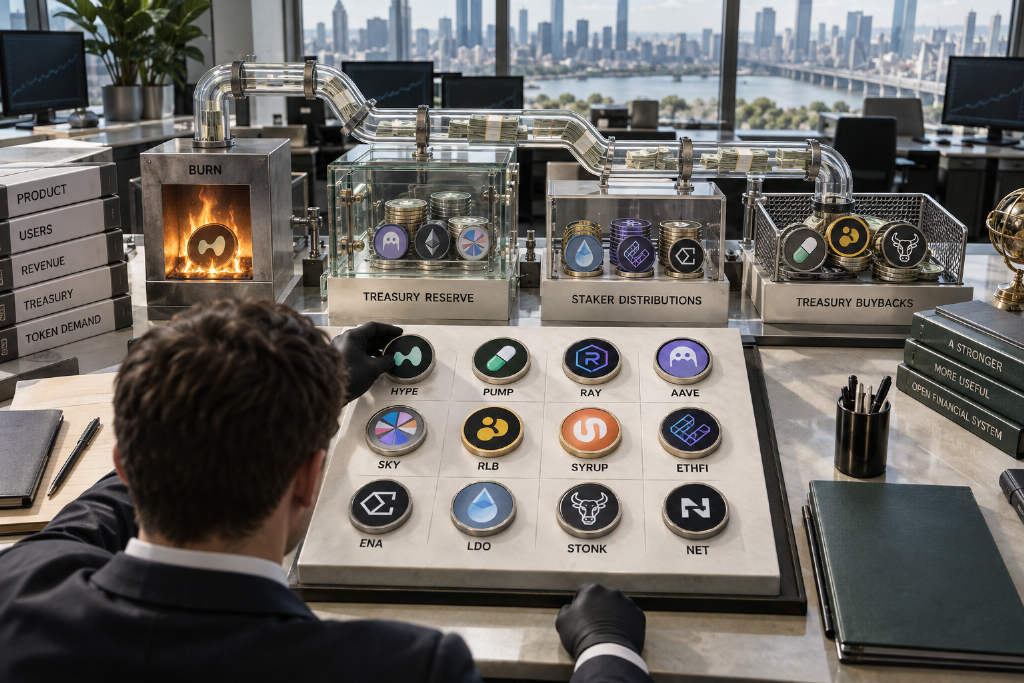
Crypto spent years creating tokens that had little direct connection to the businesses behind them. A protocol could generate $100 million in revenue, while token holders were left with governance rights. That setup is starting to change as more protocols use real revenue to buy back their own tokens in the open market.
The article argues there is a clear difference between a protocol actually spending $10 million to buy and burn its token, and merely announcing a future buyback proposal that still depends on governance approval. With revenue back at the center of crypto’s narrative, the focus is shifting to projects where the chain from product usage to revenue to token demand is beginning to hold up.
HYPE: fees flow almost directly into token demand
Hyperliquid is presented as the most obvious case on the list. The protocol has built one of the largest onchain perpetual exchanges, and the link between trading activity and HYPE is straightforward.
Trading generates fees. About 99% of those fees are routed through the Assistance Fund to buy HYPE, and the purchased tokens leave circulation under the current mechanism. In the author’s view, that is close to an ideal token model. Traders use the venue for BTC, ETH or other perpetual contracts, Hyperliquid earns revenue, and a large share of that revenue turns into demand for HYPE.
That makes trading volume and revenue the key indicators. If Hyperliquid keeps meaningful market share, the bid behind HYPE keeps its funding. If activity contracts sharply, so does the firepower behind that bid.
PUMP: the same logic, but far more exposed to attention cycles
PumpFun follows a similar logic, but the author describes it as a dirtier version. Its business depends on people continuing to launch and trade meme coins, which makes revenue highly sensitive to shifts in attention.
Still, when the market is hot, PumpFun can generate outsized revenue. Part of that revenue is used to buy PUMP on the open market, and at certain points cumulative purchases were shown in the nine-digit range.
The main question is how much PUMP actually leaves circulating supply. Buying tokens into a treasury and permanently destroying them are not the same economic event. The platform also faces a broader risk: people may eventually tire of issuing low-quality meme tokens on it.
RAY: a long-running Solana infrastructure trade
RAY may be one of the least exciting names on the list, and that is exactly why the author finds it interesting. Raydium has been around for years, survived multiple Solana cycles, and underpins a large amount of trading infrastructure that users often do not think about directly.
Historically, part of the protocol’s trading fees has been used to buy and burn RAY. That means when Solana activity picks up, Raydium benefits not only as a DEX. Token launches, swaps and LaunchLab activity can all feed the economic system around RAY.
The article points to a recent example: StonkFun has integrated with Raydium LaunchLab. STONK captures attention, while new tokens attract speculative flow.
AAVE: buybacks go into the balance sheet
Aave earns revenue through lending markets, and its DAO uses part of protocol revenue to buy AAVE from the market. The original design targeted $50 million per year, though discussions in 2026 considered reducing that figure to about $30 million as revenue conditions changed.
The major distinction from HYPE or a classic buy-and-burn model is where the tokens go. Bought-back AAVE is sent to the Ecosystem Reserve. That means the DAO is accumulating assets on its own balance sheet, and those tokens can later be used for incentives, staking, grants or other purposes.
The author says that difference matters because it forces investors to examine the full balance sheet rather than turning instantly bullish on the word buyback alone.
SKY: surplus from a stablecoin system and treasury assets
Sky, formerly MakerDAO, generates surplus from USDS, collateralized lending, treasury assets and the wider Sky ecosystem. Part of that surplus can then be allocated to buying SKY, and the capital framework allows the token to be removed from circulation.
That makes SKY very different from names such as PUMP. PumpFun needs meme-coin activity. Sky needs its balance sheet and stablecoin system to keep producing surplus.
RLB: a riskier model built on trading and gambling flows
RLB may be the strangest business in the group. Rollbit combines crypto trading, gambling and other speculative products, and has historically used part of those revenues to buy and burn RLB.
The article likens its behavior to a private internet company buying back its own stock. Users lose money in trading or gambling, Rollbit earns revenue, and part of that revenue is used to repurchase RLB and destroy it.
The author applies a bigger risk discount here than with Aave or Raydium, citing high business concentration, sizable regulatory exposure and lower transparency around parts of the underlying cash flows.
SYRUP: moving away from the old token-incentive loop
Maple Finance stands out because it has been moving away from one of crypto’s older habits: mint a token, distribute it to stakers, and call that yield.
Maple has approved a shift toward using protocol revenue to buy SYRUP instead. The article frames that as a meaningful break from the legacy model of emissions-driven incentives.
ETHFI: revenue-funded buying, then distribution to lockers
EtherFi’s system is not centered on permanently burning ETHFI. Instead, it directs value toward people who actively participate in the token economy.
Part of the revenue from eETH redemption fees is used for weekly ETHFI purchases, while part of the revenue generated across the Ether.fi ecosystem can support additional monthly buys. The ETHFI acquired through this process is mainly distributed to sETHFI holders.
That makes the structure look more like a token-denominated dividend. EtherFi earns revenue, buys ETHFI, and routes part of that value to those who lock the asset. The tokens still exist, and recipients can sell later, but the model raises a useful question: is it better to destroy the asset permanently, or to use revenue to make holding and locking it economically valuable?
ENA: large upside in the proposal, but still a proposal
The author says ENA may have the highest-potential buyback mechanism on the list, with emphasis on the word potential.
Ethena has discussed a framework under which, once USDe reaches required milestones, a very high share of protocol net revenue could eventually be used to buy ENA. Under the proposed structure, that figure could be as high as 95%.
If the mechanism were fully activated at scale, the numbers could be very large. The article notes that USDe is already a real financial product, with revenue coming from its collateral, hedging structure and broader ecosystem. At the same time, Ethena’s economics can change sharply with market conditions, and crypto has a long record of breaking attractive spreadsheet models.
LDO: an attempt to connect a major business engine to the token
Lido is compelling because it controls a massive economic engine, yet LDO has historically struggled to capture that value directly. People stake ETH, Lido generates protocol revenue, stETH becomes one of DeFi’s most important assets, and LDO holders are largely left with governance.
That gap has long been one of the main critiques of the token. A proposed buyback framework is meant to address it by allowing protocol revenue to fund LDO purchases once certain economic conditions are met, including sufficient annualized revenue.
The author draws a sharp line between an implemented buyback and the possibility of one. For LDO, the real issue is how much of the business ultimately reaches the token.
STONK: fast revenue growth, but major questions remain
The article says StonkFun has become one of the more unusual launchpads on Solana because it gives users more room to build markets around assets beyond SOL. The rough formula is simple: find an asset, build a market around it, and crypto Twitter shows up to trade it.
According to the figures cited, cumulative revenue has reached $22.9 million, with $8.3 million generated within seven days. The model widely referenced around the project is that 60% of revenue is used to buy and burn STONK.
The author also says the project needs more scrutiny. A number of the figures come from project dashboards and ecosystem sources, while there are already broad questions around reward tokens and selling pressure. Even so, the watch list is clear: revenue, capital actually used to buy STONK, and tokens actually sent to a burn address. If all three keep moving in the same direction, there is a real economic mechanism beneath the speculation.
NET: buybacks tied to net asset value
NET differs from nearly every other project in the group because its repurchase mechanism has a reference price. NetNet Capital is building an onchain treasury on Robinhood Chain. That treasury holds USDG and other assets, deploys capital into products including Morpho, and is increasingly accumulating tokenized stocks.
Each NET represents a claim on that balance sheet through the protocol’s net asset value, or NAV. Below NAV, the protocol can buy NET at roughly NAV minus 1.5% and burn what it acquires.
That means the treasury is not buying indiscriminately every day. Repurchases make sense only when the market prices NET below the value of the underlying assets. Above certain NAV multiples, the mechanism flips: NetNet can issue new NET through bonds and add the proceeds to the treasury.
The article says NET has recently traded at a notable premium to NAV, so buybacks are not the main reason the author is watching it now. The decisive question is whether the treasury can compound faster than holders are diluted.
The core filter: follow the money, not the headline
The author closes with a simple point: buyback may become one of the most abused words in crypto. What matters is where the money actually goes.
The preferred metric is annual buyback value divided by market capitalization. If a protocol worth $500 million can consistently spend $50 million a year buying its own token, that deserves attention. If a $10 billion token announces a $5 million buyback while unlocking $500 million of supply, the buyback barely matters.
In the author’s view, crypto is finally learning how to generate protocol revenue. The next question is which protocols can make that revenue matter for the token itself.