
Grant Sanderson, creator of the mathematics channel 3Blue1Brown, says this may be one of the best moments to study mathematics.
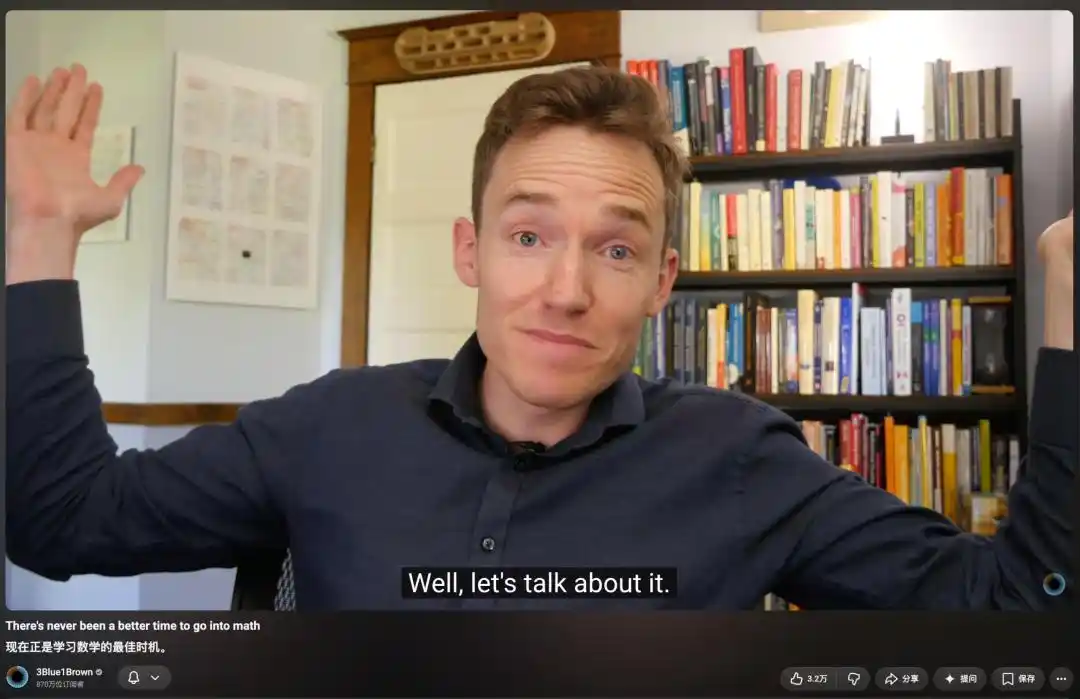
His argument does not depend on downplaying artificial intelligence. Sanderson openly considers a stronger scenario: even if AI becomes better than humans across the board at mathematical proof, the value of mathematics itself, and the main reasons it is funded, would change very little. What would change in a major way, he says, is the culture of the discipline and the way credit is assigned.
The MarsBit article says the piece was organized from Sanderson’s original 3Blue1Brown video. It highlights several of his core ideas: AI’s present-day capabilities may be overrated, but the speed of its progress is not; good mathematicians prove theorems, great mathematicians conjecture, and the greatest write definitions; once machines can generate proofs at scale, proofs should be treated as mathematics’ “raw data”; AI being better than you at solving problems does not remove the value of solving them yourself, just as a machine being better than you at lifting weights does not make exercise pointless; and the real bottleneck in education is not only whether explanations are clear enough, but whether people want to learn and can stay engaged.
What mathematicians actually do
Sanderson starts by pushing back on a narrow picture of mathematical work. Many mathematicians spend large amounts of time proving theorems, he says, but theorem-proving is not the whole field.
He uses a familiar line: good mathematicians prove theorems, great mathematicians pose conjectures, and the greatest write definitions.
From there, he breaks mathematical research into five parts:
- proving theorems, or answering why a statement is true;
- asking questions or proposing conjectures, which means deciding what is worth asking and which directions may produce rich mathematics;
- building theories, by finding the right definitions, structures, and conceptual frameworks that organize scattered results into a coherent understanding;
- finding applications that connect abstract mathematics to science and engineering;
- communicating results, ideas, motivations, and why certain structures deserve attention.
He gives the example of Descartes introducing the coordinate plane. That move was not just an answer to one isolated problem. It supplied an entire framework for thinking.
Three kinds of value in mathematics
Sanderson groups the value of mathematics into three broad categories.

Application value
The first is practical value. Basic mathematics can take decades or even centuries to reach concrete use, so he argues that a problem should not be judged only by whether it has an immediate application.
One example comes from the 16th century, when Italian mathematicians trying to solve cubic equations arrived at a strange technique: taking square roots of negative numbers. That line of work led to the idea of imaginary numbers, which centuries later became foundational in quantum mechanics and electrical engineering.
He gives another example in the long pursuit around Euclid’s fifth postulate. That effort helped produce non-Euclidean geometry, which later fed into general relativity.
Personal value
The second category is personal value. Mathematical training, in Sanderson’s view, develops problem-solving ability, and those skills transfer well.
Many people trained in mathematics do not become professional mathematicians. They move into computer science, machine learning, AI safety, finance, cryptography, and other fields. Some may have taken only a number of courses; others may hold a PhD in mathematics. Sanderson’s point is that training in abstraction, structural analysis, and problem-solving appears to travel well across domains.
That means the value of mathematics education cannot be measured only by how many mathematicians it produces. It also has to be judged by the kinds of people it prepares for other fields.
Aesthetic value
The third is aesthetic value: doing mathematics is pleasurable in itself.
Sanderson says that when he faces a good problem and sees it resolved, something “clicks” in his mind. When he encounters a new theory his brain has never processed before, it can reshape the way he thinks. For many mathematicians, he says, the experience carries an artistic kind of joy. He sees that as one reason the reaction to AI in mathematics can resemble the reaction artists have had to AI-generated art.
Where the money comes from
Sanderson also lists four main sources of funding for mathematics:
- teaching, which he describes as the largest source;
- public funding;
- private foundations;
- industry funding.
Outside teaching, he says the strongest external case for public and private support is that mathematics trains large numbers of people with specific problem-solving abilities, and those transferable skills spill over into the rest of the economy.
If AI becomes better at proving theorems
Sanderson then turns to the central question: if AI becomes better than humans at proving theorems, does that destroy the value of human mathematics?
His answer is no.
He says the evidence of the past four years suggests a pattern: at any given moment, AI’s current level tends to be overestimated, but the pace of improvement should not be dismissed.
He points to several examples. In 2023, DeepMind solved an International Mathematical Olympiad geometry problem, but critics called the result customized, brute-force, and out of step with the spirit of problem-solving. Two years later, he says, general-purpose models could solve IMO-level problems by any reasonable definition. Early machine proofs on Erdős problems were once described as low-hanging fruit. That description, he says, no longer holds, because large language models are now producing proofs on many serious problems.
He also mentions a scenario in which OpenAI releases a major result on the Navier-Stokes equations and publishes proofs for hundreds of problems at once. From today’s perspective, he says, most of those proofs might still look like extensions of recent human contributions. But he adds a reminder: four years ago, AI struggled even with basic arithmetic.
Even under that stronger assumption, Sanderson’s conclusion stays the same. “I think this has almost no effect on the value of mathematics and its funding sources, but a huge effect on the culture of the institution and the system of credit allocation,” he says.
On practical value, he argues that applications usually depend more on theory-building than on whether one isolated statement is true or false. Group theory matters for more than the conclusion that the quintic is unsolvable by radicals. The mathematics developed around Fermat’s Last Theorem matters far beyond the final yes-or-no outcome.
If proofs become easier to obtain, humans may be able to explore theory faster. Under that assumption, public and private funding would still have a rationale, and researchers might get more done with better tools.
On personal value, he returns to the gym analogy. Problem-solving ability is like building muscle: you have to participate yourself. A machine being stronger does not do the training for you.
The aesthetic side is more mixed. Some mathematicians may feel deflated if OpenAI dumps hundreds of results at once. Others may feel energized, especially if their interest lies not only in proofs but in theory-building. For them, the new tools could feel liberating.
Sanderson cites IAS mathematician Konstantin Kogler, who described an AI-generated result this way: “It was simple, with a concise and powerful idea. I first felt an unbelievable excitement, for mathematics, for power, for the truths I would learn, for the power of the ideas I was seeing.” Kogler then said thinking about the mathematics made him sleep less, and that the excitement returned because he was getting the kind of insight he truly wanted.
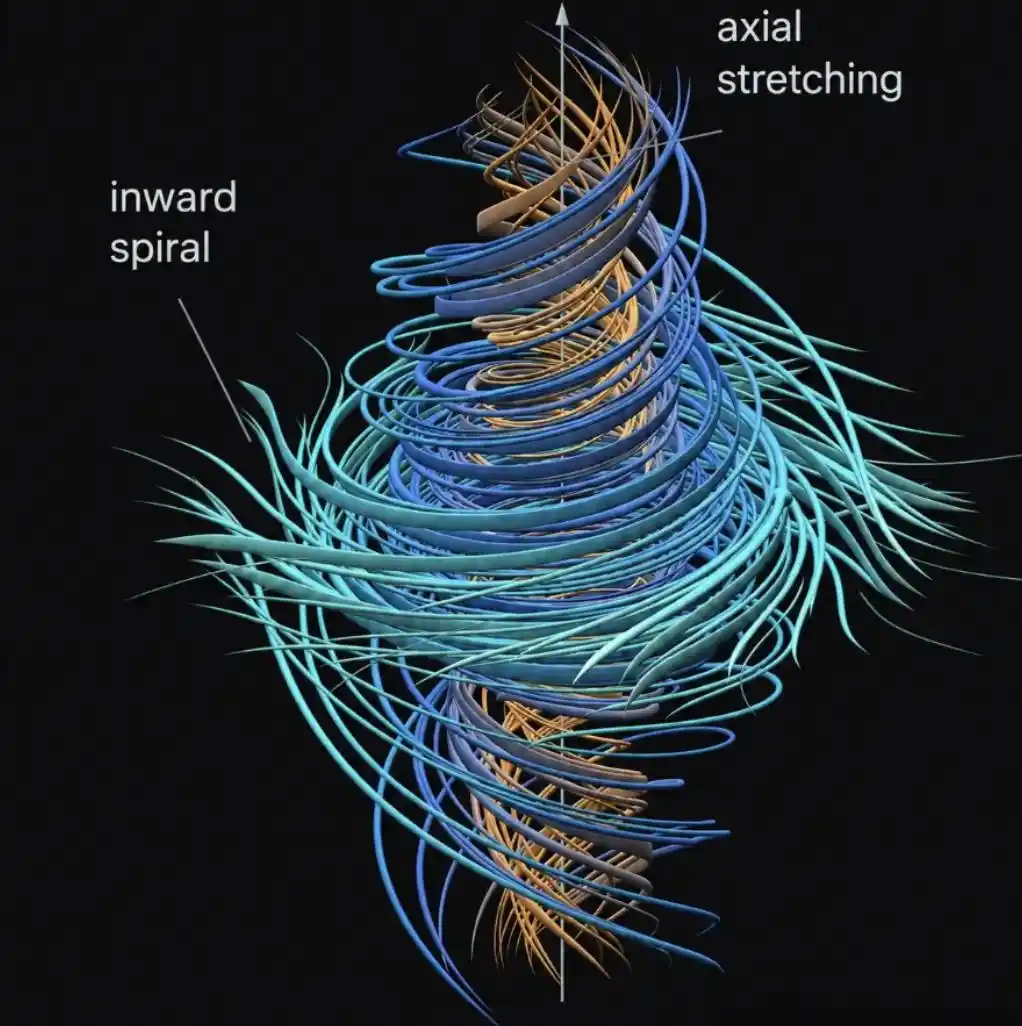
Proofs as raw data, theory as the higher-order task
Sanderson expects mathematical practice to change, and he thinks the shift will largely favor theory-building.
- Research may tilt toward theory-building because mathematicians would no longer be bottlenecked by the speed of proof production and could ask every question they want to ask.
- The work itself may become the extraction of simplicity from large numbers of proofs, then weaving those insights into new theories.
- A doctoral thesis may no longer be a handful of proofs, but the construction of an entire theoretical framework.
In that setting, proofs would be demoted to “raw data.”
He compares the change to numerical computation. Proofs would become material for theory-building rather than the endpoint. Sanderson puts it bluntly: “I don’t care whether Navier-Stokes blows up. I care whether someone understands the ideas in that proof and lets them grow into a beautiful, coherent theory. Whoever does that should get the Millennium Prize.”
He adds: “A proof is just data, like the digits of pi after the decimal point.”
Research habits would have to change as well. If you want one more proof, interacting with a model may be useful. But he says the more important move is to close the laptop, write out your own understanding, and ask what is really blocking deeper theory: the absence of a proof, or an incomplete understanding of the proofs already in hand.
If AI also gets better at conjectures and theory formation
Sanderson pushes the thought experiment one step further. What if models do not just prove human-posed statements, but become better at identifying which questions are worth asking and which conjectures lead to rich mathematics? What if they can also distill clean structures from large bodies of proof, create the right concepts, symbols, and definitions, and form genuinely new theories?
His answer remains conditional. If humans are still better at organizing problems, theorems, and proofs into theory, then practical value can still arise through human theoretical work. Lower costs for asking questions and obtaining proofs could even let individual mathematicians move faster and explore applications earlier.

If AI also takes the lead in theory-building, humans may still be needed to understand machine-generated theories deeply enough to judge whether they connect to neighboring fields such as cancer research, nuclear fusion, or high-temperature superconductivity. In that case, people would still do the work of linking mathematics to science and engineering across disciplines.
He acknowledges that the joy of being first to discover something would take a hit. But the joy of understanding may not shrink, and could even grow. His analogy stays the same: no matter how strong the machine gets, if you want stronger muscles, you still have to go to the gym yourself.
If AI eventually becomes better than humans at nearly everything, then, apart from the role mathematics plays in human development, funding math may start to look more like funding art. Even so, Sanderson notes that teaching is already a major economic base for mathematics, and its value includes both training problem-solvers and giving people a way to experience mathematics directly.
Education is not only about explanation
On education, Sanderson’s view is straightforward: the bottleneck is often not just whether something is explained clearly enough, but whether students want to learn and can keep investing effort.
That is why, even if AI becomes better at explanation, people may still want to learn from other people, and universities and student-teacher relationships may still persist.
Why he calls this one of the best times to enter mathematics
Sanderson closes by returning to his opening claim. In the foreseeable future, he expects mathematical research to lean more heavily toward theory-building. The main difference is that proofs, once a highly prized output, may become easier to obtain. As a result, the way human academic contribution is measured will change.
But as long as mathematics continues to bring joy, he says, it will continue to hold value for humans.
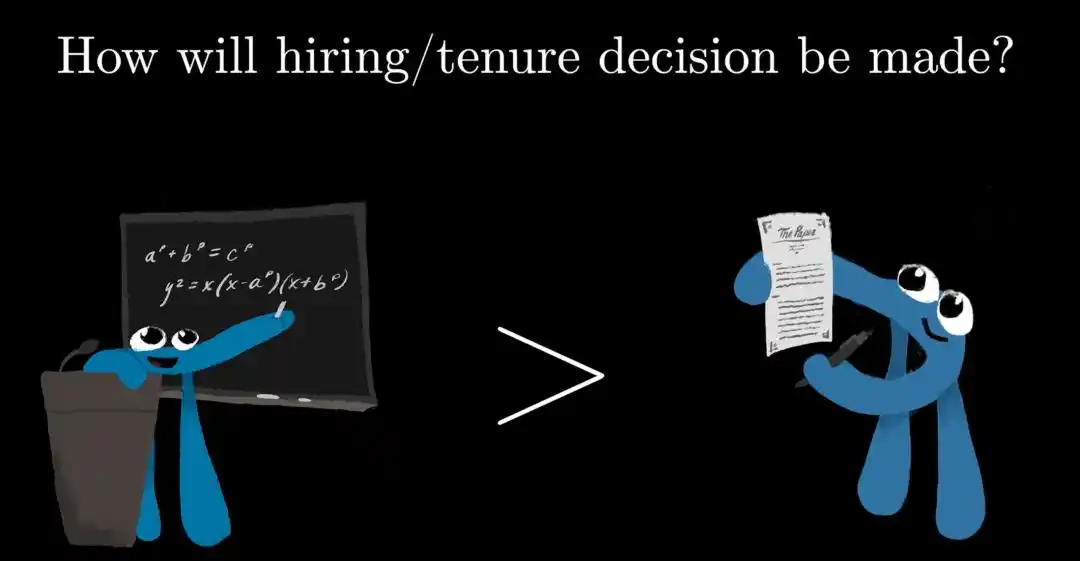
He notes that millions of viewers are willing to watch the 3Blue1Brown channel, even though what the channel really does is immerse itself in the beauty of mathematics, looking for elegant problems, satisfying solutions, and new ways of thinking. On the business side, he jokes that of course not all those millions are willing to pay. A few thousand are enough.
That is also why he says this is one of the best times to enter the field. The mathematical community already knows it has to change, and it is actively searching for the direction and examples of that change. People entering mathematics now may find themselves near one of the discipline’s key turning points, with a real chance to influence where it goes next.
His answer to a PhD student
Sanderson says the video began with a viewer’s question: as a mathematics PhD student, what should I do tomorrow?
If he were a PhD student in 2026, he says, his answer would be simple: do 3Blue1Brown.
By that he means finding a path and committing to what you love.
He ends with one more practical suggestion: close the laptop, go be social, and talk with your classmates about why you like mathematics.
The MarsBit article credits the original Chinese write-up to the WeChat account Quantum Position, written by 鱼羊.



