
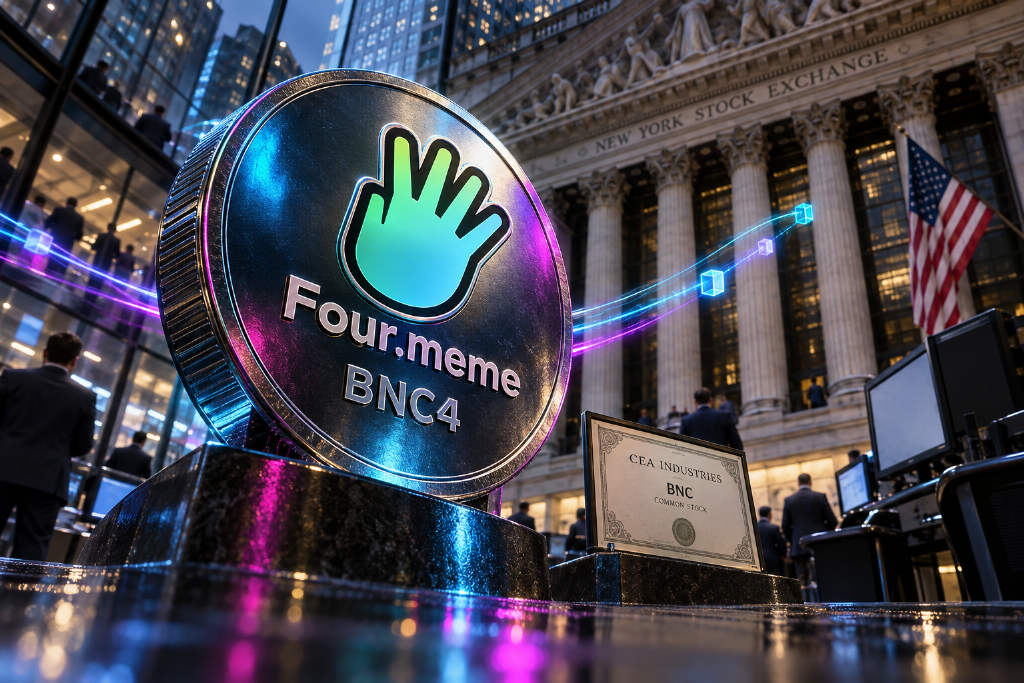
Four.meme launched its pre-bStock tokenized equity product 4Stock on Sept. 8, with BNC4 — tied to CEA Industries’ stock BNC — as the first listing. After trading began, the meme token bearing the same 4Stock name climbed quickly. GMGN data showed its market capitalization briefly reaching $80 million before pulling back to $53 million.
At the same time, BNC moved sharply higher in U.S. pre-market trading. Bitget data showed the stock reaching $6.9 pre-market, up more than 90% at one point. From the launch of 4Stock, to the premium that appeared in BNC4 on-chain, to the simultaneous attention paid to the meme token and the U.S.-listed stock, a transmission path started to take shape between tokenized equities, meme trading and the traditional stock market.
What 4Stock is
Four.meme describes 4Stock as a pre-bStock tokenized stock product focused on popular equities that do not yet have a corresponding bStock. The idea is simple: when a stock suddenly becomes a market focus but no existing bStock covers it, Four.meme buys the real shares first and then issues tokens based on the actual holdings, bringing the stock onto BNB Chain ahead of a formal bStock listing.
According to the platform, each 4Stock token is backed by one share of the relevant underlying stock. After a user submits a mint request, Four.meme uses the user’s funds to purchase the stock through a specially managed account, then mints the matching amount of 4Stock according to the number of shares actually bought and held.
Once minted, the tokens can be transferred and traded on-chain. They can also serve as the paired asset for stock-themed meme tokens on Four.meme. In that setup, 4Stock is not only a way to bring stock pricing on-chain, but also a new source of liquidity pools for future meme launches.
The first 4Stock product is BNC4. Its underlying asset is common stock in CEA Industries, listed on Nasdaq under the ticker BNC. Four.meme also said that once the corresponding bStock goes live, 4Stock may later have a 1:1 conversion path into bStock.
Why BNC was chosen first
BNC’s connection to BNB Chain is direct. CEA Industries has shifted into a digital asset treasury company centered on BNB. Company filings disclosed that as of April 30, 2026, it held 515,544 BNB with a fair value of about $317.3 million at that time.
In that sense, 4Stock can be read as an issuance mechanism designed to respond early to market themes: bring a stock on-chain before bStock coverage exists, then build trading, liquidity and a stock-meme market around that asset.
How 4Stock works: minting, fees and launch rules
For now, 4Stock uses an application-based issuance model, and both share purchases and token minting are still processed manually in batches by Four.meme.
Users must send USDC from the same wallet address that will receive the 4Stock tokens to a designated platform address. After the transfer is completed, the user needs to keep the transaction hash and submit a mint application through the official form. The minimum size for a single request is $10,000 equivalent in USDC.
Four.meme charges a 1% fee on each mint, deducted directly from the USDC submitted by the user. The remaining funds are used to buy the relevant stock at the market price at the time of execution. The number of shares purchased determines the number of 4Stock tokens minted.
Four.meme said it is developing an automated purchase-and-mint system for 4Stock. On redemption, the platform said holders will later be able to redeem 4Stock for USDC. In that process, the platform will sell the underlying stock and return the actual sale proceeds to the user. The minimum redemption size is also $10,000 equivalent, requests are processed on a 24-hour cycle, and no fee is currently planned.
Participants can also apply to introduce new 4Stock listings rather than minting only existing ones. A first issuance for a new name requires $500,000 in USDC. Of that amount, $250,000 is used to buy the corresponding stock and mint 4Stock, while the other $250,000 is paired with the newly minted tokens to form the initial liquidity pool.
The first applicant for a new listing can receive 50% of the trading fees from the related stock meme’s internal market and 50% of the initial liquidity pool revenue. That puts stock-token issuance, liquidity formation and meme-market incentives inside one product structure.
How on-chain premiums fed into BNC pre-market trading
BNC is the Nasdaq ticker for CEA Industries. The company has shifted its business focus to a BNB digital asset treasury and identifies itself as a listed digital asset treasury company focused on the BNB ecosystem. As disclosed in company filings, it held 515,544 BNB as of April 30, 2026, with a fair value of about $317.3 million. That leaves BNC as a stock with relatively close ties to both BNB pricing and the BNB Chain ecosystem.
After 4Stock went live, interest moved from the chain to BNC through two main channels.
- The first was the capital channel. When users applied to mint BNC4, Four.meme needed to use their submitted USDC to buy real BNC shares. That means demand for BNC4 minting could become actual buy demand in the stock market.
- The second was the attention channel. After launch, BNC4 traded above $30 on-chain at one point, while BNC itself was around $4 in after-hours stock trading. That wide gap drew arbitrage traders into the mint process and also shifted part of the trading focus on BNB Chain toward the U.S. stock.
As of the time of writing, BNC4 was trading at $7.03 on-chain, an 18% premium to BNC’s $5.92 pre-market price on Bitget.
Trader 0xShawn said Four.meme processed his BNC4 mint request according to the application queue. After receiving the tokens, he sold 6,666 BNC4 on-chain for about 231,339.98 USDT, summarizing the trade as turning "30,000 into 230,000."
That produced a visible transmission chain: rising attention around BNC4 on-chain → a premium in BNC4 → user applications to mint BNC4 → Four.meme buying BNC → new capital and new attention flowing to BNC.
What the first trading day showed
The first-day performance of BNC4 and BNC showed how quickly this mechanism can move information and trading interest between on-chain markets and the traditional equity market. It also exposed the limits of the product in its current form: minting is still handled manually in batches, official redemption is not yet open, and on-chain prices can deviate sharply from the underlying stock.
What comes next for 4Stock, based on the source material, will depend on whether automated minting and redemption are delivered as planned, whether reserves of the underlying stock remain transparent, and whether these assets can sustain ongoing on-chain trading and usage demand.
