
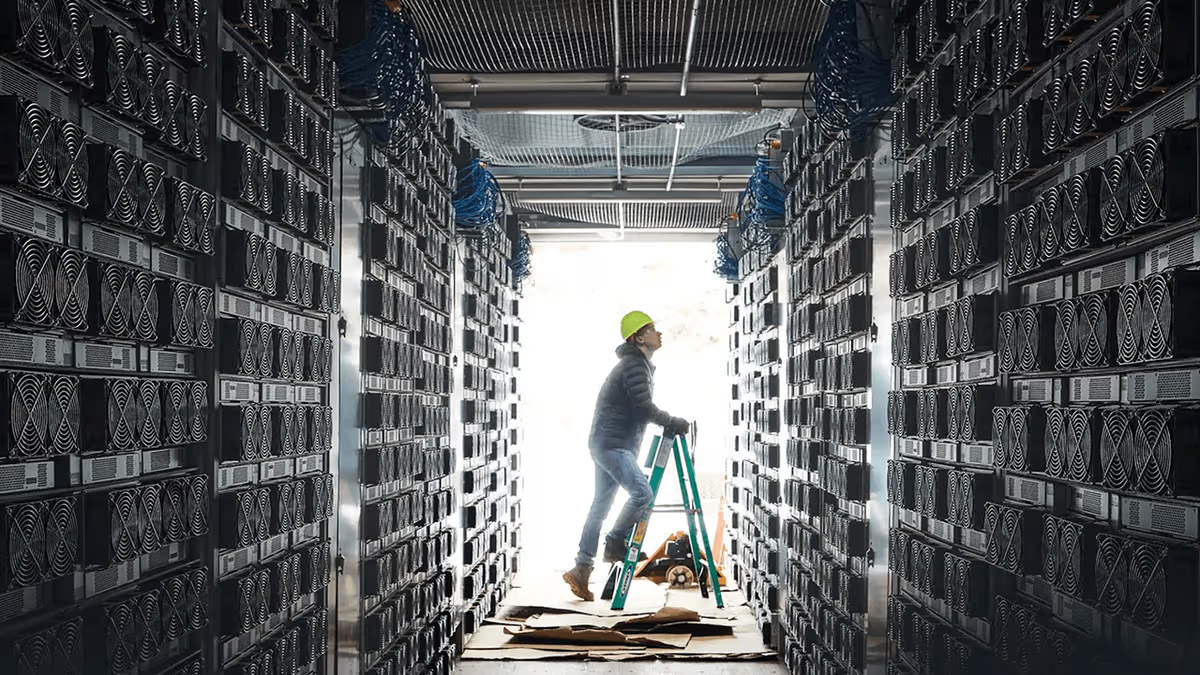
As Bitcoin's price fell to a low not seen since February, the network's hashrate also shrank significantly, with 145 ahashes per second (EH/s) withdrawing since the end of May.
 Listen to the articleAdd us on Google
Share

Key Takeaways
- Key points:
- Since May 28, Bitcoin network hashrate has decreased by 145 EH/s, and as prices fell to the low point in February, the current hashrate has dropped to 885 EH/s.
- Hashprice fell 26.96% to $28.26/PH/s in 30 days, and Elektron Energy CEO Rapha Zagury called this Bitcoin's first "hash rate bear market."
- It is expected that the difficulty will be reduced by 10.76% on June 13, 2026, while fees remaining below 1% of miner rewards remain a long-term structural risk.
Miner income tightens, Hashprice plunges 27% in 30 days
According to hashrateindex.com data, since the network reached 1,030 EH/s on May 28, 2026, Bitcoin's hash rate has significantly declined. Currently, this value has dropped to 885 EH/s. This decline was accompanied by a reduction in miner revenue, which remains closely tied to Bitcoin's market value.
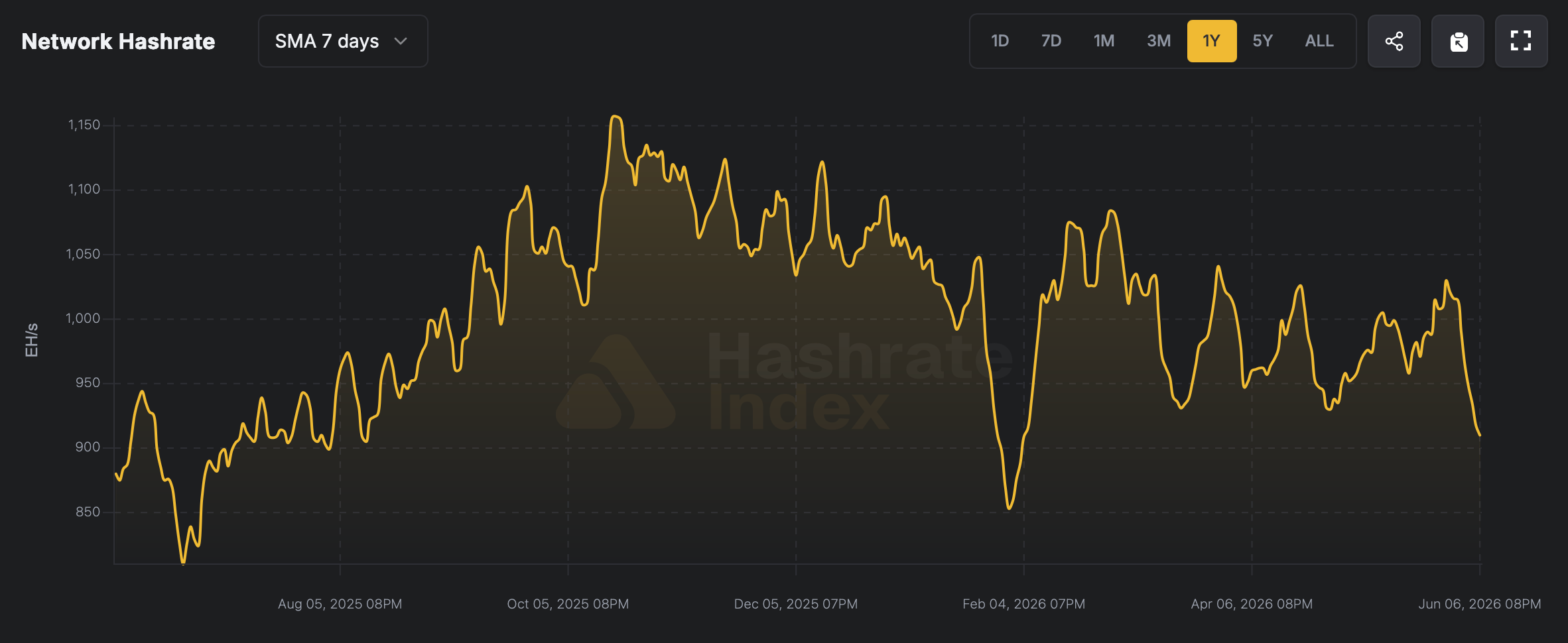
According to hashrateindex.com data, Bitcoin's total hash rate is as follows.
As of press time, based on data as of June 7, the estimated daily hash price per second of hash power is $28.26. Thirty days ago, on May 7, the figure was $38.69, meaning mining revenue had dropped 26.96% compared to a month earlier.
As block generation time exceeds 10 minutes, on-chain fees account for less than 1% of miner rewards
On-chain fees remain negligible, accounting for less than 1% of miner rewards, and based on the median average, this proportion over the past 24 hours was just 0.73%. A positive sign is that in recent adjustments, network difficulty has steadily decreased, recalibrating the hash power needed to discover new blocks. However, this also means reduced computing power to maintain cybersecurity, with block intervals often exceeding the protocol's expected 10-minute average.
Ad
The previous adjustment raised the difficulty by 1.72%, and a significant reduction is expected on June 13, 2026. Although predictions may still change, as block generation continues to slow down, the difficulty of the next epoch may decrease by 10.76%. Currently, the average block generation time over the past 24 hours hovers around 11 minutes and 12 seconds.
The CEO of Elektron Energy announced that Bitcoin has entered its first historic hashrate bear market
Many network observers believe that miners are facing increasingly difficult circumstances, with Elektron Energy CEO Rapha Zagury noting that Bitcoin is experiencing its first-ever "hash rate bear market."
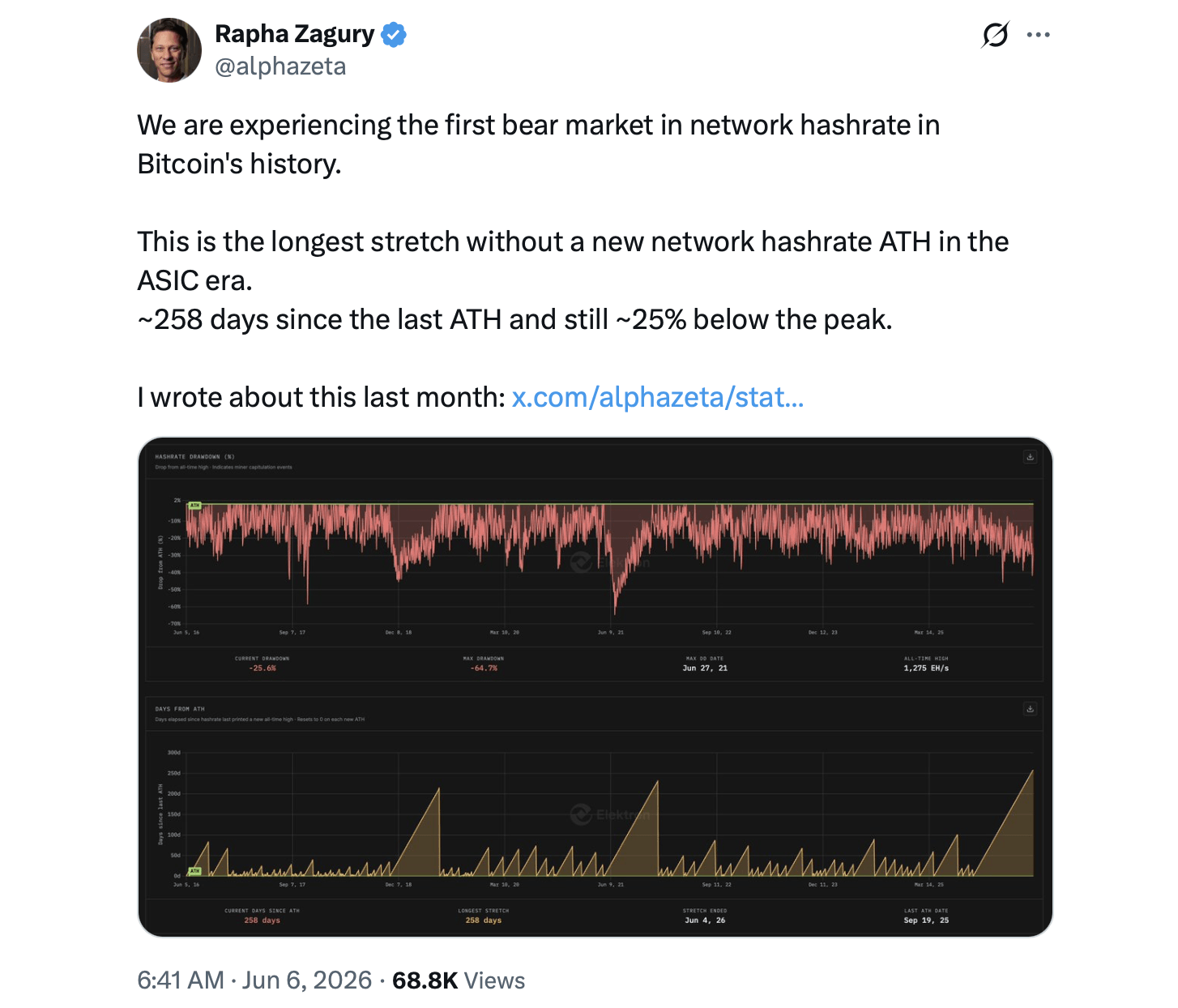
Recent comments from Elektron Energy CEO Rapha Zagury. Image source: X.
In an article published last month on the X platform, Zaguli explained that this phenomenon is characterized by a market-driven gradual contraction, with unprofitable mining rigs continuously shutting down, and network hash power has dropped by about 25% from its peak in September 2025. Although this development challenges the industry's long-held assumption that hash rate will only increase over time, Zaguli insists that Bitcoin's security remains rock solid, as the funding required to carry out a 51% attack remains prohibitiously high.
Instead, Zaguli believes that a more significant long-term challenge lies in stagnation in the transaction fee market, which will ultimately need to compensate for the ongoing reduction in block rewards. Meanwhile, many publicly listed mining companies are shifting resources toward artificial intelligence (AI) infrastructure, allowing more streamlined and disciplined miners to take advantage of Bitcoin's adaptive difficulty adjustment mechanism—which reduces competition and allows surviving participants to gain a larger share of network rewards.
The long-term threat from stagnation in the trading fee market is far more profound than the temporary decline in hash rate
Many analysts believe that although the issues in the fee market are gradual, they are fundamentally deeply structured. Block rewards are halved every four years, but currently, transaction fees account for less than 1% of miner rewards. Before the 2024 halving, transaction fees accounted for a much higher proportion of miners' income than they do now. Over time, the consequences of this imbalance could be far more severe than the temporary shrinkage of computing power.