
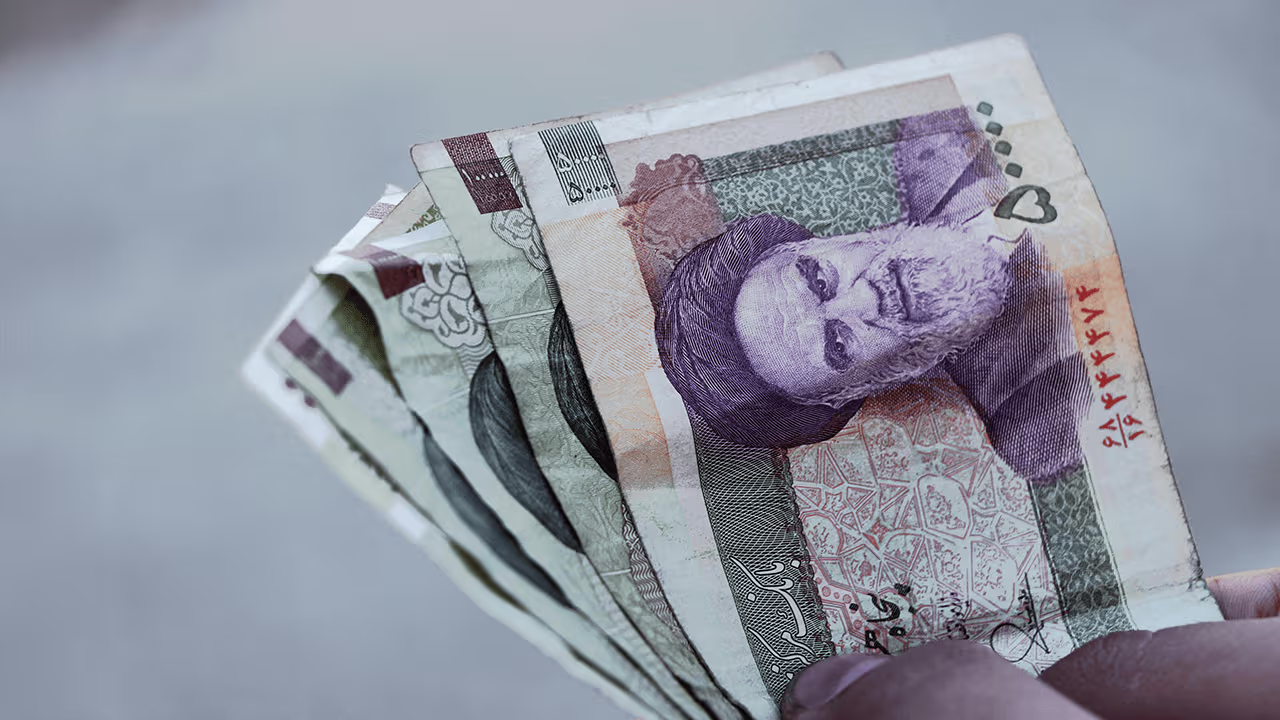
On Tuesday, the U.S. Treasury Department imposed sanctions on Nobitex, Iran's largest digital asset exchange, as well as three other Iranian cryptocurrency platforms, subjecting cryptocurrency flows related to Iran to stricter compliance scrutiny.
 Listen to the articlePrioritize us on Google


Key Takeaways
- Key points:
- On June 2, 2026, the U.S. Treasury Department's Office of Foreign Assets Control (OFAC) imposed sanctions on Nobitex and three Iranian exchanges.
- The U.S. Treasury stated that Nobitex will handle over 50% of Iran's cryptocurrency inflows in 2025.
- Ramzinex handled $2.45 billion in transactions, and the companies will soon face stricter Iran due diligence.
The United States has expanded its sanctions against Iran's cryptocurrency sector, with four exchanges and four nationals sanctioned
The U.S. Treasury Department's Office of Foreign Assets Control (OFAC) has placed Nobitex, Wallex, Bitpin, Ramzinex, and four Iranian nationals on its sanctions list. Foreign financial institutions and individuals who conduct specific transactions with the aforementioned companies may also face sanctions.
Ad
The U.S. Treasury Department stated that Nobitex will process more than 50% of all digital asset inflows into Iran by 2025 and have helped facilitate payments related to the Islamic Revolutionary Guard Corps of Iran, including wallets used by ransomware groups linked to the guard.
The agency also accused Nobitex of assisting Iran's central bank in obtaining hundreds of millions of dollars in stablecoins to support the riyal's exchange rate, while allowing insiders in the regime to access international exchanges and evade sanctions.
U.S. Treasury Secretary Scott Besant stated that the Iranian government has "absorbed" digital asset technology for sanctions evasion and wealth transfer, adding that the Treasury will "continue to track fund flows" through banks and digital asset channels. The U.S. Treasury Department's Office of Foreign Assets Control (OFAC) placed Nobitex on the sanctions list under Executive Order 13224 for providing substantial support to Iran's Islamic Revolutionary Guard Corps; At the same time, under Executive Order 13902, it was added to the sanctions list for its involvement in Iran's financial sector operations.
Other exchanges that were named
According to the Ministry of Finance, Wallex is Iran's second-largest digital asset exchange by trading volume, receiving about 12% of Iranian digital asset inflows in 2025 and reportedly assisting with transactions related to the Iranian Revolutionary Guard.
According to the U.S. Treasury, Bitpin will receive about 10% of Iranian digital asset inflows in 2025 and have processed millions of dollars in transactions related to the Iranian Revolutionary Guard. Ramzinex is a Tehran exchange founded in 2018, handling over $2.45 billion in transactions, including activities related to the Iranian Revolutionary Guard Corps and a government-backed financial institution.
Compliance risks are intensifying
These sanctions freeze property and interests within U.S. jurisdiction and generally prohibit Americans from transacting with designated parties. Entities holding 50% or more of the shares held by sanctioned individuals will also be sanctioned.
For cryptocurrency companies, this move raises the importance of screening Iran-related addresses, counterparties, and exchange risk exposures. This move also means that non-U.S. entities facilitating major transactions involving the aforementioned platforms will face higher risks. This appointment comes after Nobitex has experienced turbulent times. The exchange suffered an attack amounting to about $90 million in June 2025, adding another major variable to Iran's cryptocurrency ecosystem.
Nobitex is hailed as Iran's largest digital asset platform and serves as the country's core hub for cryptocurrency activity, serving both as a retail gateway and a cross-border venue for value transfer beyond traditional banking channels. For traders and compliance teams, this signal is clear: the risk exposures associated with Iranian exchanges are now more visible, easier to track, and more likely to provoke regulatory scrutiny.