
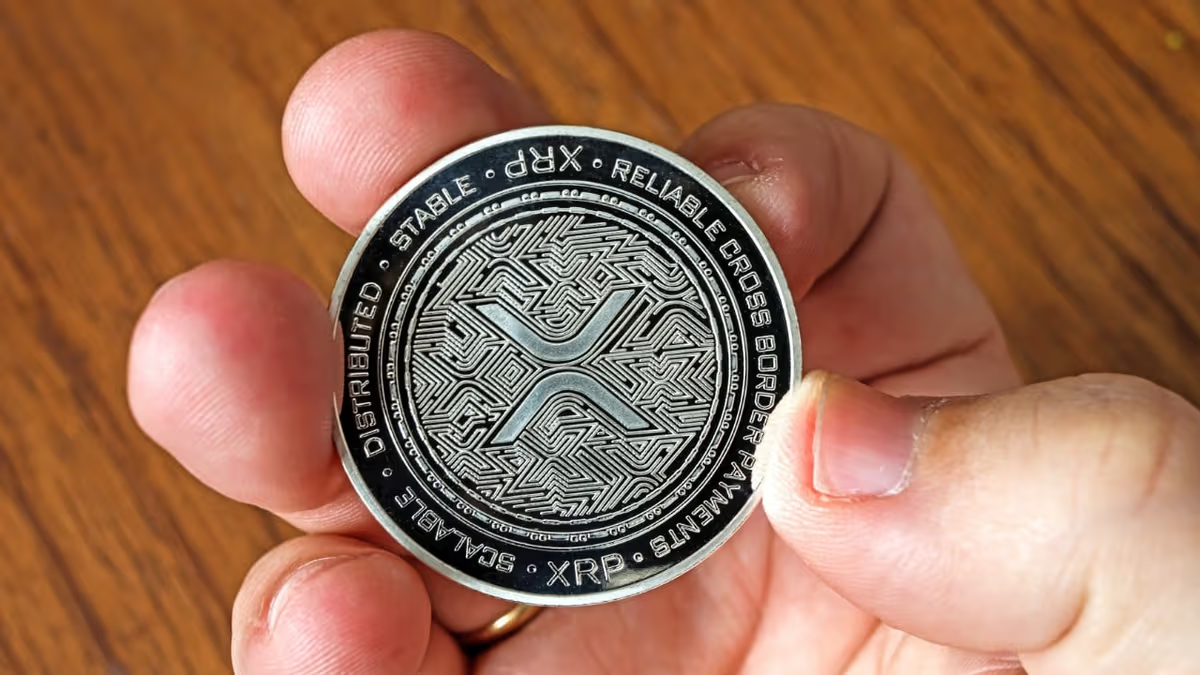
David Schwartz, Honorary CTO of Ripple, stated that as the XRP ledger supports issuing assets, tokenized real-world assets, and increasingly diverse financial products such as securities, funds, repurchase agreements, and loans, XRP's utility continues to expand.
 Listen to the articleAdd us on Google
Share

Key Takeaways
- Key points:
- XRP Ledger is moving beyond the payments sector to support tokenized assets and financial products.
- Tokenized securities, funds, repurchase agreements, and loans are expected to expand real-world applications of the XRP ledger.
- Schwartz stated that the growing asset ecosystem of the XRP ledger may deepen its role in financial markets.
"Understanding XRP in One Minute" demonstrates how XRPL breaks through basic transfer functions
On June 5, Ripple released a new episode of the "XRP One Minute" video, in which David Schwartz explains the scalability of XRP's utility. Schwartz is Ripple's Honorary CTO and one of the original architects of the XRP Ledger (XRPL). The video opens with a question: "How is the utility of XRP expanding?" His response focused on tokenized assets, enterprise adoption, and financial services built on XRPL.
"Bitcoin kicked off by providing a public blockchain that allows people to hold and transfer Bitcoin," Schwartz explained. He emphasized that this breakthrough has shown people the possibility of owning and transferring digital value on open infrastructure. Subsequently, the XRP Ledger further expanded this model by supporting native digital assets and issued assets. Schwartz stated:
"The XRP Ledger is closely following, offering native digital assets similar to Bitcoin, as well as supporting issuance assets representing stablecoins or various tokenized assets."
This distinction is at the heart of Schwartz's practical argument. XRP Ledger is not limited to sending XRP between users; it also supports assets representing US dollars, funds, securities, stocks, or other forms of value. This gives XRPL a broader financial role, as it can integrate asset issuance, transfer, and settlement functions on a single network.
Ad
Tokenized assets may drive XRP's utility into financial markets
Schwartz continued, "Today, enterprises are using the XRP ledger to offer real-world tokenized assets [RWAs], and in the near future, they will offer a wide range of products, from tokenized securities to money market funds, and even tokenized stocks." This statement expanded the scope of the discussion beyond the payments sector. Tokenized assets are expected to bring familiar financial products onto blockchain tracks, making their issuance, transfer, and settlement more convenient.
The next phase will drive the XRP ledger deeper into the credit market. "And soon," Schwartz noted, "we will see features like tokenized buybacks and tokenized loans." " Repurchase agreements are widely used short-term financing tools in traditional markets. Tokenized lending will extend XRPL's functions to borrowing, collateral, and repayment activities. Together, these products demonstrate that their value lies in the practicality built around financial infrastructure, not just speculation. Ripple's Honorary CTO stated:
"Enterprises will offer features that attract mass retail users, and only then will decentralized finance (DeFi) truly deliver on its promise—replacing traditional finance (TradFi) and providing financial services that everyone needs."
His perspective places businesses at the core of retail adoption. Consumers may not adopt DeFi just because blockchain terminology is used. When tokenized funds, loans, repurchase agreements, and stocks appear simple, liquid, compliant, and practical, they may adopt it. For Schwartz, XRP's utility expands when XRPL supports financial services already familiar to people and institutions. The same practical theme also appears outside of Ripple's official promotions. Panos Mekras, CEO of Anodos Finance, recently stated that since 2023, his company has been using XRP for purchases, holding, and paying the team wages. This case is directly related to Schwartz's views on practical financial use. It suggests that businesses may view XRP as liquid capital for fund management, payments, and operations, rather than merely a trading asset.
Schwartz's comments also reflect XRP's long-term development trajectory after 14 years in the market. Brad Garlinghouse, CEO of Ripple, called it a "lifelong honor" to be part of the XRP family, while Schwartz described XRP's origins as an effort aimed at building a better way to transfer value. Recent discussions have shifted focus to tokenization, fund management, settlement, and on-chain financial products. Garlinghouse also highlighted XRP's speed, low transaction costs, scalability, and long operational history, features expected to support the tokenized assets, loans, funds, and settlement products described by Schwartz.