
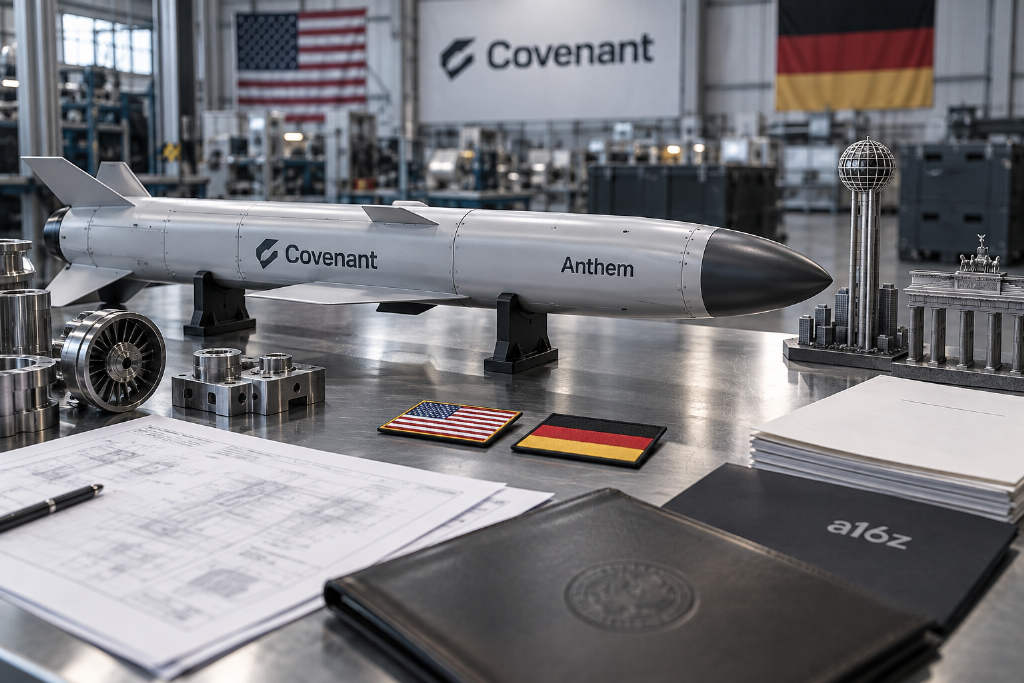
Defense technology startup Covenant, backed by Andreessen Horowitz (a16z), has come out of stealth and said it completed three funding rounds totaling more than $250 million. The company is developing Anthem, a low-cost cruise missile built around heavy payload capacity and long range, and plans to establish production facilities in Dallas, Texas, and Germany. Covenant said it wants to scale to thousands of missiles a year by 2027 to address a U.S. capacity gap in deep precision strike.
Covenant says it raised $250 million in two years
The company said it completed $250 million in fundraising over a two-year period. The capital is intended to support demand tied to deep precision strike, which Covenant described as an area where U.S. capacity remains insufficient. In its positioning, Anthem is meant to serve as an alternative to traditional missile systems that are more expensive while still offering high payload capability.
Covenant also pointed to execution speed. It said the engineering team went from ideation to a full-scale operational prototype in 11 months and one day. The company added that it has already secured military contracts with the U.S. military and European allies. The new funding will be directed toward supply-chain redundancy and production buildout as it works toward a 2027 deployment timetable.
Anthem is pitched as low-cost, long-range, and high-payload
According to the company’s description, Anthem is similar in form factor and mission profile to the U.S. military’s Tomahawk cruise missile. It is described as offering long range, high payload, and precise strike capability. In the article, heavy payload or high payload refers to the ability of a missile or vehicle to carry heavier or larger tactical equipment and munitions while maintaining destructive effectiveness over long distances.
Covenant drew a distinction between Anthem and traditional defense systems on manufacturing cost and production scale. It said legacy defense equipment is often constrained by high unit costs and supply-chain bottlenecks, limiting efficient mass production. Anthem’s design focus, the company said, is "affordable mass production," using a more flexible supply-chain structure to lower unit manufacturing costs and create a model capable of sustaining large volumes of strategic equipment.
Dallas and Germany form a two-site production network
To support scale manufacturing, Covenant plans to set up two production bases, one in Dallas, Texas, and one in Germany. The company said this arrangement is designed to create a cross-border supply chain with built-in redundancy. Under its operating plan, each factory is expected to deliver 1,000 missiles next year.
At full utilization, a single plant is designed for annual capacity of 5,000 missiles. Combined, the two sites would reach a maximum yearly capacity of 10,000 missiles. Covenant said this setup is aimed at solving a familiar problem for defense startups: turning a prototype into mass-produced equipment. The company said it wants to provide the U.S. military and allied countries with a stable and repeatable munitions supply capability.
Team includes engineers with Iron Dome experience
Covenant said its technical strength rests on a senior engineering team. Its chief technology officer previously served as chief systems engineer for Israel’s Iron Dome air defense system and has hands-on experience developing large-scale defense systems.
The team also includes president Abi Denburg, missile engineers with more than 20 years of experience, military veterans, and reservists. According to the report, that execution capacity has allowed the company to compress development timelines that usually take years in the traditional defense sector, speeding up validation and implementation for a new weapons system.
Key points disclosed in the report
- Funding and operating scale: Covenant completed three rounds of financing totaling more than $250 million and has secured military contracts with the U.S. and European allies.
- Product positioning: Anthem is described as having Tomahawk-like long-range and heavy-payload characteristics, with emphasis on low cost and affordable mass production.
- Development progress: The company said it took 11 months and one day to move from concept to a full-scale prototype, with deployment targeted as early as 2027.
- Production plan: The Dallas and Germany facilities are expected to deliver 1,000 missiles each next year, with a long-term combined design capacity of 10,000 units per year.
- Team background: The CTO previously worked as chief systems engineer for Iron Dome, and the broader team includes senior missile engineers and defense specialists with more than 20 years of experience.