
Mega-funds with over $10 billion in assets under management are flooding seed rounds at an unprecedented rate. Murph Capital, using data from Harmonic, has analyzed the early-stage investment behavior of 20 top mega-funds across three distinct eras: the SaaS era (2015–2019), the Zero Interest Rate era (2020–2022), and the AI era (2023–2026). The conclusions are nuanced: mega-funds achieve seed-to-Series B conversion rates 3.7–4.2 times higher than the market average, but this advantage rapidly erodes when they scale up deployment. For emerging managers (EMs), survival is still possible, but only if they pick the right niche.
Research Framework: Three Eras, 20 Funds, Public Data
The study relies on public filings and real-time data from Harmonic, which covers 30+ million companies and 190 million people. The ten-year timeframe is divided into the SaaS era (dominated by cloud software investments), the Zero Interest Rate era (the post-COVID flood of cheap capital), and the AI era (the generative AI explosion). The 20 funds include a16z, Sequoia, General Catalyst, Accel, Lightspeed, Bessemer, Khosla Ventures, Founders Fund, Greylock, Index Ventures, Lux Capital, NEA, and others, all with AUM exceeding $10 billion.
Three Structural Drivers of the Mega-Fund Influx
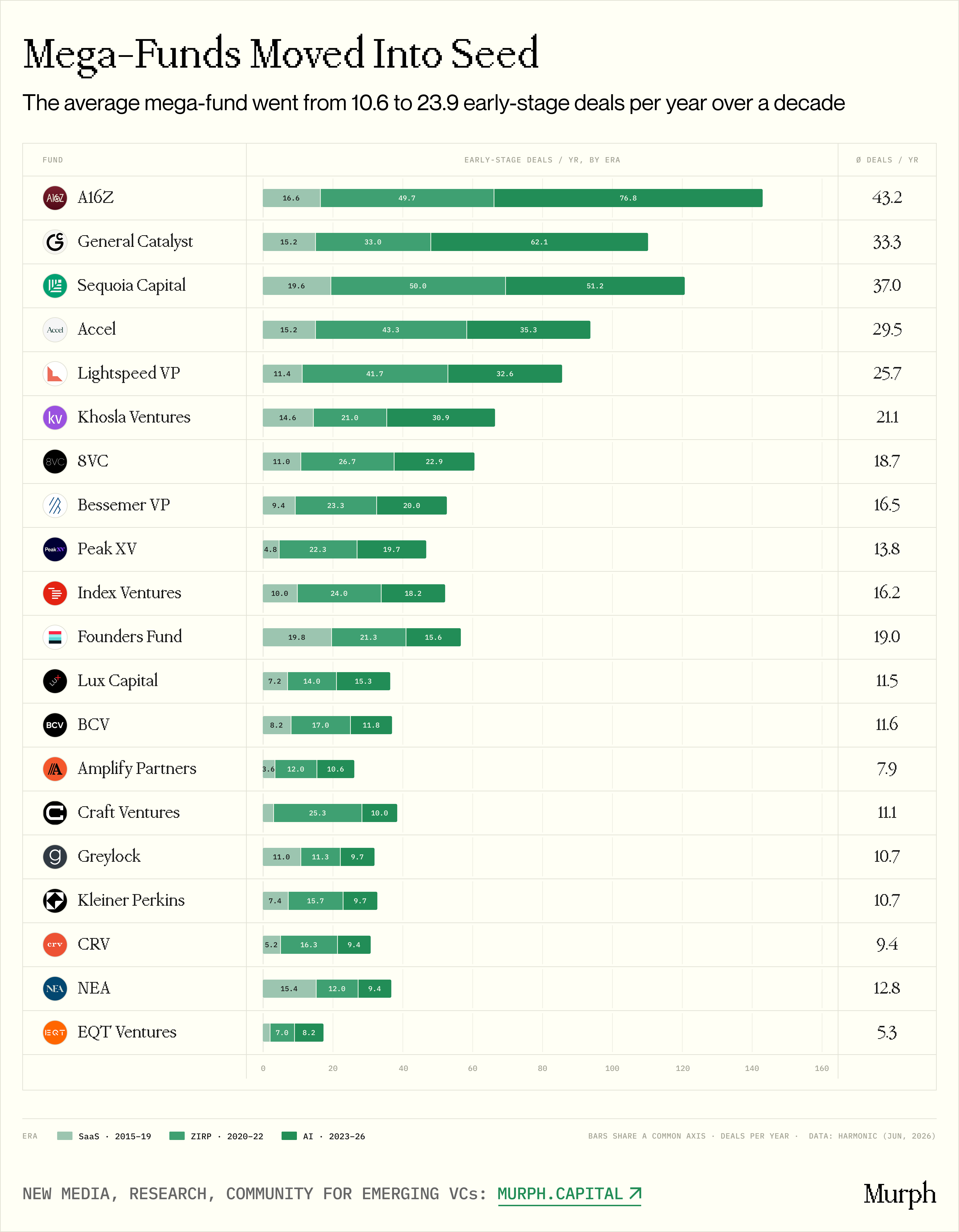
The data confirms anecdotal impressions: a typical mega-fund completed 10.6 early-stage deals per year in the SaaS era, rising to 23.9 in the AI era—a 2.37x increase. Surprisingly, this growth did not reverse after the end of zero interest rates: the AI-era average (23.9) is nearly identical to the Zero Interest era average (24.3), and only three funds reduced their early-stage pace. This proves the shift is structural, not cyclical. Three underlying drivers explain the trend:
- Higher capital needs of AI startups: GPU infrastructure, data pipelines, and research scientists earning $300k–$500k annually raise baseline costs from $500k (SaaS era) to $2–5 million (AI era).
- Founder power shifts pricing leverage: Top AI founders can choose between a16z, Sequoia, and Lightspeed at the seed stage, driving up round sizes not because the company objectively needs more capital, but because the founder can demand it.
- Fund math: The top five funds in the cohort grew combined AUM from ~$34 billion to ~$249 billion—a 7x increase—while seed deal count only rose 2–4x. A $6 million seed check represents just 0.01% of a $90 billion AUM fund, removing any incentive to negotiate over valuation.
Three Behavioral Clusters: Accelerators, Stabilizers, and Contrarians
In the Zero Interest era, all 20 funds increased early-stage activity. But the AI era revealed clear divergence into three paths:
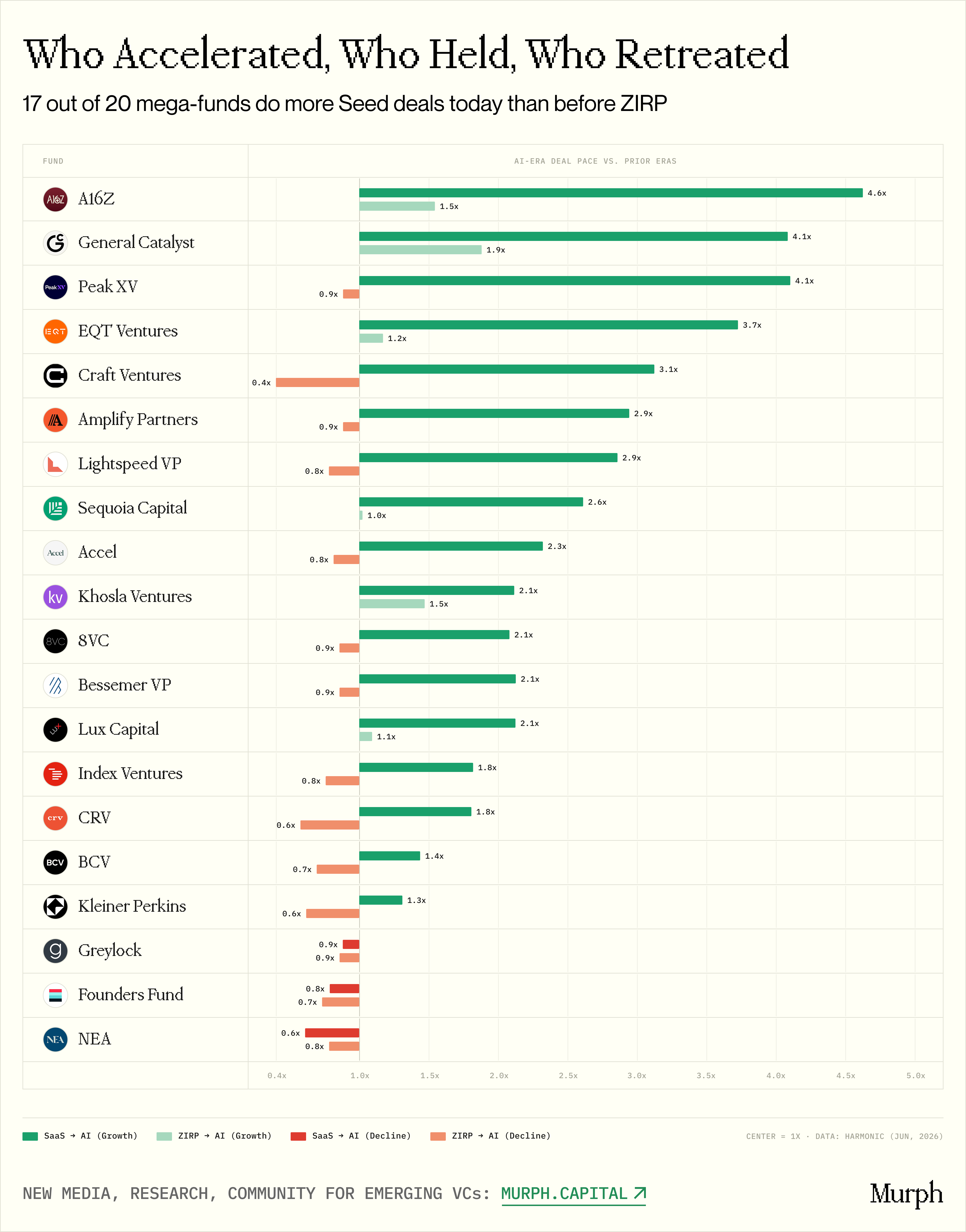
- Accelerators: a16z (75.3 deals/year), General Catalyst (61.5), and Khosla (31.5) are doing more early-stage deals in the AI era than even during zero interest rates.
- Baseline lifters: Bessemer, Lux, Index, and others saw the zero-interest spike recede, but their baseline activity remains 2–3x higher than the SaaS era.
- Contrarians: Founders Fund, NEA, and Greylock either decreased or flatlined early-stage activity. Founders Fund deliberately pivoted to large, concentrated late-stage bets (OpenAI, Databricks), while Greylock maintained a high-conviction, low-volume approach.
Strategic Transformation: Early-Stage Allocation Hits Record Highs
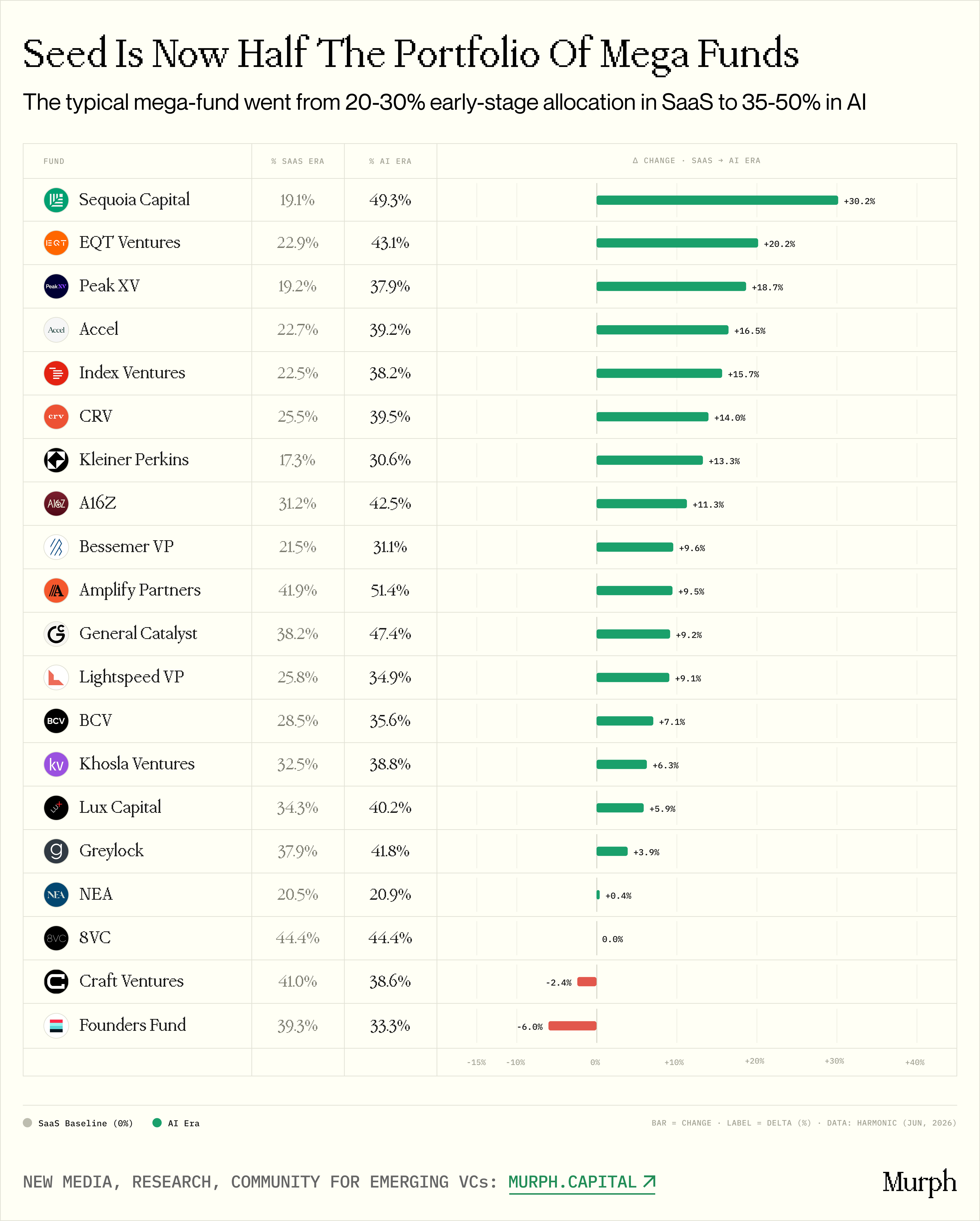
Sixteen of the 20 funds set new records for the proportion of total deals allocated to early-stage in the AI era. In the SaaS era, a typical mega-fund allocated 20–30% of its deal flow to seed; in the AI era, that baseline has jumped to 35–50%. Sequoia underwent the most dramatic shift, from less than 20% to 49%; General Catalyst from 30% to 47%; a16z from 31% to 42%. The common LP refrain that mega-funds "occasionally write a seed check when we meet an exceptional founder" is now demonstrably false. These firms have made seed investing a core strategic priority, backed by dedicated teams and accelerator programs like a16z Speedrun and Sequoia Arc.
Round Sizes: The Dual-Track Strategy and the Illusion of $50M+ Super Seeds
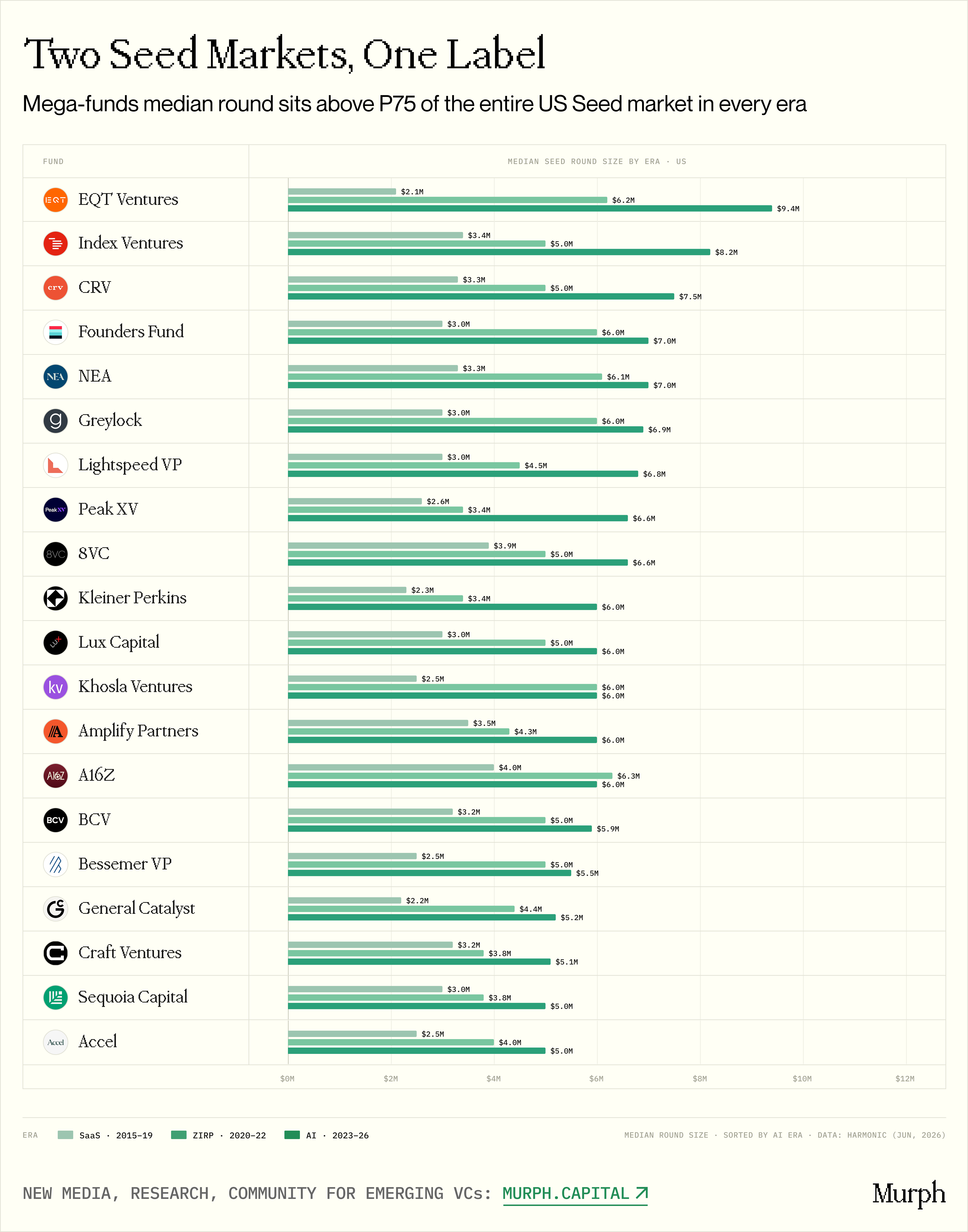
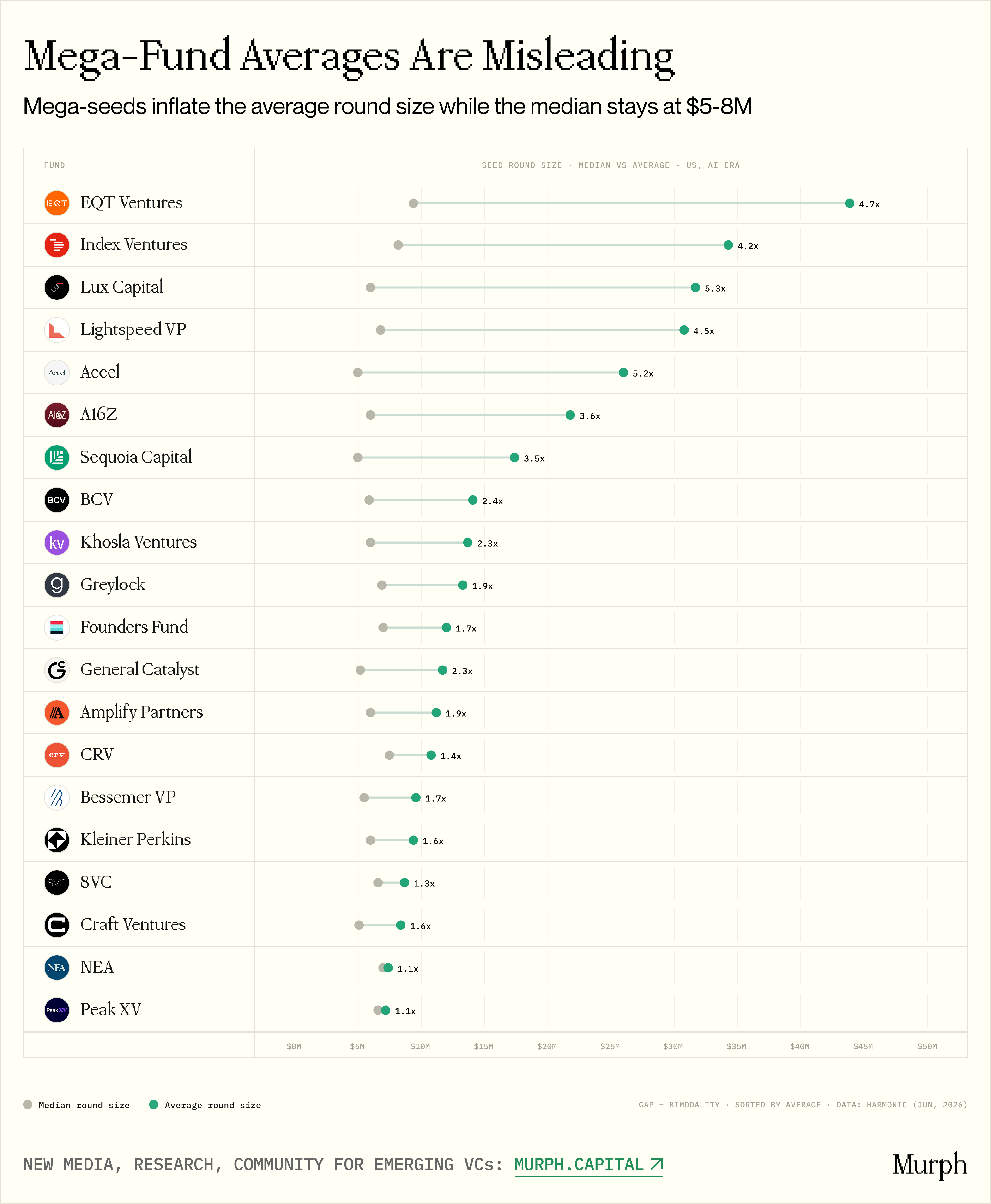
The median seed round involving a mega-fund ($6.2 million) is 4.3x larger than the U.S. market median (~$1.4 million), and this ratio has remained remarkably stable across all three eras. Mega-funds systematically operate in the top quartile of the market. However, a subset of "dual-track" funds—a16z, Sequoia, Lightspeed, Accel, Lux, Index—play two simultaneous games: classical seed rounds ($5–8 million) and super-seed rounds ($50 million to $500+ million), which pull the statistical average up 3–5x. In contrast, "homogeneous" funds like General Catalyst, Khosla, Bessemer, and Greylock deploy consistently in the $5–8 million range with no massive outliers. For EMs, the real competitive threat comes from homogeneous funds, which crowd the same classical seed rounds where EMs typically lead deals.
Lead Rates: Who Is Setting Terms?
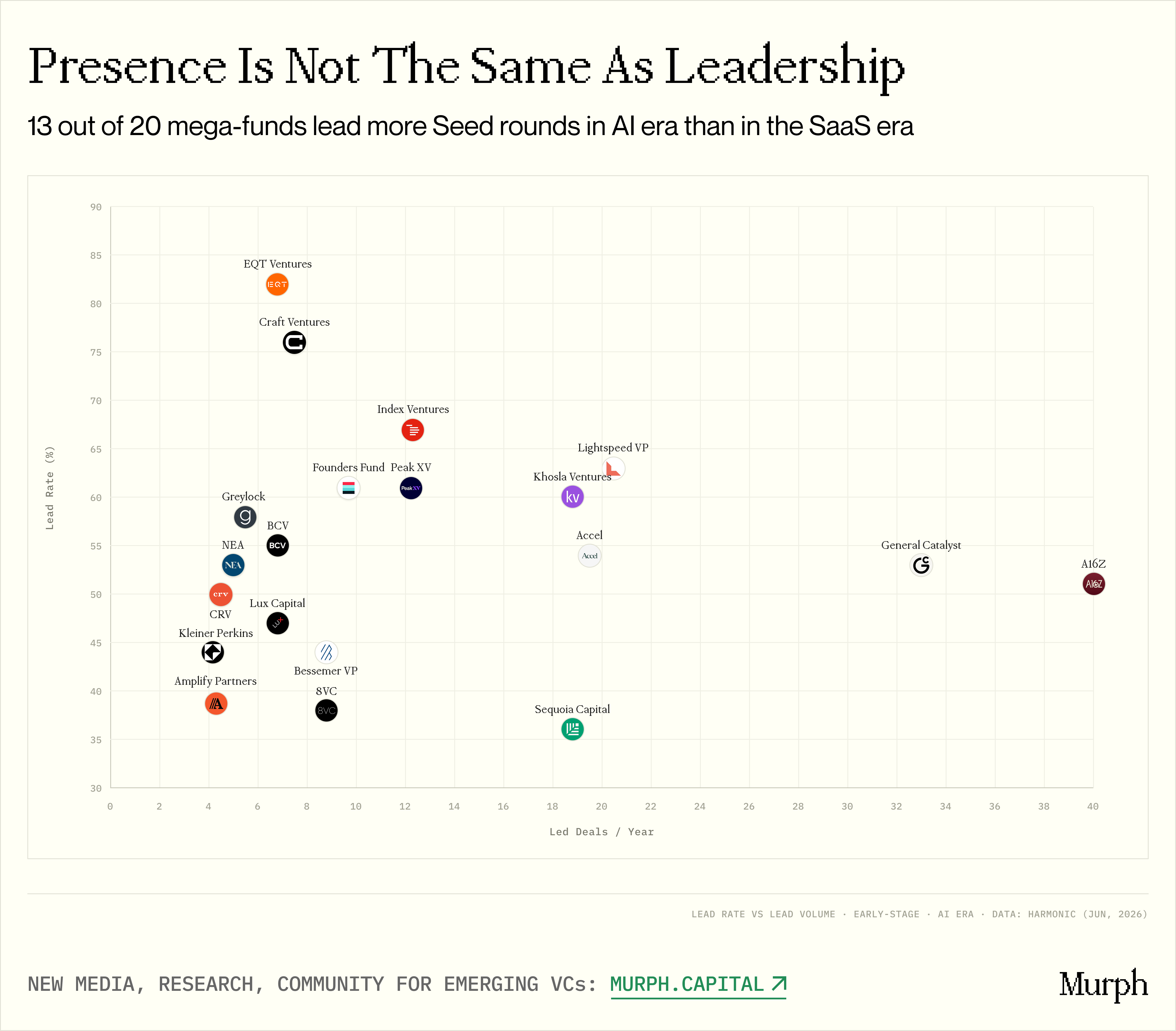
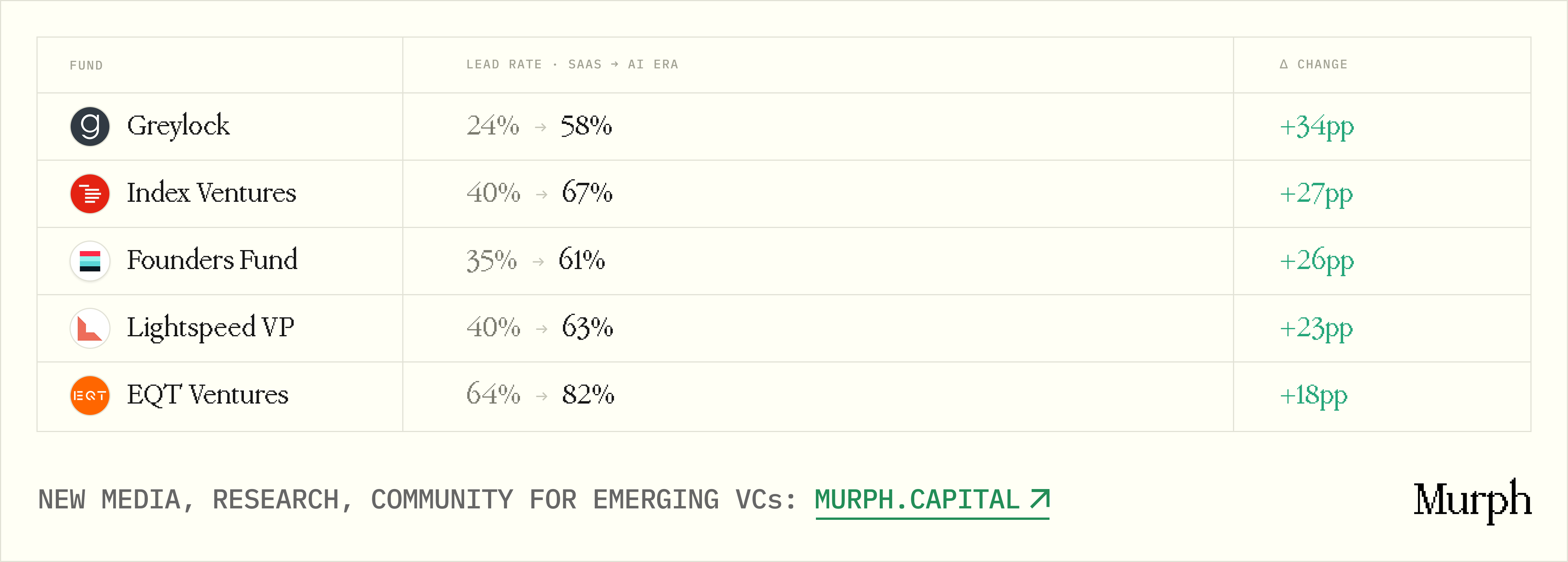
There is a fundamental difference between participating in a round and leading it. Khosla (60% lead rate), Lightspeed (63%), and Accel (54%) are "conviction lead" funds—they deploy aggressively and demand the driver's seat. Interestingly, a16z and Sequoia, despite being the most active in absolute terms, saw their lead rates decline from the SaaS era to the AI era (a16z from 67% to 51%, Sequoia from 52% to 36%). This is simply because when you are doing 77 or 51 deals a year, it is physically impossible to lead every one. Yet in absolute numbers, a16z still leads about 40 seed rounds per year, and General Catalyst about 33—more than the total early-stage outputs of half the funds in the cohort. Importantly, 13 of the 20 funds increased their lead rates from SaaS to AI era. Greylock jumped from 25% to over 50%, transforming from a passive co-investor to an active round leader.
Sector Distribution: Where the Giants Are Hunting
Two sectors—Enterprise AI & Automation, and AI Infrastructure & Developer Tools—account for 42% of all early-stage deals by the 20 funds, and every single fund is active in both. Other sectors show far less concentration: Cybersecurity (only 76 deals, but a 62% lead rate), Defense & Aerospace (34 deals, 66% lead rate). Climate & Energy (26 deals, 12 active funds), Logistics (24 deals, 13 active funds), and traditional verticals like PropTech, EdTech, Legal, and HR have only 8–12 funds active. For EMs with deep domain expertise in these less crowded sectors, the competitive pressure is structurally lower—they face at most 8–12 institutions making 2–3 pricing decisions per year, a fundamentally different game.
Conversion Rate Validation: 3.7–4.2x Advantage, But Volume Is Poison
The study tracked the percentage of seed-stage companies that later reached a Series B round, comparing the market overall against companies backed by at least one mega-fund. For the SaaS and Zero Interest eras (the AI era is too young), mega-fund-backed startups achieved seed-to-Series B conversion rates 3.7–4.2 times higher than the market average. However, when looking at individual funds, a troubling pattern emerges: of the 15 funds with sufficient data (10+ seed deals per era), 14 experienced a conversion rate decline of 10–25 percentage points from SaaS to Zero Interest era. Sequoia tripled its deal count (20 to ~50/year) and saw conversion crater from 46% to 14%; Lightspeed quadrupled (12 to 42/year) and saw conversion drop from 31% to 11%. The only exception was Greylock, which kept deal volume essentially flat and saw conversion rise from 29% to 44%. Deal velocity and portfolio quality are in direct tension.
The Danger Index: Which Mega-Funds Threaten EMs Most?
To quantify competitive threat, the article builds a 0–30 point Danger Index based on three pillars: deal volume (number of early-stage deals per year in the AI era), strategic commitment (percentage of total deals allocated to early-stage), and price overlap (median round size—the most critical factor, as funds operating in the $4–5 million range compete directly with EMs' sweet spot). The top four funds posing the greatest danger are General Catalyst (24.5), a16z (22.9), Sequoia (22.8), and Accel (22.2). If an EM is leading $2–3 million rounds in climate tech, these Tier-1 giants rarely appear, making the Danger Index a useful map for where to deploy and where to avoid.
Conclusion: Surviving in the Cracks
The mega-fund invasion of early-stage markets is a permanent recalibration of venture capital, not a temporary anomaly. Trying to beat them at their own high-velocity, deep-pockets game is mathematically futile. But the data reveals a critical crack in their armor: the inescapable tension between massive deployment scale and maintaining portfolio conversion quality. In the AI era, the EM's ultimate counter-strategy is not to match deal volume, but to exercise strict sector discipline, patiently underwrite complex future unit economics (which mega-funds often overlook), and stay small, focused, and deeply tied to founders before the multi-stage platforms even know they exist. In a VC ecosystem increasingly centered on sheer scale, the premium of absolute discipline is the most defensible moat an emerging manager can build.